


Quick Answer: When you weigh salt free and maintenance free claims, treat "salt-free" as accurate and "maintenance-free" as marketing. Salt-free conditioners use no salt, but they don't remove hardness; most, especially template assisted crystallization (TAC) units, change how minerals behave so less scale sticks. They still need prefilter changes, eventual media replacement and water inside the maker's limits for iron, manganese, chlorine and hardness. Before you buy, get the scale-reduction test data and the spec-sheet limits in writing.
"Softens water without salt. No maintenance. No electricity. Lasts a lifetime." If you've shopped for a salt-free system, you've read some version of that line. Parts of it are true. Parts describe something different from what most buyers picture. Below, each common claim gets taken apart, with the document or test that proves or disproves it.
In this guide
- Read "salt-free" literally and "softener" skeptically
- What "maintenance-free" leaves off the schedule
- The spec-sheet limits that decide whether it works
- Match the certification to the claim
- What independent tests say about salt free and maintenance free claims
- Four more marketing lines worth questioning
- Run these checks before you sign
- FAQ
- Buy salt-free for scale control, not for "no upkeep"
Read "salt-free" literally and "softener" skeptically
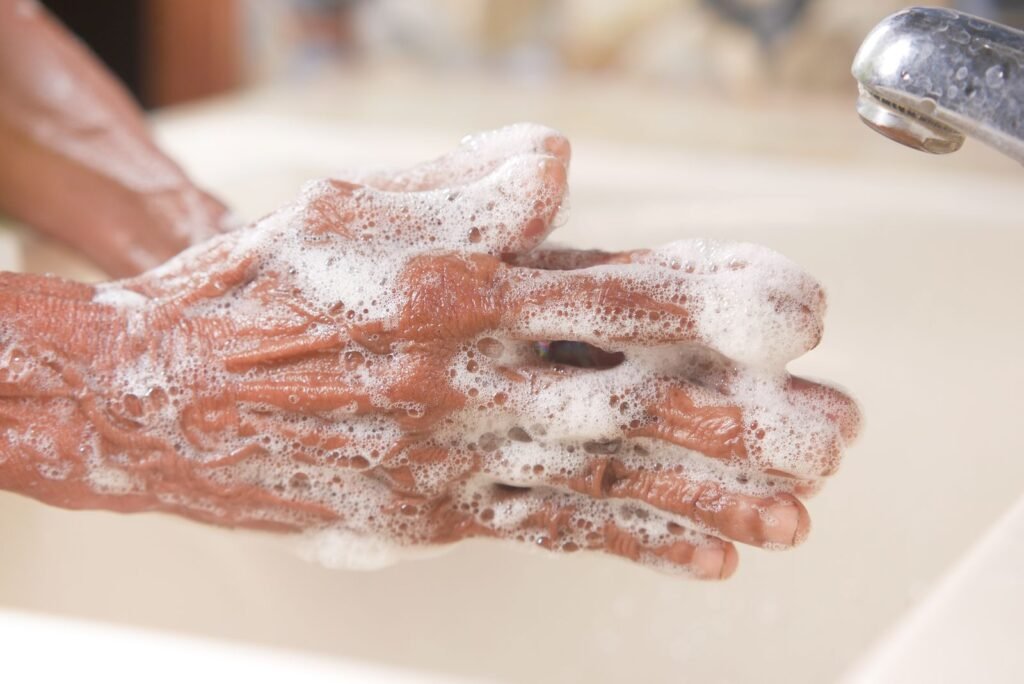
What's true: no salt, no brine tank, no regeneration, no drain line. For some homes, such as those with a septic system, a sodium-restricted diet or a local limit on softener discharge, that alone is the reason to buy.
What to check: whether the unit actually removes calcium and magnesium. Almost no salt-free product does. A conventional softener swaps hardness ions for sodium or potassium, which is the process Penn State Extension describes in its water softening guide. TAC media does something else: it turns dissolved hardness into microscopic crystals that stay suspended in the water instead of sticking to surfaces. Your hardness test reads about the same before and after. Our explainer on whether a salt-free system actually softens water walks through the mechanism.
That has everyday consequences:
- Soap and shampoo lather much as they did in hard water.
- Spots still form where water evaporates on glass, faucets and kettles, because the minerals are still in the water. They tend to wipe off more easily.
- Laundry and dishwasher detergent doses don't drop the way they do with soft water.
- You won't get the slick "soft water" feel in the shower.
If spots, lather or skin feel are your main complaint, a conditioner isn't the tool. Our SpringWell FutureSoft vs Pelican NaturSoft comparison shows how two big sellers word this, and where the fine print sits.
Ask the seller: "Will a hardness test strip read differently after your system?" An honest answer is no.
What "maintenance-free" leaves off the schedule

What's true: no salt to haul, no settings to program, usually no power.
What's missing: almost every whole-house salt-free system has some of these recurring jobs:
- A sediment or carbon prefilter. Cartridges clog with sediment and wear out removing chlorine. Watts, for example, rates the OneFlow+ carbon/sediment block for up to 50,000 gallons and says to replace it at least yearly.
- Scale media that wears out. The same manual lists scale prevention for "up to 3 years," which means sooner in harder water or a busy household. Tank-style TAC systems often claim several years.
- Carbon media in combo units that exhausts faster with high chlorine or chloramine and heavy use.
- O-rings, bypass valves and fittings that need an occasional look.
None of that is hard, but it costs money every year. Our guide to salt-free water conditioner maintenance lays out a schedule.
Ask the seller: "What gets replaced, how often, and what does each part cost today?" Then price five years of parts, not just the unit.
The spec-sheet limits that decide whether it works
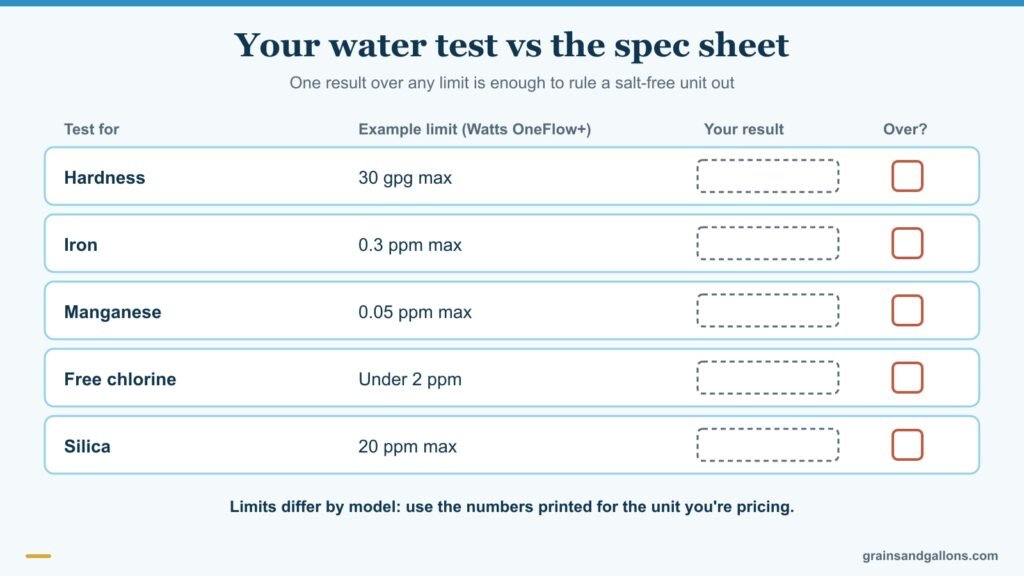
What's true about "works on any water": nothing. Every salt-free system has limits, even when they're buried in the manual. These are the numbers to find:
| Spec-sheet item | Why it matters | Example: Watts OneFlow+ |
|---|---|---|
| Maximum hardness | Above it, scale control drops off | 30 gpg |
| Maximum iron | Iron coats TAC media and stops it working | 0.3 ppm |
| Maximum manganese | Fouls media at very low levels | 0.05 ppm |
| Chlorine / chloramine | Can damage some media; may need carbon first | Under 2 ppm free chlorine |
| Silica, copper, oil, sulfide | Some media are sensitive; most don't treat silica scale | Silica 20 ppm max |
| pH range and service flow | Outside these, results aren't supported | Check the sheet |
Compare each line with a lab test of your water, not a guess. Well water with any iron or manganese is where salt-free systems most often disappoint; our guide to when a salt-free conditioner is the wrong choice covers the red flags. For a maker that publishes everything, our Watts OneFlow review goes through the full sheet line by line.
Hardness ceilings deserve extra caution. Sellers' own guidance varies widely, from about 10 grains per gallon to 30, so trust the number printed for your model rather than a general claim. If a seller can't give you these figures at all, treat that as the answer.
Match the certification to the claim

"Certified" is only meaningful when the certificate covers the claim being made.
- NSF/ANSI 44 covers cation exchange water softeners, meaning salt-based systems. A salt-free unit can't be certified as a softener under it. Our page on what NSF/ANSI 44 means explains the standard.
- NSF/ANSI 42, 61 or 372 on a salt-free unit usually cover material safety, lead-free compliance or a carbon stage's chlorine reduction. Useful, but silent on scale.
- Scale-reduction protocols are what you want. Germany's DVGW W512 and IAPMO's Z601 run treated and untreated water heaters side by side and weigh the scale. As described in Water Conditioning & Purification, both originally required an 80% reduction in scale versus the untreated control. IAPMO has revised Z601 since, so ask which edition a product passed.
Watch for mismatches: a box that says "NSF certified" next to a scale claim, when the listing only covers materials. Confirm any listing on the certifier's own website, not the seller's.
Ask the seller: "Which standard, which edition, which lab, and can I see the report?"
What independent tests say about salt free and maintenance free claims

The best-known independent comparison is the WateReuse Research Foundation's study 08-06, led by Arizona State University. It tested alternatives to salt softeners on real water supplies and reported that template assisted crystallization reduced scale formation by more than 88%, while electrically induced precipitation and electromagnetic treatment each managed about 50%.
Two takeaways for shoppers:
- The technology matters more than the "salt-free" label. TAC has the strongest evidence. Plug-in electronic and magnetic descalers that wrap wires around a pipe make similar promises with weaker results.
- Even good results are about scale, not softness. The study measured scale formation, not lather, spots or feel.
If you try an electronic descaler anyway, buy one with a real return window and judge it by visible scale on a showerhead or kettle over several months.
Four more marketing lines worth questioning
"Removes existing scale from your pipes"
Some TAC systems are marketed as gradually dissolving old scale. Independent data is rare and results vary. Don't buy a conditioner expecting it to clean an already-scaled water heater or tankless heat exchanger; descale those directly first. Our guide on whether a salt-free conditioner removes existing scale goes deeper.
"Lasts 6 years" or "1,000,000 gallons"
Lifespan figures assume water inside every limit in the table above. Divide the gallon rating by your household's real daily use to get years, then shorten it if your water sits near any limit.
"Protects tankless heaters and boilers"
Possibly, but check two things: whether the water heater maker accepts a conditioner in place of softening for its warranty, and whether the conditioner is rated for that use. Our page on salt-free conditioning for tankless and boilers covers the details.
"Keeps the healthy minerals" and "eco-friendly"
Both are true in a narrow sense: the calcium and magnesium stay in the water, and there's no brine discharge or regeneration water. Neither tells you whether scale control works on your supply.
Run these checks before you sign
- Test your water with a lab or a good kit: hardness, iron, manganese, pH, and whether your city uses chlorine or chloramine.
- Compare every number with the model's spec-sheet limits.
- Get scale-reduction evidence (DVGW W512, IAPMO Z601 or equivalent) and verify the listing yourself.
- Price five years of ownership: prefilters, replacement media and any pretreatment for iron.
- Decide what you need. Soft water (lather, fewer spots, slick feel) means a salt-based softener. Less scale in pipes and heaters is a salt-free job.
- Read the return policy and warranty. Look for a trial period long enough to see results, and check whether the warranty covers performance or only leaks and defects.
After installation, judge it by scale, not by feel
A hardness strip won't tell you anything, so pick evidence that matches the claim. Clean one showerhead and one kettle completely on install day and photograph them. Check both every month for three to six months; with a working TAC unit, new deposits should be softer and wipe off more easily than before. Keep the photos, the water test and the install date together, because that file is what a seller or warranty claim will ask for if results fall short.
FAQ
Do salt-free water softeners really work?
The better ones reduce scale, especially TAC systems, which cut scale by more than 88% in the WateReuse study. They don't soften water, so hardness readings, lather and spotting stay similar.
Is a salt-free water conditioner really maintenance-free?
No. Expect prefilter or carbon cartridge changes, often yearly, and scale media replacement every few years, plus occasional checks of O-rings and the bypass.
Can a salt-free system be NSF/ANSI 44 certified?
Not as a softener. NSF/ANSI 44 covers cation exchange softeners. Salt-free units may carry NSF/ANSI 42, 61 or 372 for materials or a carbon stage, which says nothing about scale.
What certification proves a salt-free scale claim?
A scale-reduction protocol such as DVGW W512 or IAPMO Z601, which compare treated and untreated water heaters. Ask for the report and confirm it on the certifier's site.
Will a salt-free system stop water spots?
Not fully. The minerals stay in the water, so spots still form when water evaporates, though they often wipe away more easily.
Do salt-free systems work on well water?
Only if the water is inside the limits, which is often not the case. Many TAC units allow very little iron (0.3 ppm) and manganese (0.05 ppm), so test first.
Buy salt-free for scale control, not for "no upkeep"
Salt free and maintenance free claims hold up only halfway: the salt part is real, the zero-maintenance part isn't, and "softener" is usually the wrong word. A salt-free conditioner earns its place when your water is inside its limits, it carries real scale-reduction evidence, and you've budgeted for cartridges and media. If you need soft water, buy a softener instead.