

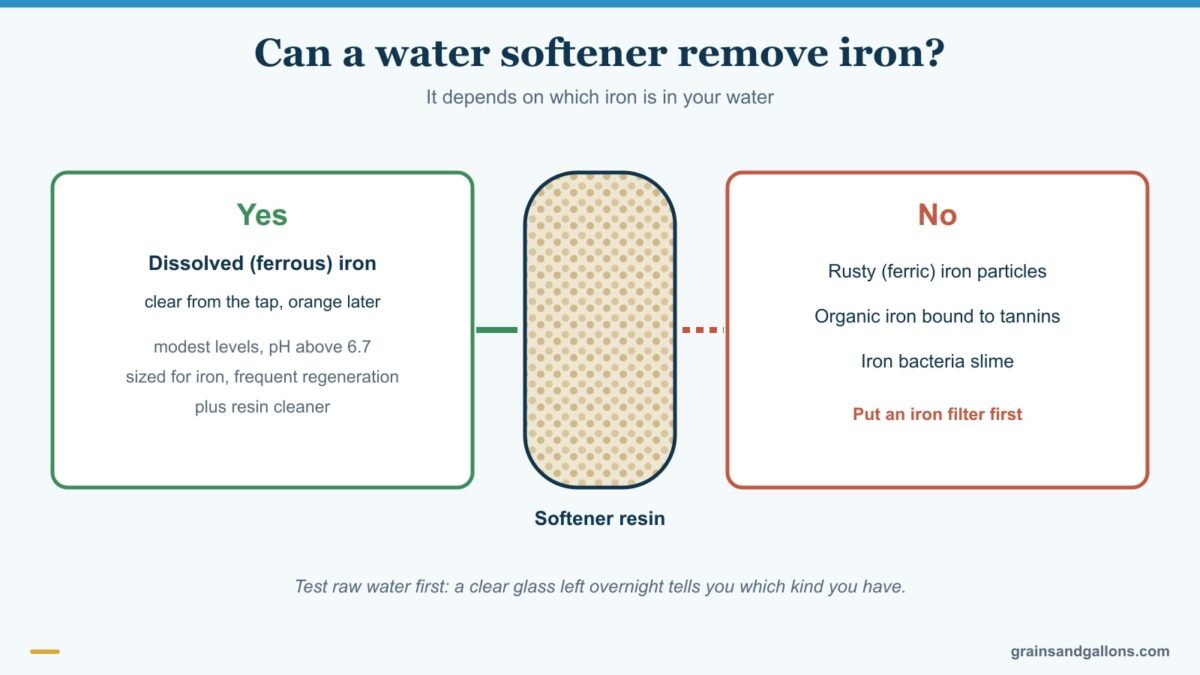
Quick Answer: Can a water softener remove iron? Yes, but only dissolved "clear-water" iron in modest amounts, with pH above about 6.7 and the softener sized and regenerated for it. It can't reliably remove iron that has already rusted into particles, iron bound to organic matter, or iron bacteria; those need an iron filter or other treatment ahead of the softener. Test raw water with a kit such as the ITS WaterWorks total iron test and do the glass test below.
Disclosure: As an Amazon Associate, Grains & Gallons earns from qualifying purchases.
Can a water softener remove iron from your well water? The salesperson says yes. The plumber says you need a separate iron filter. They're answering slightly different questions, because "iron" in well water isn't one thing.
In this guide
Ferrous, ferric, organic: why the form decides

Dissolved (ferrous) iron. Underground, without oxygen, iron stays dissolved and the water comes out clear. Once it meets air, it oxidizes and turns orange-brown. Ferrous iron carries a positive charge like calcium and magnesium, so softener resin swaps it for sodium along with the hardness.
Oxidized (ferric) iron. If the water picks up oxygen or chlorine before the softener, the iron is already rust particles. Resin isn't a filter: particles coat the beads and clog the bed.
Organic iron and iron bacteria. Iron bound to tannins, or the slimy orange film iron bacteria leave in toilet tanks, doesn't respond to ion exchange.
The glass test: fill a clear glass from a tap before the softener, look right away, then again the next morning. Clear at first with orange sediment later is ferrous iron. Orange or cloudy straight from the tap is ferric. Tea-colored with no sediment points to tannins. Slime and a swampy smell suggest bacteria.
How much iron can a water softener remove?
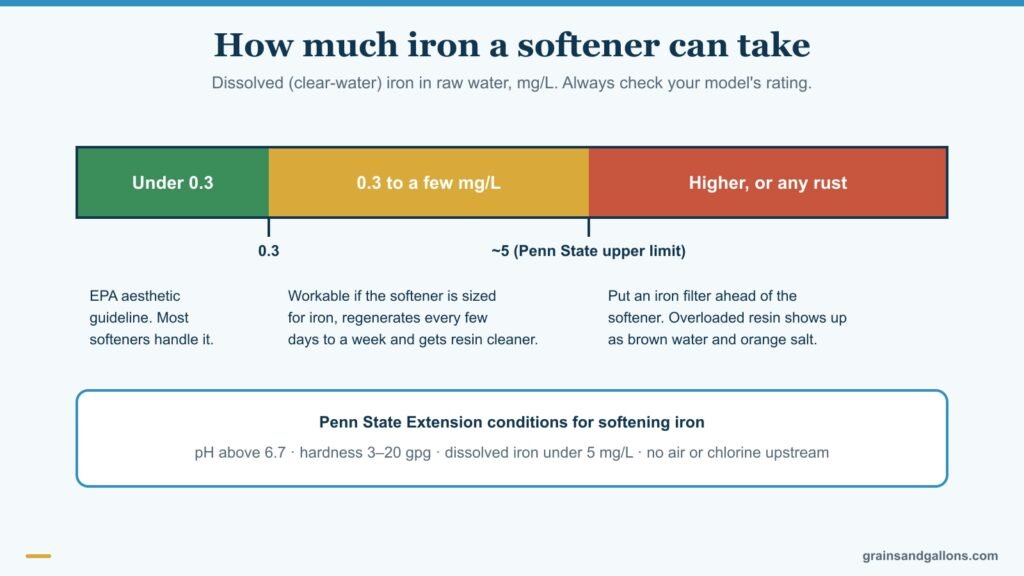
Manufacturer iron ratings vary a lot, so check the spec sheet. Penn State Extension's iron and manganese guide says softeners are generally recommended only when pH is above 6.7, hardness is 3–20 grains per gallon and dissolved iron is under 5 mg/L, and warns that oxidized iron "will foul the softener resin." Many standard softeners are rated well below that.
- Under 0.3 mg/L: EPA's secondary guideline for iron, where staining and metallic taste start. Most softeners handle this easily.
- About 0.3 to a few mg/L of clear-water iron: Workable with the right setup. Iron-rated units like the one in our SoftPro Iron Master review target this range.
- Higher levels, or any oxidized iron: Put a dedicated iron filter first. Overloaded resin shows it with brown water and orange-stained salt.
Test raw water, not softened water; our iron test kit comparison and how to test well water for iron cover how.
Making a softener handle clear-water iron
Size for iron, not just hardness. Iron eats resin capacity. Sizing calculators add a few grains per gallon of "compensated hardness" per mg/L of iron, with rules of thumb in the 3 to 5 range. See how iron changes softener sizing.
Regenerate often. The longer iron sits on the resin, the more it oxidizes in place and stops coming off with brine. Every few days to a week beats every two or three weeks.
Use a resin cleaner on a schedule to strip iron brine leaves behind; compare options in water softener resin and iron cleaners.
Keep air and chlorine out upstream. Anything that oxidizes the iron before the softener turns it into particles the resin can't handle.
Signs you need an iron filter instead

- Water is orange straight from the tap.
- Iron is above the softener manufacturer's limit.
- You also have manganese, rotten-egg odor or iron bacteria.
- pH is low (acidic water is often treated first with a calcite neutralizer).
- A softener has already fouled with iron once.
Air-injection, catalytic media and chlorine-based systems are the common types; iron filter before a water softener explains the order.
FAQ
Will a water softener remove iron stains?
No. A softener only treats water going forward. Existing orange stains need an iron-specific cleaner; avoid chlorine bleach, which can set them.
Is it bad to run iron through a water softener?
Small amounts of dissolved iron are fine if you size for it, regenerate often and use resin cleaner. Too much iron, or oxidized iron, fouls the resin and shortens its life.
Does pH affect iron removal by a softener?
Yes. Iron stays dissolved more readily in slightly acidic to neutral water, while higher pH and oxygen push it toward particles. Penn State recommends softeners for iron only above pH 6.7, partly because acidic water usually needs neutralizing anyway.
Can a water softener remove iron bacteria?
No. Iron bacteria form slime that ion exchange can't touch, and they can foul the resin. Shock chlorination and filtration deal with them; see iron bacteria in well water.
What's the cheapest way to remove iron from well water?
For low levels of clear-water iron, a softener you'd buy for hardness anyway, plus resin cleaner, is usually cheapest. For higher or oxidized iron, an iron filter costs more up front but saves the softener.
Clear iron yes, rusty iron no
So, can a water softener remove iron? Yes, when the iron is dissolved, modest and the softener is sized, regenerated and cleaned for it. If your glass test comes up orange, slimy or tea-colored, or the numbers top your softener's rating, put an iron filter in front and let the softener stick to hardness.