

Quick Answer: The VIQUA VH410 is a solid, no-frills whole-home UV unit for a typical well-water house. Viqua rates it at 14 gpm at the 40 mJ/cm² dose and 18 gpm at its own 30 mJ/cm² standard, and the controller alarms if the lamp fails. Buy it only if your water already meets Viqua's limits: under 7 gpg hardness and under 0.3 mg/L iron. Otherwise the lamp sleeve fouls and the UV dose drops. Smaller homes can step down to the VH200-F10, which adds a sediment pre-filter. If you want a sensor that actually measures UV output, the VH410M is the Viqua to get.
Disclosure: As an Amazon Associate, Grains & Gallons earns from qualifying purchases.
A UV lamp is only as good as the water in front of it. That's the one sentence most UV buyers never hear, and it decides whether a Viqua protects your family or just glows in the basement. The light has to pass through a quartz sleeve and then through the water. Scale on the sleeve, iron or tannin color in the water, or water moving through faster than the unit's rating all cut the dose that reaches the bacteria.
So this review spends more time on what has to happen before the Viqua than on the box itself. We haven't installed one. Everything below comes from Viqua's product pages and spec sheets for the VH and D4 families.
In this guide
- Pick the model by dose, not by the biggest number on the box
- Viqua's fine print: what your water must look like first
- Certification: what "Class B" means for your well
- The controller, and why the sensor question matters
- Living with it: the yearly lamp change
- When a Viqua is the wrong purchase
- Alternatives
- Should you buy the VH410?
Pick the model by dose, not by the biggest number on the box
Viqua prints flow at three UV doses. The highest flow figure is the one that gets quoted, but it's at the lowest dose. Here's Viqua's table for the VH family, at 95% UV transmittance (very clear water):
| Model | 16 mJ/cm² (US Public Health) | 30 mJ/cm² (Viqua standard) | 40 mJ/cm² (NSF/EPA) | Lamp power |
|---|---|---|---|---|
| VH150 | 12 gpm | 5 gpm | 3.5 gpm | — |
| VH200 | 16 gpm | 9 gpm | 7 gpm | 35 W |
| VH410 | 34 gpm | 18 gpm | 14 gpm | 60 W |
The Amazon listing calls the VH410 "18 GPM." That's the 30 mJ/cm² figure. If you want the 40 mJ/cm² dose that NSF and EPA guidance uses, size it as a 14 gpm unit.
A worked example. A 2.5-bath house with a well pump might see two showers, the washer and a kitchen faucet running at once on a busy morning. That's somewhere around 8 to 10 gpm. The VH200 can't deliver the 40 mJ/cm² dose at that flow (it tops out at 7 gpm). The VH410 can. A one-bath cabin with a single shower and a sink is VH200 territory.
When in doubt, size to your well pump's maximum output, not to how much water you think you use. A UV can't slow the water down; your pump decides how fast it moves.
Viqua's fine print: what your water must look like first
The VH and D4 spec sheets list these maximums for water entering the UV:
- Hardness: under 7 gpg (120 mg/L)
- Iron: under 0.3 mg/L
- Tannins: under 0.1 mg/L
- Water temperature: 36–104°F
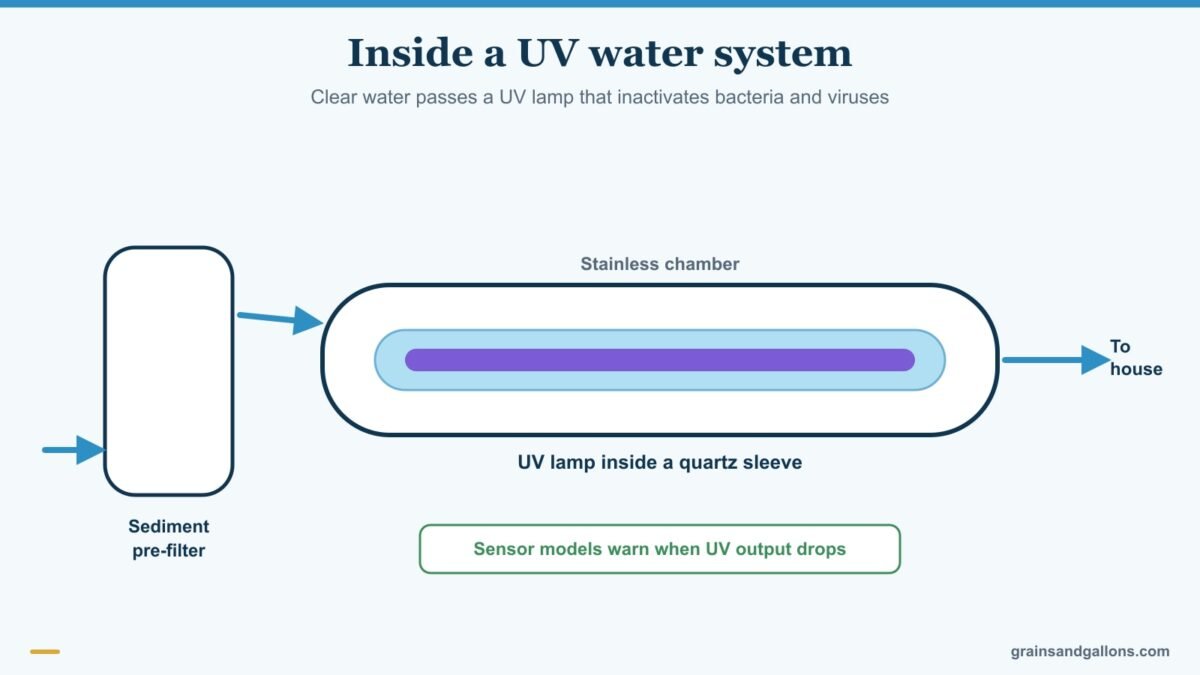
Above those, minerals plate onto the quartz sleeve, or color in the water absorbs the UV before it reaches the microbes. Lots of wells fail one or more of these limits. That means the realistic setup is:
- Sediment filter (some Viqua packages include one)
- Iron treatment and/or softener, if you're over 0.3 mg/L iron or 7 gpg hardness. A softener handles modest dissolved iron, as covered in can a water softener remove iron. Higher iron needs a dedicated filter.
- UV last, right before the water branches out to the house
Getting that order wrong is the most common UV mistake. Our guide to the well water treatment train order explains why UV always goes last. One more caution: if your issue is slimy orange buildup, read about iron bacteria in well water first. UV treats the water passing through, but it won't clear growth that's already living in your well and pipes.
Certification: what "Class B" means for your well
Viqua's NSF/ANSI 55 spec sheet covers the "-V" versions (VH200-V, VH410-V, VH410M-V, D4-V and D4-V+), and the certification is Class B. The sheet says plainly that Class B systems are "not intended for treatment of contaminated water." Class B is for supplemental treatment of water that's already considered safe. Under that Class B rating at 70% transmittance, the VH410-V is rated at 14 gpm and the VH200-V at 7.8 gpm.
What that means for you:
- Your well tests clean and you want a safety net? That's exactly the Class B use case, and the VH410 fits.
- Your well tested positive for coliform or E. coli? Fix the source first: well cap, casing, grouting, shock chlorination. Then retest. A UV is a barrier, not a cure for a contaminated well. Our planned guide on testing well water for coliform bacteria covers when and how to test.
Viqua lists the VH410 as inactivating Cryptosporidium, Giardia, E. coli and fecal coliform, and it notes that real-world results depend on installation, lamp age and water quality.
The controller, and why the sensor question matters
The VH410's controller gives you an audible lamp-replacement reminder, a countdown display and an alarm if the lamp fails. It also holds lamp output steady through power fluctuations. That's good. But it only knows whether the lamp is on, not how much UV is getting through the water.
That's the gap a UV sensor fills. In Viqua's line, the VH410M and D4+ have one, which shows UV intensity continuously. Per Viqua's NSF sheet, the sensor-equipped models also support a solenoid valve that shuts off water if UV output drops too low. If your water quality swings with the seasons, or if family members are especially vulnerable, the sensor is worth paying for.
Living with it: the yearly lamp change
Viqua rates its lamps at 9,000 hours. A UV lamp runs 24/7, so that's about 375 days. In practice, it's a once-a-year change whether the bulb still glows or not. The output fades long before the light goes out.
The VH410 uses the Viqua S410RL-HO lamp. Check price on Amazon. Buy the genuine Viqua part. Several third-party "compatible" lamps are listed, and some claim longer life than Viqua rates. We wouldn't trust a disinfection device to an unverified bulb. Viqua also sells a combined lamp-and-sleeve kit (QL-410). Clean or replace the quartz sleeve when you change the lamp, more often on harder water.
Other practical specs for the VH410:
- Size: 23.5 x 3.5 inches, so you need about double that length in clear wall space to slide the lamp out.
- Connections: 3/4-inch to 1-inch MNPT combo
- Power: 60 W, running constantly
- Shipping weight: 17 lb
Our planned guide on replacing a UV lamp and sleeve walks through the swap.
Check price on Amazon: VIQUA VH410
When a Viqua is the wrong purchase
- City water. It's already disinfected. A UV adds cost and electricity for little benefit in most homes.
- Hard, iron-heavy water and no budget for pre-treatment. Spending on the UV but skipping the softener or iron filter gets you a fouled sleeve within months.
- Chemical problems. UV does nothing for nitrates, arsenic, lead, hardness or taste.
- A contaminated well you haven't fixed. See the Class B note above.
Alternatives
Viqua VH200-F10: the VH200 chamber (shorter, with a 35 W lamp) pre-mounted on a reversible bracket with an integrated sediment pre-filter. Viqua rates the VH200 at 9 gpm at its 30 mJ/cm² standard and 7 gpm at 40 mJ/cm². The listing says this package includes a UV sensor and a countdown display, with a 10-year chamber warranty. Right for a cabin, a small one-bath home, or a point-of-entry on a low-flow well. Too small for most family homes if you want the NSF/EPA dose. Check price on Amazon.
VIQUA VH410M: the step up for people who want monitoring. It's the VH410 chamber with a built-in UV sensor that reports UV intensity continuously, and it's designed to work with a normally closed solenoid valve (sold separately) that shuts off water during a system error. The listing gives 18 gpm. That matches the VH410's 30 mJ/cm² figure, so plan on roughly 14 gpm at the NSF/EPA dose and confirm with Viqua's flow table. Warranty is 10 years on the chamber, 3 years on electronics and hardware, and 1 year on the lamp, sleeve and sensor. Check price on Amazon.
iSpring UVF55FS: a lower-cost, non-Viqua option. The listing describes a 12 gpm whole-house UV with 1-inch MNPT connections and a sensor switch. We couldn't confirm the UV dose behind that 12 gpm figure or any NSF/ANSI 55 listing, so treat it as a budget choice for clean water, not a direct equal to the Viqua. Check price on Amazon.
Should you buy the VH410?
The VH410 is a sensible, well-documented whole-home UV with honest flow tables and a reliable lamp-failure alarm. Size it at 14 gpm if you want the NSF/EPA dose, meet its water limits with a softener or iron filter upstream, and change the lamp every year. If you want a sensor that confirms the UV is actually getting through, spend more on the D4+ or the VH410M.