

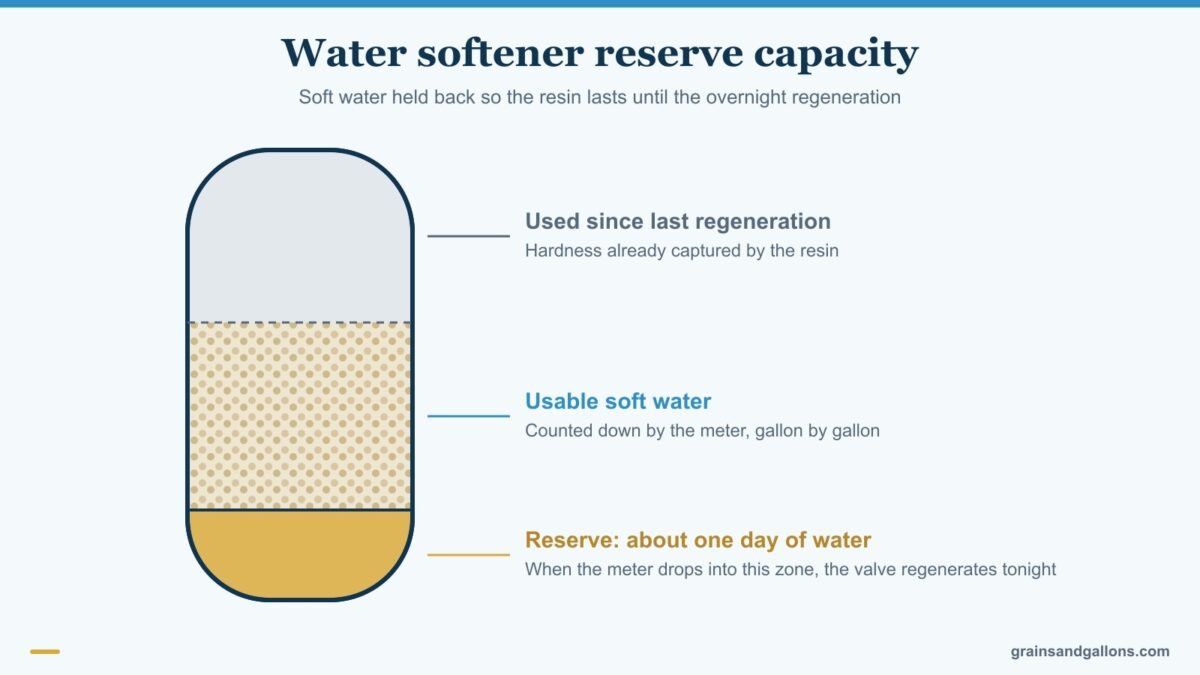
Quick Answer: Water softener reserve capacity is the soft water a metered softener holds back so you don't run out between the moment the resin gets low and the regeneration it schedules for 2 a.m. A good reserve is about one day of your household's water use, which for many homes works out to roughly 15–30% of the softener's capacity. Too little and you get hard water late in the day; too much and you regenerate early and waste salt.
Picture a car with a gas gauge but no low-fuel light, and a rule that you can only refuel at 2 a.m. You'd learn quickly to head to the station while there's still a day's driving left in the tank. That cushion is water softener reserve capacity. The idea fits in one sentence; the rest of this page is the arithmetic, the settings that store it, and the signs it's set wrong.
In this guide
- Why a delayed-regeneration softener holds water back
- Water softener reserve capacity, worked through for a family of four
- Work out your own reserve from the water bill
- Gallons, percent or self-learning: how valves store the reserve
- Iron and hardness changes move the target
- Too little or too much reserve: what you'll notice
- FAQ
- Hold back one day of water, and size the softener for a week
Why a delayed-regeneration softener holds water back
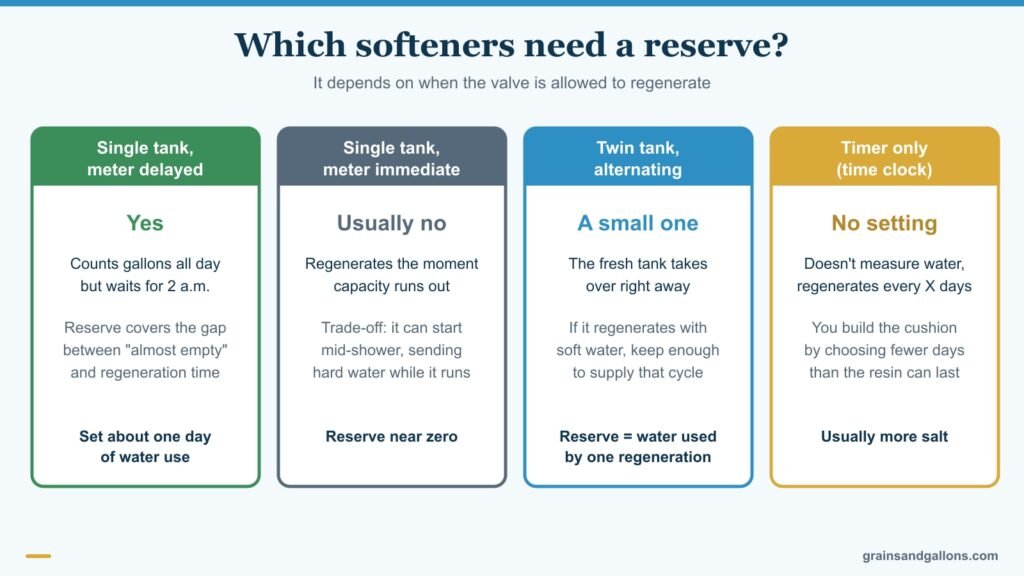
Most metered (demand-initiated) softeners use delayed regeneration. They count gallons all day, but they don't regenerate the moment the resin is spent. They wait for a quiet hour, usually around 2 a.m., so nobody is in the shower when the house switches to unsoftened water for an hour or two.
That creates a gap. If the resin runs out at 4 p.m., you'd get hard water from 4 p.m. until the 2 a.m. regeneration. The reserve closes it: at the regeneration time each night, the valve asks whether at least one more day of soft water is left. If not, it regenerates tonight, while there's still some capacity in the tank. Pentair's Fleck 5600SXT manual puts it plainly: the control works out system capacity by dividing unit capacity by feed water hardness and subtracting the reserve, and the reserve should be set so the system keeps delivering treated water between the time capacity is used up and the actual regeneration time.
Other designs need less, or none:
- Meter immediate. Regenerates as soon as the meter hits zero, so the same manual says these generally don't use a reserve. The catch is that a single-tank unit can start regenerating mid-afternoon and send hard water to the house while it runs.
- Twin tank. A fresh tank takes over on the spot. If the system regenerates with soft water from the other tank, the manual says to set the reserve to the volume used during regeneration.
- Timer only. A time-clock softener doesn't measure water at all. It regenerates every set number of days, so your cushion is choosing a shorter interval than the resin could last, which usually costs more salt.
The single-tank, meter-delayed design, the most common one in homes, is where the reserve setting matters.
Water softener reserve capacity, worked through for a family of four
The house:
- Hardness: 15 grains per gallon (gpg)
- Water use: about 70 gallons per person per day, so 280 gallons a day
- Hardness removed per day: 280 × 15 = 4,200 grains
The softener:
- A unit sold as "48,000 grain," set at a moderate salt dose where its working capacity is about 30,000 grains. Most softeners deliver well under the headline number at efficient salt settings; what grain capacity really means explains why.
- Gallons between regenerations at full capacity: 30,000 ÷ 15 = 2,000 gallons
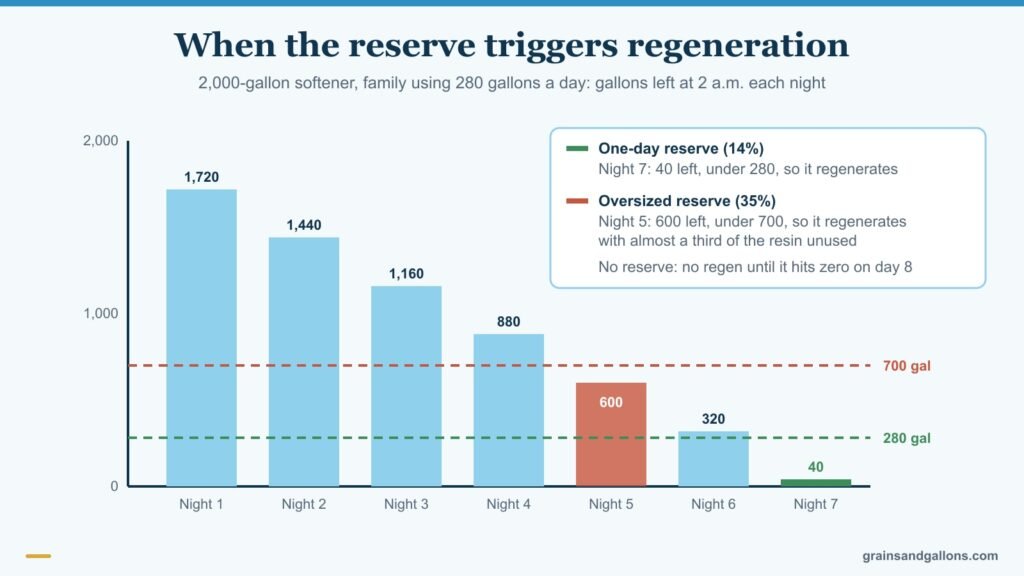
With no reserve: 2,000 gallons lasts 7.1 days. At 2 a.m. after day 7 the meter reads about 40 gallons left. The valve sees "not zero" and doesn't regenerate. On day 8 the resin runs out mid-morning, and you have hard water until the next 2 a.m.
With one day of reserve (280 gallons, about 14%): After day 6 the valve sees 320 gallons left, still more than 280, so no regeneration. After day 7 it sees 40 gallons left, less than the reserve, so it regenerates. No hard water.
With an oversized reserve (35%, 700 gallons): After day 5 the valve sees 600 gallons left, under 700, and regenerates with almost a third of the resin unused. That's roughly one extra regeneration every couple of weeks, and over a year a noticeable pile of extra salt and water for no benefit.
Work out your own reserve from the water bill

The goal is one normal day of water, plus a little margin for a heavy day.
- Find your daily gallons. Divide the gallons on your water bill by the days in the billing period. If the bill includes lawn watering or a pool, use a winter bill, since the softener usually only treats indoor water. Without a bill, 60–75 gallons per person per day is a common planning figure. For a sense of scale, the EPA's WaterSense program says the average American family uses more than 300 gallons a day at home, with roughly 70% of it indoors.
- Find the softener's gallon capacity. Divide its working grain capacity at your salt setting by your hardness in gpg. Many metered valves show this number on the display.
- Divide daily gallons by gallon capacity. That's your one-day reserve as a percentage. For the example house, 280 ÷ 2,000 = 14%.
- Adjust for how steady you are. Add a little if you have occasional heavy days (guests, a big laundry day, filling a hot tub). Hold close to one day if your use is very steady.
For the example house, a setting around 15–20% is sensible. Larger households on smaller softeners end up with bigger percentages, sometimes 30% or more. That's a hint the softener is undersized, since regenerating every three days with a third of the resin held back burns a lot of salt. Signs a water softener is undersized covers the other clues.
Gallons, percent or self-learning: how valves store the reserve

Control valves hold the reserve in one of three ways, and some let you choose:
- Fixed reserve in gallons. On the Fleck 5600SXT this is "RC." You enter a volume, such as 280 gallons. The manual notes it can't be set above half the calculated capacity, and it stays the same even if you later change the hardness or capacity setting.
- Percentage (safety factor). Fleck calls it "SF," adjustable from 0 to 50% of system capacity. Because it's a percentage, the reserve in gallons moves whenever hardness or capacity changes.
- Variable (calculated) reserve. The valve tracks your actual use, on some models by day of the week, and sets the cushion to match. A household that uses more water on Saturdays gets a bigger reserve on Friday night. On the 5600SXT, when variable reserve is selected in master programming, changing SF has no effect.
For a family whose water use swings around guests and laundry days, variable reserve is usually the better choice. For a steady household, a fixed one-day reserve is simple and predictable. Where the setting lives differs by brand, and some valves bury it in a dealer menu; how to set softener capacity and reserve walks through the common valves button by button.
Iron and hardness changes move the target
A reserve that was right last year can drift, because it's tied to gallon capacity and gallon capacity depends on hardness.
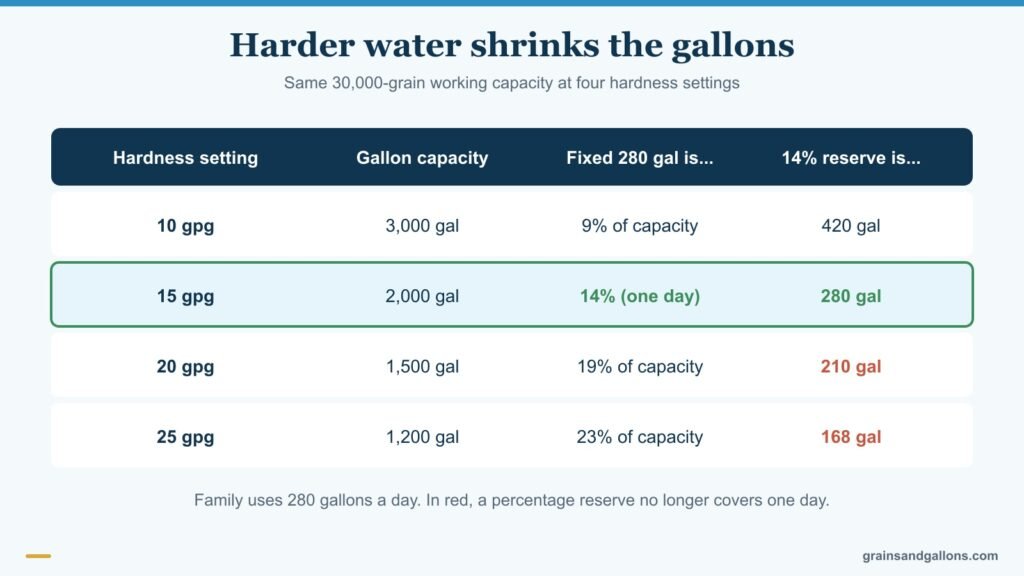
- New hardness number. If a fresh test shows 20 gpg instead of 15, the example softener's capacity drops from 2,000 to 1,500 gallons. A fixed 280-gallon reserve is now about 19% of capacity instead of 14%. That's still one day of water, which is the point, but the softener regenerates more often. A percentage reserve does the opposite: 14% of 1,500 is only 210 gallons, less than a day, so check it after any hardness change.
- Iron on a well. Iron uses up resin capacity like hardness and is harder to strip off, so dealers add it to the hardness setting as "compensated hardness." That shrinks gallon capacity in the same way. How iron changes water softener sizing has the usual multipliers. Penn State Extension also warns that oxidized iron will clog the resin, which quietly lowers real capacity no matter what the reserve says.
- More people at home. A new baby, a returning college student or someone working from home raises daily gallons. Recalculate one day of use.
Too little or too much reserve: what you'll notice
Too small:
- Hard water late in the day before a regeneration night, especially after heavy use.
- A hardness test that's fine in the morning and hard in the evening on the day before regeneration. That pattern has its own guide: hardness returning before regeneration.
Too large:
- Salt use higher than you'd expect for your water and household.
- The display showing a lot of gallons left on the night it regenerates, as in the 700-gallon example above.
- Regenerations every three or four days on a softener that should go a week.
Neither, but still having trouble:
- If capacity itself is set wrong, or the resin has lost capacity, adjusting the reserve just moves the problem around. Fix the capacity or hardness setting first, then size the reserve.
- Check the day override too. It forces a regeneration after a set number of days even if the meter hasn't counted down. Set too short, it regenerates before the reserve ever comes into play.
FAQ
What is a good reserve capacity setting for a water softener?
About one day of your household's water use. Divide your daily gallons by the softener's gallon capacity to get the percentage. For many homes with a correctly sized softener, that lands between roughly 15% and 30%, but your own numbers beat any rule of thumb.
Does a bigger reserve waste salt?
Yes. Every gallon held in reserve is capacity you paid for in salt but didn't use before regenerating. A reserve much larger than one day forces earlier regenerations, so you use more salt and water over a year with no improvement in soft water.
Do I need a reserve on a twin-tank softener?
Only a small one. A twin-tank system switches to the fresh tank immediately, so there's no overnight gap to cover. If it regenerates using soft water from the other tank, Pentair's manual says to set the reserve to the water used by one regeneration.
Why does my softener regenerate with lots of gallons left?
Usually because the reserve is set too high, the day override is too short, or the valve uses variable reserve and recently saw a heavy-use day. Check the reserve and day override in the settings menu before changing anything else.
Is variable reserve better than a fixed reserve?
For households whose water use changes from day to day, usually yes, because it adapts the cushion to recent use. A fixed reserve of one day works well when use is steady and is easier to predict and troubleshoot.
Hold back one day of water, and size the softener for a week
Water softener reserve capacity does one job: it bridges the hours between "almost empty" and the 2 a.m. regeneration. Set it to one normal day of water and recheck it whenever your hardness, iron or household changes. If one day works out to a third of your capacity, the reserve isn't the problem; the softener is small for the house.
If you're shopping, a metered valve with adjustable or variable reserve is what makes this math possible. Penn State Extension notes that timed models regenerate whether the resin needs it or not, while demand models suit households with changing use. Our guide to the best metered (on-demand) water softeners sticks to valves that count gallons. A softener large enough to go about a week between regenerations keeps the reserve to a small slice of total capacity; for many three-to-four-person homes with moderately hard water, that's the 48,000-grain class.