

Quick Answer: Water hammer after water softener installation is usually air trapped in the lines or a pipe knocked loose during the cut-in. Run every tap until it stops spitting, then re-strap any pipe that jumps. If it only bangs when the washer or dishwasher shuts off, add an arrester at that valve, such as the screw-on Sioux Chief 660-H Mini-Rester. Above 80 psi, a pressure reducing valve makes every bang smaller.
Disclosure: As an Amazon Associate, Grains & Gallons earns from qualifying purchases.
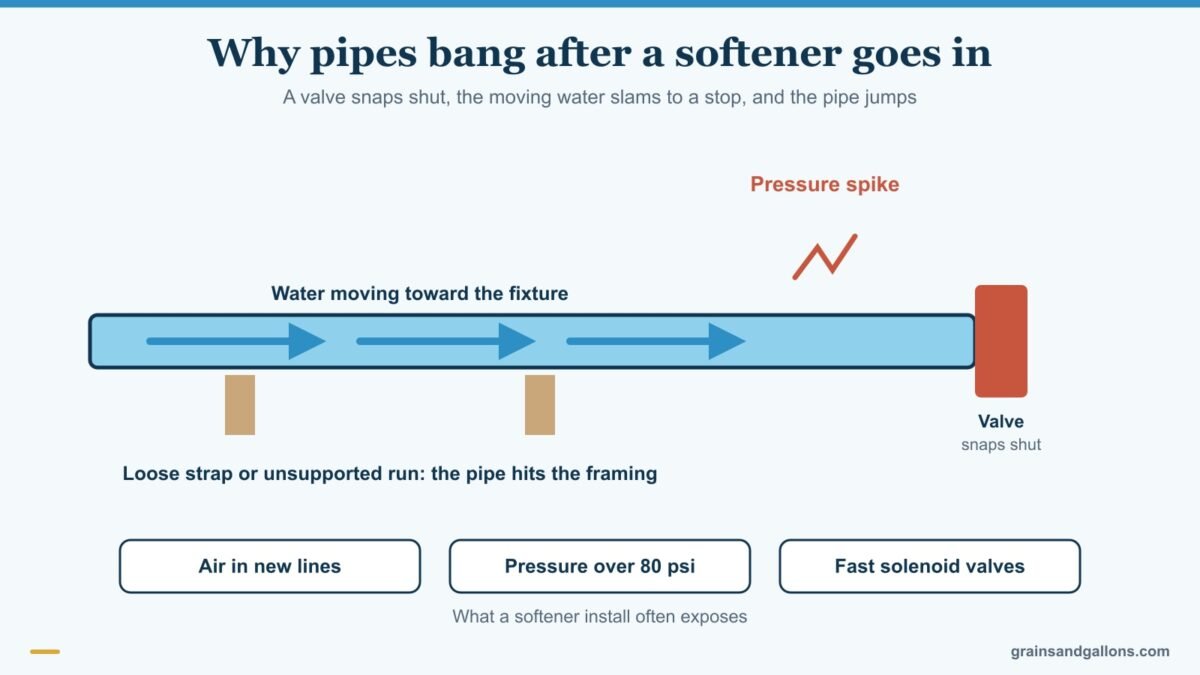
Water hammer after water softener installation tends to show up as a 2 a.m. thud in the wall, or a bang every time the washer fills. Hammer is a pressure shock: moving water stops suddenly when a valve snaps shut, and the column of water slams to a halt, flexing the pipe against the framing. A softener rarely causes it alone; the install exposes old weak spots.
In this guide
When the banging happens tells you why
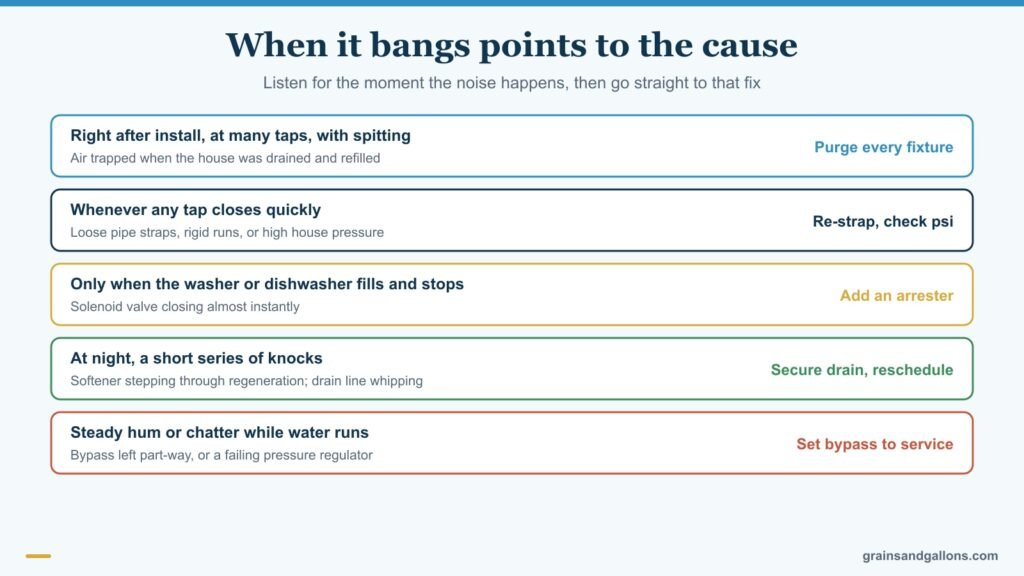
- Right after install, at many taps, with spitting faucets: air trapped in the lines.
- Whenever any tap closes quickly: loose pipe straps, a rigid run or high pressure.
- Only when the washer, dishwasher or ice maker valve closes: a fast solenoid valve.
- At night, a short series of knocks: the softener stepping through regeneration.
- A steady hum or chatter while water runs: a bypass left part-way, or a failing pressure regulator.
Air pockets and pipes knocked loose during the install
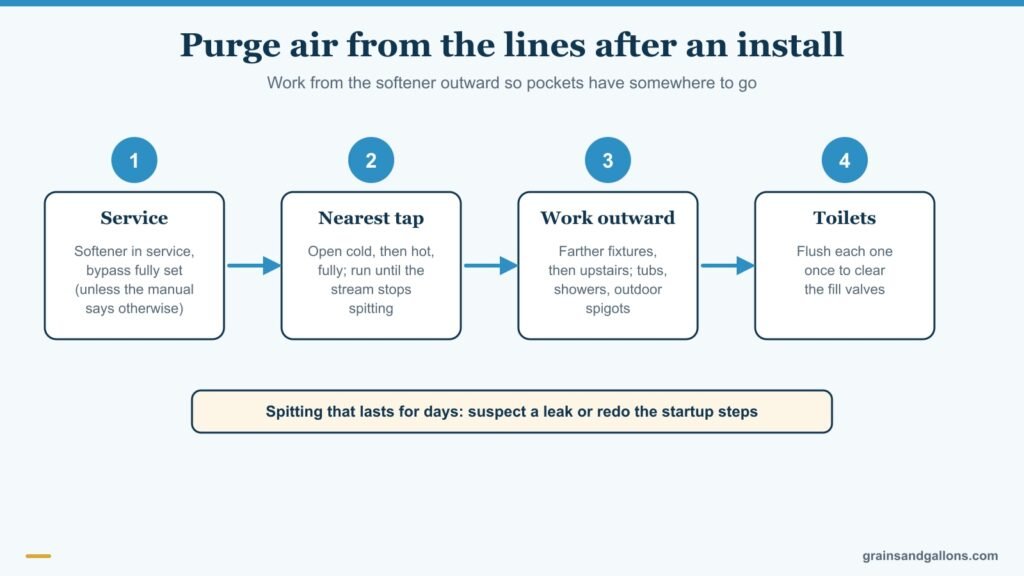
Cutting in a softener means draining and refilling the house. Air gets trapped at high points and in branches, then compresses and lets go, so you get spitting faucets and loud knocks as pockets move.
Purge it:
- Put the softener in service with the bypass fully set, unless your manual says to purge in bypass first.
- At the fixture closest to the softener, open cold and hot fully and let each run until the stream is smooth.
- Work outward to the farthest fixtures and upstairs, including tubs, showers and outdoor spigots.
- Flush each toilet once.
If spitting continues for days, suspect an air leak (common on wells) or redo the manual's startup steps.
The cut-in can also pop straps loose or leave a run hanging. Have someone snap a faucet shut while you watch the pipes near the softener and along the main. If a pipe jumps, add cushioned clamps rated for that pipe type, without strapping PEX so tight it can't expand. Braided flexible connectors at the softener take strain off the bypass valve and soak up some shock.
Is house pressure too high for the softener?
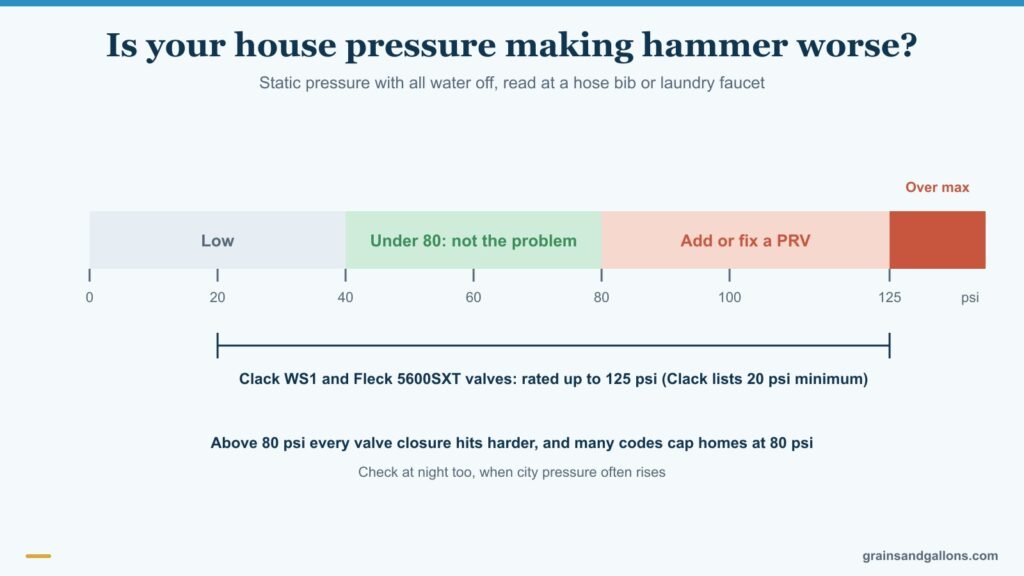
High pressure doesn't create hammer, but it makes every shock bigger. Many plumbing codes cap household pressure at 80 psi. The valves themselves have limits too: the Clack WS1 service manual lists 20–125 psi operating pressure, and the Fleck 5600SXT manual says pressure is not to exceed 125 psi. More in water softener pressure requirements.
Screw a gauge onto a hose bib or laundry faucet with all water off, and check it at night too, when city pressure often rises. Under 80 psi, pressure isn't your main problem. Over 80 psi, add a pressure reducing valve, or replace one that has worn out; see our pressure reducing valve picks. A PRV can make the system closed, so local code may then require an expansion tank. If pressure swings up and down instead, read water pressure fluctuating with a softener.
Washers, dishwashers and other fast-closing valves
Washing machines, dishwashers and ice makers use solenoid valves that shut almost instantly. Family Handyman calls these the most intense source of hammering and recommends manufactured arresters installed close to the valve.
For a washer, the simplest arrester screws onto the hose bib between the valve and the hose, like the Sioux Chief 660-H above. Fit one on both the hot and cold supply. Dishwasher and ice maker arresters go in the supply line under the sink or behind the fridge.
Knocks while the softener regenerates
If the knocking happens only at regeneration time, often 2 a.m. by default, listen at the unit. A clunk as the valve steps between positions is normal on many models; repeated banging is not.
- Drain line. A long, unsupported drain tube can whip as flow starts and stops. Clip it down and check the drain flow control; see drain line whistling or hammering.
- Water use mid-cycle. A toilet refilling or an ice maker opening while the valve shifts can cause odd knocks. Pick a quieter regeneration time.
- Bypass and valve internals. Make sure the bypass handles are fully in service. If a manual regeneration sounds mechanical or harsh, a worn piston or seals may need a dealer.
FAQ
Why is there water hammer after water softener installation?
The softener itself rarely causes it. The install usually exposes something already there: trapped air, a loosened pipe, high pressure or a fast appliance valve. Regeneration can add a few knocks if the drain line isn't secured.
Is water hammer dangerous?
Occasional light knocks aren't an emergency, but repeated, strong hammer can loosen joints and stress valves over time. Call a plumber if fixtures shake or a joint starts to leak after banging episodes.
Where should a water hammer arrester go?
As close as possible to the fast-closing valve that causes the bang, such as the washer hose bibs or the dishwasher supply.
Will water hammer go away on its own?
Hammer from trapped air usually fades within a day of running the taps. Hammer from loose pipes, high pressure or solenoid valves keeps happening until you fix that cause.
Purge the air first, then strap and check pressure
Most water hammer after water softener installation clears once the air is purged and loose pipes are re-strapped. If it keeps going, the timing points to the rest: a gauge reading over 80 psi calls for a PRV, bangs at the washer call for an arrester, and night-time knocks point to the drain line or regeneration schedule. Call a plumber for violent hammer or leaking joints.