

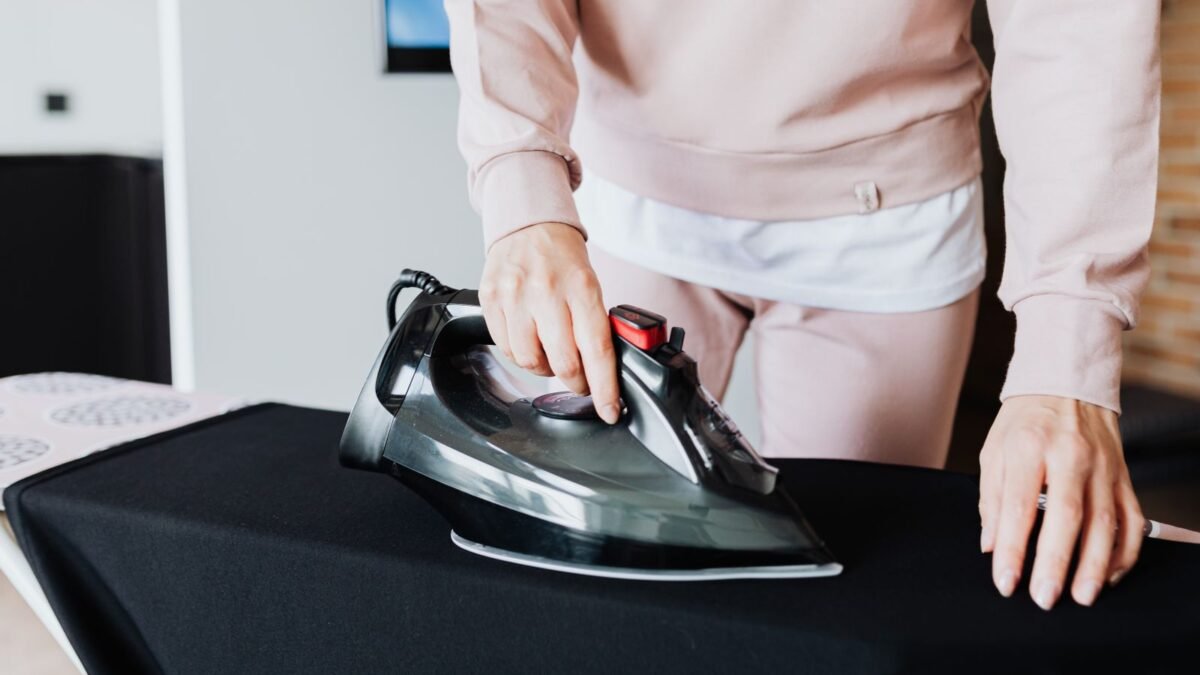
Quick Answer: A steam iron spitting white flakes is shedding limescale from inside its steam chamber. Run the self-clean cycle over a sink, clean the anti-calc valve if it has one, then change your water: in hard water areas, mix tap with distilled about half and half, as Rowenta and Philips suggest. Skip softened water, which Rowenta tells owners not to use.
A steam iron spitting white specks onto a dark shirt isn't throwing dirt or starch. It's mineral scale, the same crust that builds up in a kettle.
In this guide
Why a steam iron spitting white flakes means scale
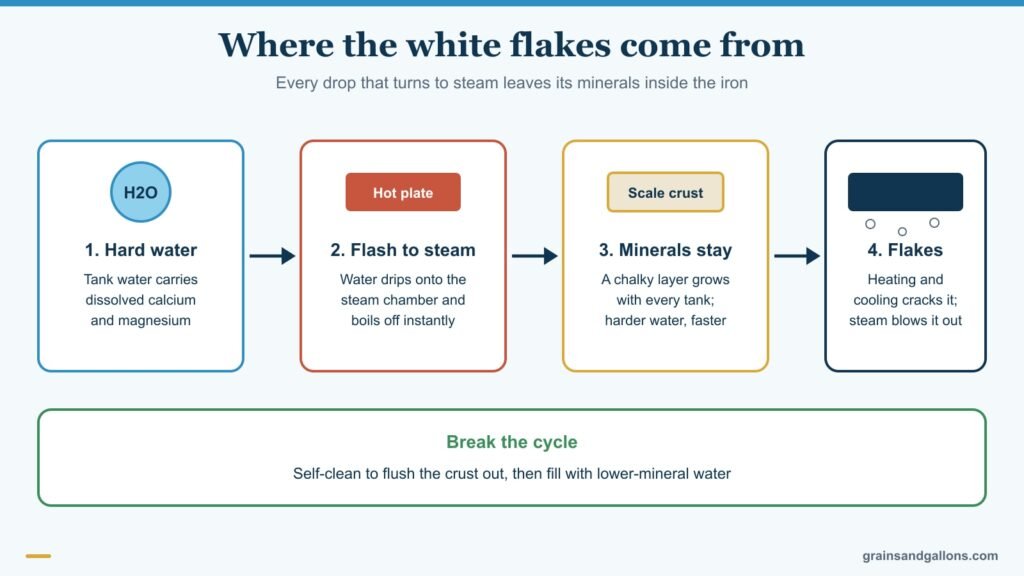
Water drips from the tank onto a hot plate inside the soleplate and flashes to steam. Each drop leaves its calcium and magnesium behind, and over weeks that becomes a crust. As the iron heats and cools, the crust cracks, and the next burst of steam blows flakes out. The harder your water, the sooner it starts; a home hardness test tells you where you stand.
Philips notes one harmless exception: a new iron can release white flakes on its very first use, and they stop shortly.
Flakes, drips or brown water: read the symptom
| What you see | Likely cause | Fix |
|---|---|---|
| Dry white or gray flakes | Scale breaking loose | Self-clean, then change water |
| Clear drips or spurts | Steaming before the iron is hot, or on a low setting | Wait for the heat light; steam only on higher settings |
| Spurts after the shot button | Using burst of steam too often | Pause between shots |
| Brown water | Scale plus residue, or water types the maker warns against | Self-clean and switch water |
Rowenta's DW13/DW23/DW24 manual lists dripping from the soleplate as a sign the iron isn't hot enough or the shot button is overused, and Philips' soleplate leaking guide says the same about steam boost. That's technique, not cleaning.
Run the self-clean cycle over a sink
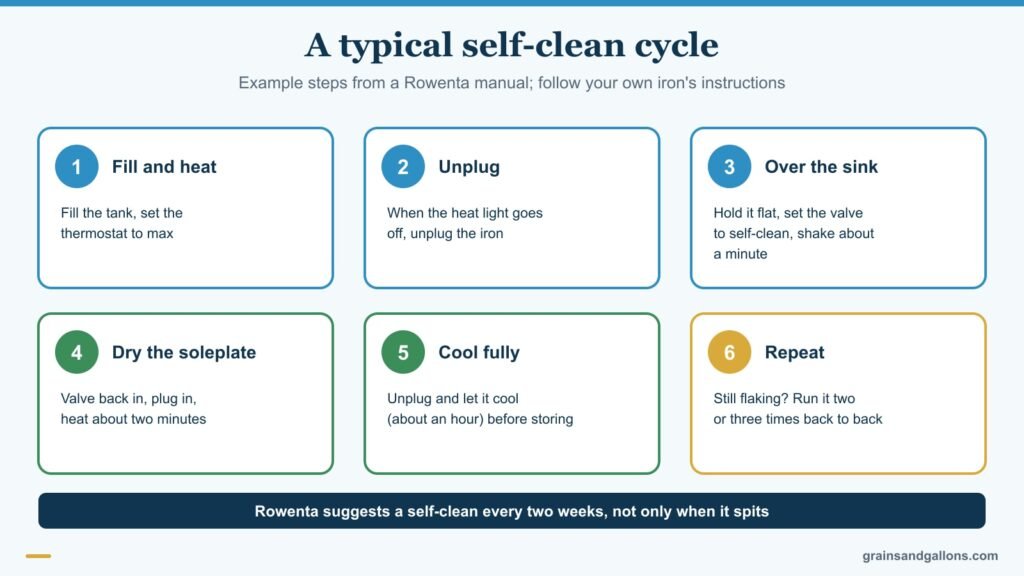
Steps vary, so use your manual. Rowenta's routine:
- Fill the tank and set the thermostat to max.
- When the heat light goes off, unplug the iron.
- Hold it flat over a sink, move the valve to self-clean and shake gently for about a minute.
- Put the anti-calc valve back, plug in and heat about two minutes to dry the soleplate.
- Unplug and let it cool fully (about an hour) before storing.
Rowenta recommends this every two weeks, plus soaking the removable anti-calc valve for four hours in lemon juice or white vinegar. If flakes continue, run two or three cycles back to back. Don't pour vinegar or descaler into the tank unless your manual allows it; Philips warns that additives can damage its irons.
Pick water that won't refill the scale
Rowenta designs its irons for untreated tap water and suggests 50% tap and 50% distilled if your water is very hard. Philips gives the same 50/50 option, or distilled alone. Rowenta's do-not-use list includes:
- softened water
- pure distilled water and rain water
- scented water, dryer or air conditioner water
- boiling water and bottled mineral water
If you have a whole-house softener, fill from a tap that bypasses the softener or use the tap/distilled mix. If white flakes also appear in drinking glasses, see white particles in tap water.
Empty the tank after each use and store the iron upright with steam off.
FAQ
Why is my new iron spitting white flakes?
Philips says some white flakes on first use are normal and stop shortly. If they continue, check your water and run the self-clean cycle.
Can I use distilled water in my steam iron?
Philips allows it; Rowenta says to use a 50/50 tap and distilled mix instead.
Is softened water OK for a steam iron?
Rowenta lists softened water among the types not to use because it can cause spitting and brown staining. Use unsoftened tap or a tap and distilled mix.
How do I get white flakes off clothes?
Brush the dry flakes off once cool, and rewash if marks remain.
How often should I descale my iron?
Rowenta suggests a self-clean every two weeks, even before spitting starts.
Clean it twice, then switch water or replace the iron
A steam iron spitting white flakes usually stops after one or two self-clean cycles and a water change. If it still spits, the scale is lodged where nothing reaches. Replace it with an iron that has real anti-calc protection; see our best steam irons for hard water and limescale in kettles, coffee makers and irons.