

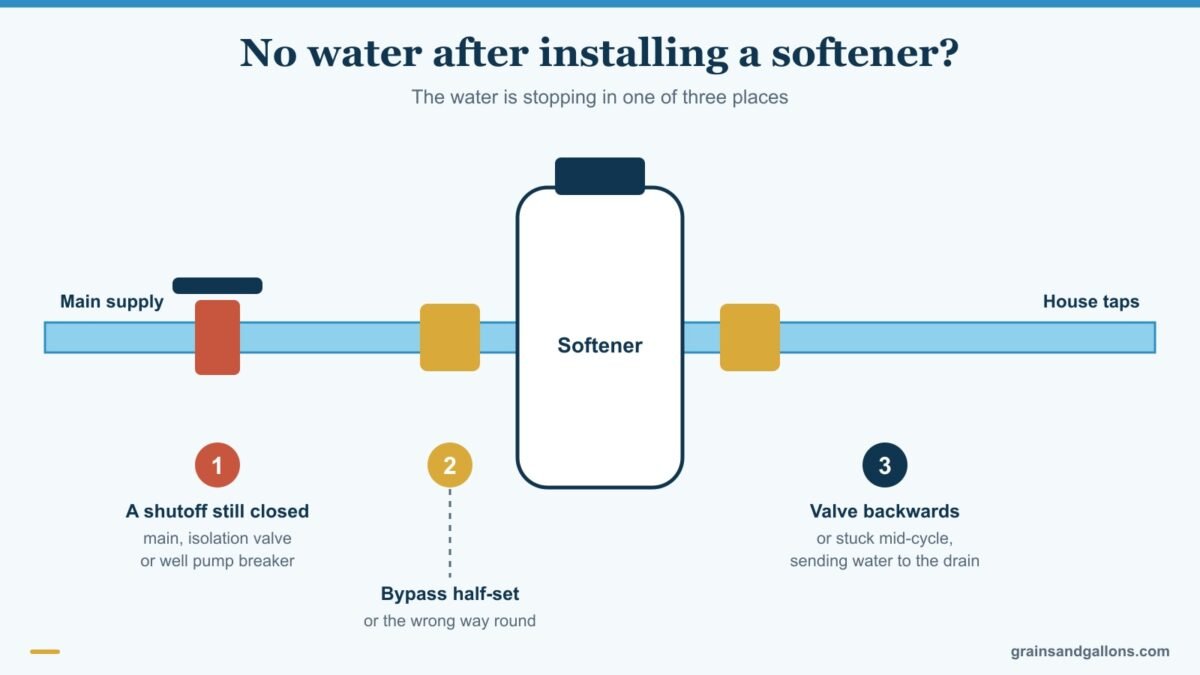
Quick Answer: No water after installing water softener plumbing almost always means a valve setting, not a failed install. Put the softener's bypass in the bypass position and open a cold tap. If water comes back, the problem is the bypass setting, reversed inlet and outlet plumbing, or a control valve that isn't in service. If there's still no water in bypass, a shutoff valve, or the well pump breaker on a well system, is still off.
The pipes are connected, the fittings are tight, you've opened the main, and you turn on the kitchen tap. Nothing, or a sputter and then nothing. Having no water after installing a softener is unnerving after an afternoon of plumbing. The good news is that it's almost always one of a handful of settings, and a single test tells you which half of the system to look at.
If you do have water but the pressure is weak, that's a different problem. Our guide to low water pressure after a water softener covers it.
In this guide
- No water after installing water softener plumbing? Run the bypass test
- No water even in bypass? Find the closed shutoff
- When bypass works but service doesn't
- Sputtering taps mean trapped air, not a failure
- Bring the softener online slowly
- FAQ
- No water after installing usually means a valve, not a bad softener
No water after installing water softener plumbing? Run the bypass test
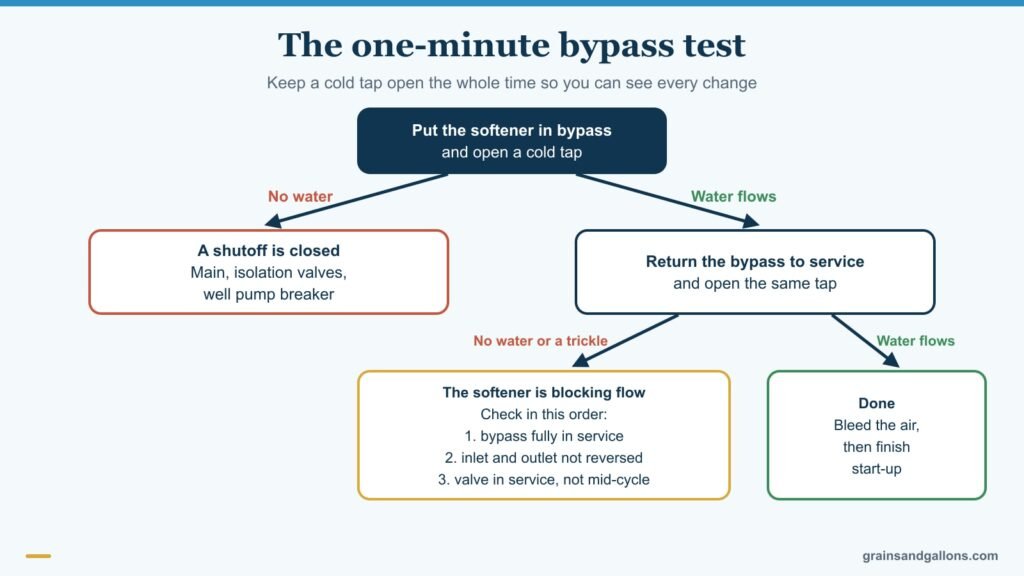
Keep a cold tap open the whole time so you can hear and see every change.
- Put the softener in bypass and open a cold tap.
- Water flows: the house plumbing is fine. Go to step 2.
- No water: the softener isn't the cause. A shutoff is closed (next section).
- Move the bypass back to service and check the same tap.
- Water flows, maybe spitting air: you're nearly done. Bleed the air and finish start-up.
- No water or a trickle: the softener is blocking flow. Check the bypass orientation, the flow direction and the valve position, in that order.
No water even in bypass? Find the closed shutoff
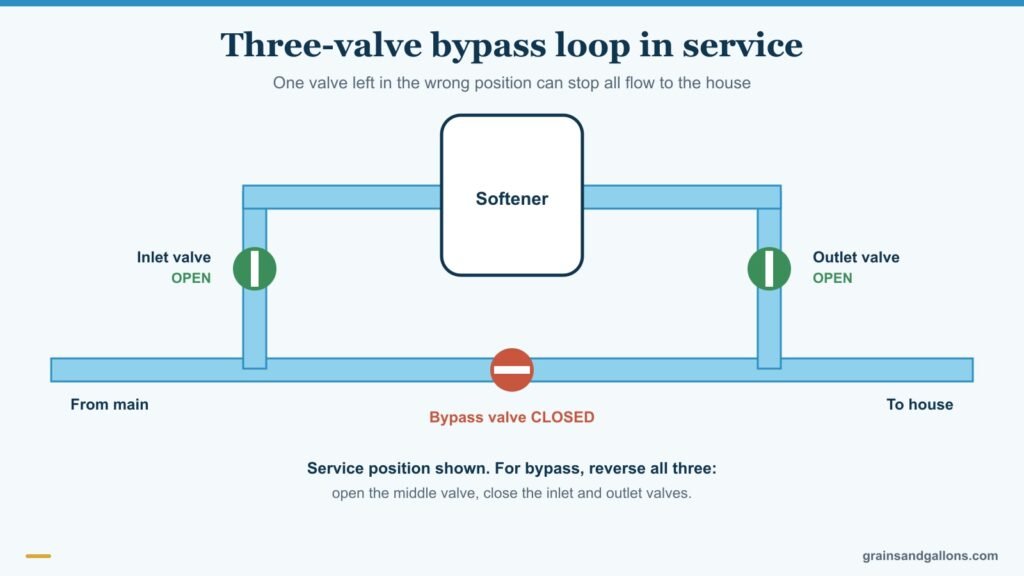
If bypass doesn't bring water back, the water isn't reaching the softener or isn't getting past it. Check:
- The main shutoff. Gate valves take many turns to open fully. A ball valve is open when its handle runs parallel to the pipe.
- Isolation valves at the softener. Many installs add a shutoff on each side of the softener. One may still be closed.
- A three-valve bypass loop. In service, the inlet and outlet valves are open and the middle bypass valve is closed. For bypass, it's the reverse. If one valve is left in the wrong position, both settings can leave you with no water at all.
- The well pump. On a private well, the pump breaker may still be off from the install. Check that the pressure tank gauge shows pressure.
- The tap you're testing. Test a cold tap first. A hot tap also depends on the water heater's cold inlet valve.
The opposite pattern, where water flows in service but stops when you switch to bypass, has its own causes. See no water pressure after bypass.
When bypass works but service doesn't
If water flows in bypass and stops in service, the softener or its bypass is the blockage. Work through these in order.
The bypass is reversed or only half-set
Bypass valves differ from brand to brand. Some use a single knob or lever with arrows. Others use push-pull plungers or a stem you slide in, and some have two handles that both need turning. On some designs, the position that looks "open" is actually bypass. Look for "service" and "bypass" markings on the body, check your manual's diagram, and move the valve fully to each position. A bypass left partway between positions is one of the most common causes of little or no flow. If the bypass is cracked, sticks or won't seat, our roundup of the best water softener bypass valves covers replacements by valve type.
It's plumbed backwards
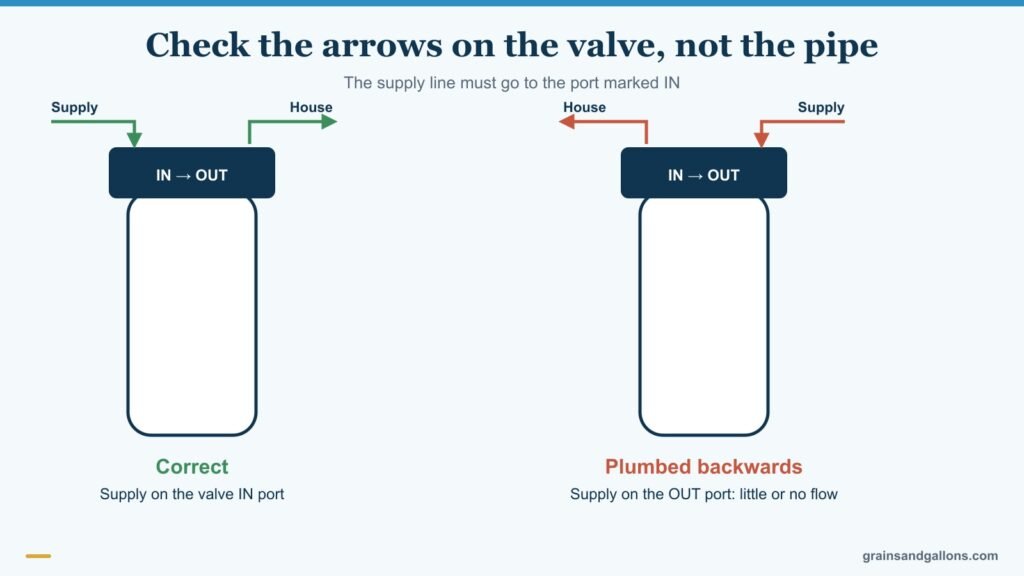
The control valve has an inlet and an outlet, marked with arrows or "IN" and "OUT." Pentair's 5600SXT softener manual warns that when you're replacing an old unit, the existing inlet and outlet plumbing may already be reversed. It tells installers to make certain the valve's inlet connects to the incoming supply. A reversed valve may pass little or no water, and some behave strangely during regeneration. Check the marks on the valve itself, not on the old pipes. Softener plumbed backwards covers the signs and the fix.
The control valve isn't in service
A new valve may not be sitting in its service position, and many people press regenerate straight after the install. If the valve is in backwash or brine draw, much of the water is going down the drain or into the brine tank instead of to the house. Signs include a steady flow into the drain line, a filling brine tank, or a display showing a cycle step instead of the time. Let the cycle finish, or step it back to service as your manual describes. Most valves need power to move, so make sure the unit is plugged into a live outlet. If it won't leave one step, see softener stuck on one cycle position.
Debris from the install
Cutting and soldering knock loose scale and solder bits, and these can lodge in a sediment prefilter or the softener's inlet. If you added a new prefilter in the same job, check its cartridge. If the softener has an inlet screen, check that too.
Sputtering taps mean trapped air, not a failure
A new resin tank is full of air. Open the water fast and that air compresses, then spits out of the taps in bursts. It can sound like no water at all for a few seconds. Leave two or more downstream cold taps open and give it a minute or two before deciding something is wrong. The air clears on its own.
If you get a burst and then nothing, the air isn't the real problem. Go back to the bypass test.
Bring the softener online slowly
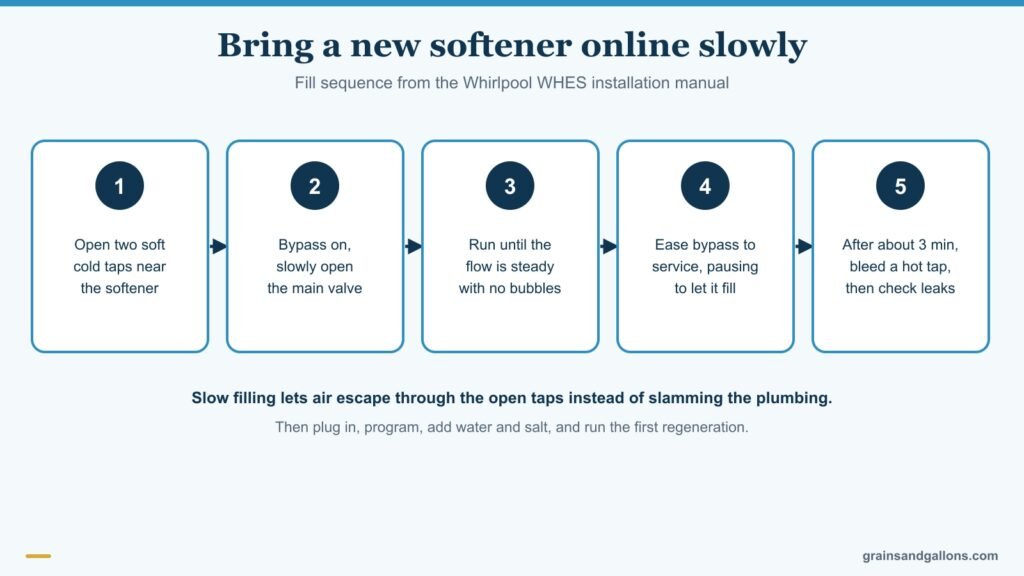
Once you've found the cause, refill the system the way the manufacturers describe. This sequence comes from the Whirlpool WHES installation manual:
- Fully open two or more softened cold-water faucets close to the softener.
- Put the bypass in the bypass position.
- Slowly open the main supply valve and run water until the flow is steady with no air bubbles.
- Move the bypass toward service slowly, pausing several times so the softener can fill. On a three-valve loop, close the bypass valve, open the outlet valve, then slowly open the inlet valve.
- After about three minutes, open a hot tap until it runs steadily without bubbles. Then close the taps and check every joint for leaks.
Then plug the unit in, program it, add water and salt to the brine tank as your manual directs, and run the first regeneration. Pentair's 5600SXT manual has you start a manual regeneration and run backwash until the drain water runs clear. Our water softener startup procedure walks through each step.
FAQ
Why is there no water after installing a water softener?
Usually a valve setting. The most common causes are a bypass left partway between positions, a closed shutoff or three-valve loop valve, a softener plumbed with the supply on the outlet port, or a control valve sitting in a regeneration step. The bypass test tells you which group you're dealing with.
Can air in the pipes stop water completely?
Only briefly. Air trapped in a new softener tank can make taps sputter or pause for a few seconds, but it clears with downstream taps open. If flow stops for good, look for a closed valve, a reversed connection or a valve stuck mid-cycle.
Will a softener installed backwards damage anything?
It can. Besides blocking flow, some valves behave strangely during regeneration when the water enters through the wrong port. Shut it off, put it in bypass, and swap the connections before running it in service.
Why does water run constantly to the drain after installation?
The control valve isn't in service. It's in backwash, rinse or another regeneration step. Let the cycle finish or step it back to service, and make sure the unit has power.
No water after installing usually means a valve, not a bad softener
Most cases of no water after installing water softener plumbing trace back to a closed shutoff, a half-set bypass, reversed connections or a valve left mid-cycle. Run the bypass test first, fix the setting it points to, then refill slowly with the taps open. For a second install, our list of common water softener installation mistakes is worth a read. A complete water softener installation kit can also make the connections cleaner.
Call a plumber if a soldered joint leaks, if the softener's connections had to be reduced on 1-inch or larger plumbing and you're not comfortable re-cutting, or if there's still no water in bypass with every shutoff open.