

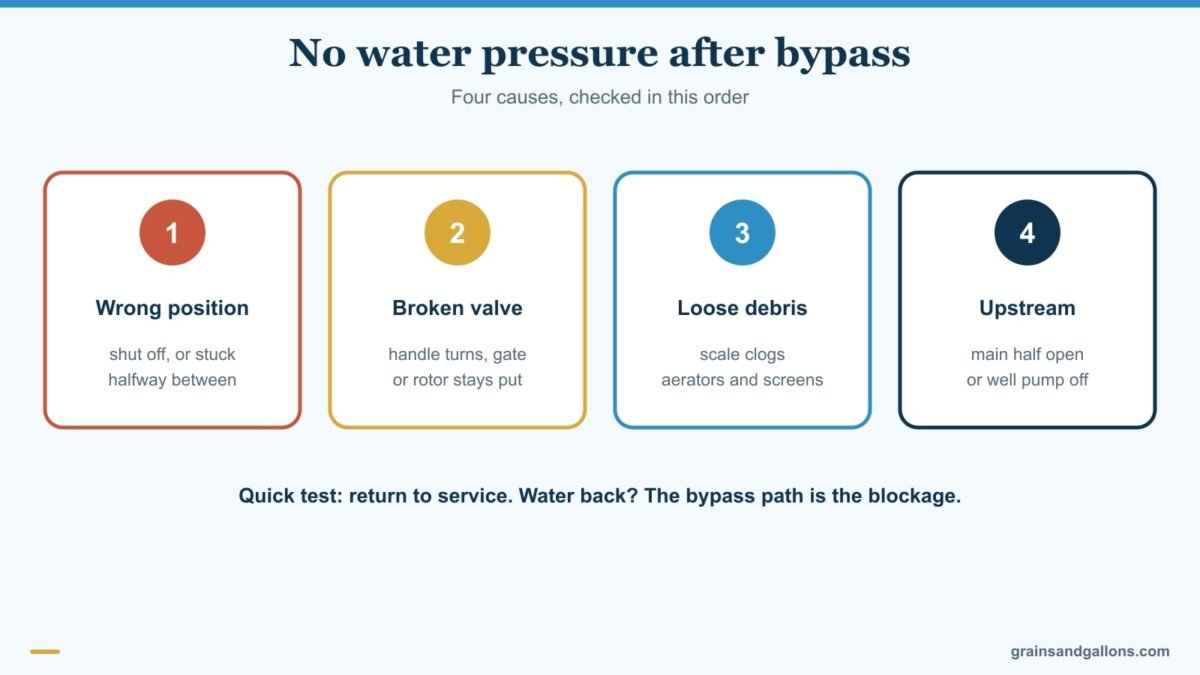
Quick Answer: No water pressure after bypass usually means the valve isn't really in bypass. It may be in a position that shuts water off, or stuck partway. On a Clack two-handle bypass, both handles point toward the center for bypass. Inlet-to-center with outlet-with-flow is the shut-off position. On a three-valve loop, the inlet and outlet valves should be closed and the middle valve open. If the handles look right and there's still no water, an old gate valve may have a broken stem, or loosened debris may be clogging your aerators.
Bypass is supposed to be the safe position. You flip it to add salt or work on the softener, and water should go straight to the house as if the softener weren't there. So when every tap goes weak or dead the moment you bypass, it feels backwards.
This guide covers no water pressure after bypass in the order the causes usually turn up. The first checks take less than five minutes. One test helps throughout: put the softener back in service. If water comes back, the bypass path is the blockage. If service is dead too, look upstream.
If your problem started right after a new install, see no water after installing a water softener instead.
In this guide
- Is the Clack-style bypass in shut off instead of bypass?
- Single-handle and three-valve loops: what bypass should look like
- A handle that turns but a valve that doesn't move
- Debris knocked loose into aerators and screens
- Check the main, the well and the bypass path itself
- FAQ
- No water pressure after bypass is a valve problem until proven otherwise
Is the Clack-style bypass in shut off instead of bypass?

Two-handle bypasses, like the one on Clack WS1 valves, have four positions, not two. Clack's WS1 service manual describes them:
- Normal operation: both handles point in the direction of the arrows engraved on the control valve.
- Bypass: both handles point to the center of the bypass valve. The softener is isolated and untreated water goes to the house.
- Diagnostic: the inlet handle points with the flow and the outlet handle points to the center. The valve stays pressurized, but no water leaves it to the house.
- Shut off: the inlet handle points to the center and the outlet handle points with the flow. Water is shut off to the plumbing.
If you turned only one handle, or turned the wrong one, you may be in diagnostic or shut off. Turn both handles to the center and try again. Clack also notes that the handles pull off, so they can be reinstalled backwards. If the arrows don't make sense, check the handle orientation against the engraved arrows on the valve.
Single-handle and three-valve loops: what bypass should look like

Single-handle, knob or push-pull bypasses are common on cabinet softeners. They have markings molded into the knob or body. Pushed or turned only partway, they sit between ports and choke the flow. Move yours fully to the bypass stop.
Three-valve loops use separate shutoffs. Bypass means the inlet valve closed, the outlet valve closed and the middle bypass valve open. The middle valve is the one that connects the incoming pipe straight to the outgoing pipe without passing through the softener. The usual mistake is closing the inlet and outlet but forgetting to open the middle valve.
The order matters too. Pentair's 5600SXT manual tells you to open the valve in the bypass line first, then close the valves at the softener's inlet and outlet. Done in that order, the house never loses water.
A handle that turns but a valve that doesn't move

If the handles look right but nothing changes, the valve itself may be stuck or broken.
- Plastic bypass valves can seize from scale or dried O-rings. The handle might move a little and stop. If it spins freely, something inside has probably broken. Clack's manual says to depressurize the system, then turn the handles toward the center and back several times to make sure the rotors turn freely. Our guide to a stuck water softener bypass valve shows how to free one without cracking it.
- Old gate valves in a three-valve loop are a known trap. The stem can separate from the gate inside, so the handle turns but the gate stays shut, or drops shut and stays there. If the middle valve on an old loop is a gate valve nobody has touched in years, suspect it first.
The service test settles it. If water returns when you open the softener's own inlet and outlet again, the bypass valve or the loop valve is blocking the bypass path.
Debris knocked loose into aerators and screens
Turning valves that haven't moved in years can knock scale and sediment loose, especially in galvanized or older copper plumbing. That debris travels with the water. It clogs faucet aerators, showerheads, and the inlet screens on washing machine and dishwasher hoses.
The clue is uneven pressure. It's fine at an outdoor spigot or the laundry tub, but weak at bathroom faucets. Unscrew an aerator and look. If it's packed with grit, clean all of them, plus the appliance inlet screens.
Check the main, the well and the bypass path itself
If you closed the main to work on the softener, make sure it's fully open again. A gate valve or old multi-turn valve left half open will choke the whole house. On a private well, check that the pump breaker is on and look at the pressure tank gauge. If it reads low or zero, the problem is the well, not the bypass.
Sometimes there's water, but it's weak in bypass and normal in service. Then the bypass path itself is the restriction. That's rare, but it does happen:
- A partly closed or failing middle valve on a three-valve loop
- A bypass that only opens partway because the handle binds
- Undersized fittings or tubing used to plumb the loop
Compare pressure at a spigot with a gauge, in service and then in bypass. If service is clearly better, the bypass path is the problem. If both are weak, the issue is upstream or elsewhere. Our guide to low water pressure after a water softener covers what else to check.
FAQ
Why do I have no water when my softener is in bypass?
Usually the bypass isn't fully in the bypass position. On a two-handle Clack bypass, turning only the inlet handle to the center puts it in shut off. On a three-valve loop, the middle valve may still be closed. Less often, a broken valve or a closed main is to blame.
Which way should Clack bypass handles point for bypass?
Both handles point toward the center of the bypass valve. In normal operation, both point in the direction of the flow arrows engraved on the control valve.
Can a bypass valve break inside?
Yes. Plastic bypass rotors can crack or seize, and old gate valves can lose the connection between the stem and the gate. In both cases the handle moves but the water path doesn't change. Replace the failed valve.
Why is pressure only bad at some faucets after I used the bypass?
Debris loosened by turning old valves usually lodges in faucet aerators and appliance screens. If pressure is normal at a spigot but weak at sinks and showers, clean the aerators.
Should I replace an old gate valve in my bypass loop?
If it has failed or is stiff, yes. A quarter-turn ball valve is the usual replacement, because you can see at a glance whether it's open or closed. It means cutting into the plumbing, so hire a plumber unless you're comfortable soldering or using push-fit fittings.
No water pressure after bypass is a valve problem until proven otherwise
In almost every case, no water pressure after bypass comes down to the bypass valve or the loop around it. It's in the wrong position, stuck, or broken. Line up the handles, check the middle valve on a three-valve loop, then use the service test to confirm the bypass path is the blockage. Clean the aerators if you knocked debris loose, and check the main and well before blaming the softener.
If the bypass is cracked or its rotors are broken, match a replacement to your valve family. Our guide to the best water softener bypass valves covers Fleck, Clack and the common cabinet-softener types. Our walkthrough on how to install a water softener bypass valve shows the swap. If you're rebuilding a three-valve loop with ball valves, the kits in our water softener installation kits roundup include the fittings.