

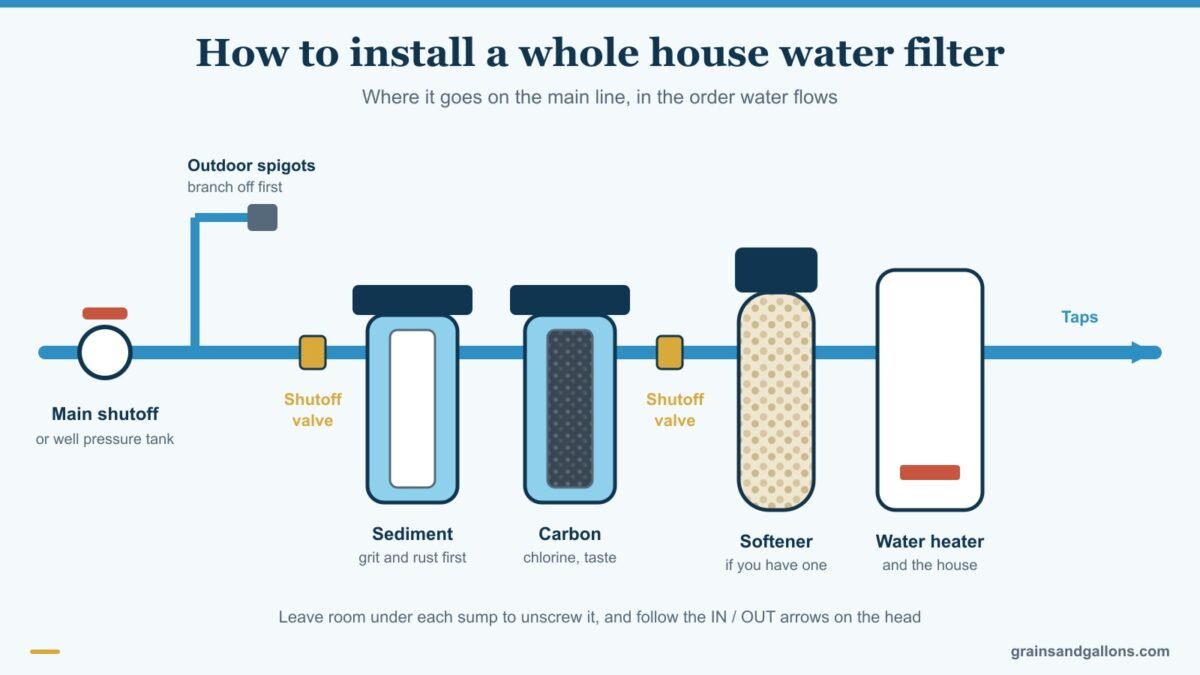
Quick Answer: Here is how to install whole house water filter housings: shut off and drain the main, mount the bracket to solid backing just after the main shutoff (or well pressure tank), cut the line, and connect the supply to the IN port and the house to the OUT port. Add a ball valve on each side or a three-valve bypass, bond across the housing if the pipes are metal, then pressurize slowly and flush new carbon until the water runs clear.
If you're working out how to install whole house water filter systems yourself, most of the risk is in the planning, not the plumbing. Housings end up where the sump can't be unscrewed, behind the water heater, or after the softener they should be protecting. Pick the spot carefully and the rest is an afternoon cut-in job.
In this guide
- Plumbing order: what comes before and after the filter
- Pick a spot with sump clearance and solid backing
- Tools and fittings to gather first
- How to install whole house water filter housings, step by step
- Add a three-valve bypass so cartridge changes take minutes
- Bleed the air, flush the carbon, then watch it for a week
- Plan the spot first and the plumbing is the easy part
- FAQ
Plumbing order: what comes before and after the filter
A whole house filter is a point of entry filter, so it goes on the main line before the first branch you want treated:
- Main shutoff (city water) or pressure tank (well)
- Pressure regulator, if you have one
- Sediment stage, if your water carries grit
- Carbon or multi-stage cartridge filter
- Water softener, if you have one
- Water heater and the house
Carbon before the softener is the usual choice on chlorinated city water, because chlorine is hard on resin. Iron and specialty media can change the order; see filter before or after a water softener and why a sediment prefilter before a softener helps.
Leave outdoor spigots on a branch before it: the Minnesota Department of Health notes this extends carbon life.
Pick a spot with sump clearance and solid backing
- Room below the housing to unscrew the sump, lift it off the cartridge and fit a bucket. A few inches is the bare minimum.
- Studs or a plywood backer. A housing full of water is heavy; never hang it from drywall alone.
- A horizontal run of pipe, which makes the cut-in far simpler.
- Out of sunlight and above freezing. Clear sumps can grow algae. Pentair's Big Blue technical sheet warns to protect housings from freezing and lists port sizes, so you buy the right adapters.
- Somewhere visible. Hidden filters don't get changed.
Tools and fittings to gather first
- Housing(s), cartridges, bracket and screws
- Two full-port ball valves (three plus two tees for a bypass loop)
- Pipe and fittings to match your house (copper, PEX or CPVC) and adapters to the port size
- Thread tape rated for potable water, silicone grease for the O-ring
- Pipe cutter, deburring tool, two wrenches, the housing wrench and a bucket
- A bonding jumper with clamps if the pipes are metal
Still choosing hardware? A Big Blue style housing is the DIY standard, while a 3-stage whole house system puts three stages on one bracket.
How to install whole house water filter housings, step by step
1. Shut off and drain
Close the main (on a well, also switch the pump off at the breaker). Open the lowest faucet and one upstairs to drain the lines.
2. Mount the bracket
Mark and screw the bracket into solid backing, hang the housing, and measure from its ports to the pipe so you know where to cut.
3. Fit the adapters to the head first
Wrap male adapters with three to five turns of thread tape, clockwise as you face the thread end, and snug them into the head without cranking: heads are often plastic. Solder copper adapters before they go near a plastic head.
4. Cut the main and connect IN and OUT
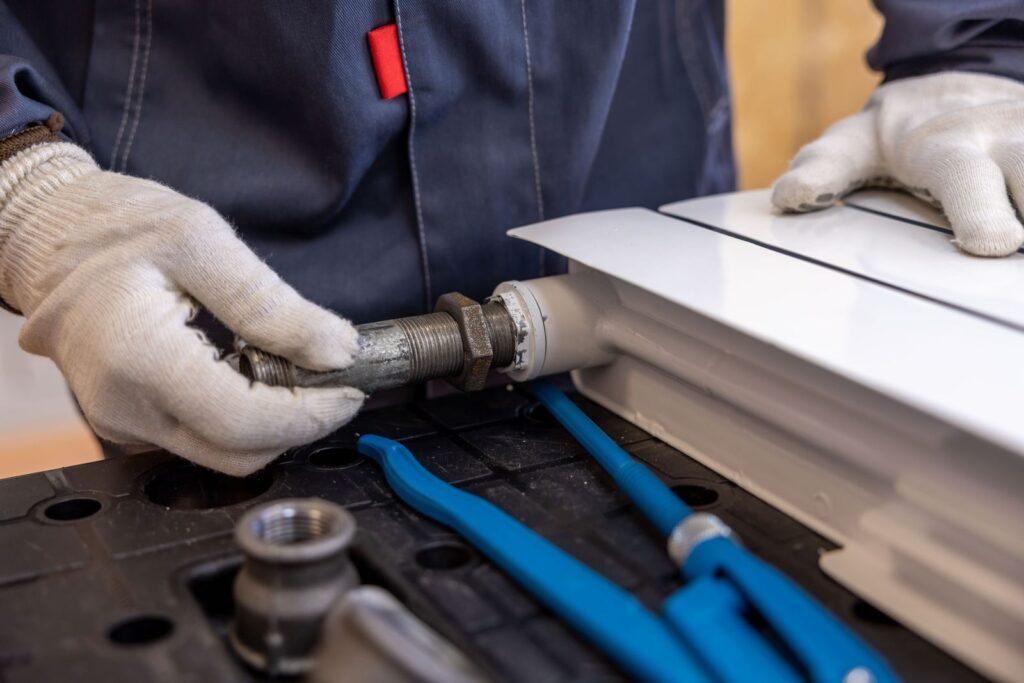
Cut out a section, deburr, and connect the supply to IN and the house to OUT. Backwards flow can collapse some cartridges. Add a ball valve on each side, or the bypass loop below.
5. Bond across the filter
A plastic housing breaks the continuity of metal pipe. If your grounding relies on the water pipe, clamp a bonding jumper from one side of the filter to the other, or ask an electrician.
6. Load the cartridge
Grease and seat the sump O-ring, center the cartridge, and thread the sump on hand-tight.
Add a three-valve bypass so cartridge changes take minutes
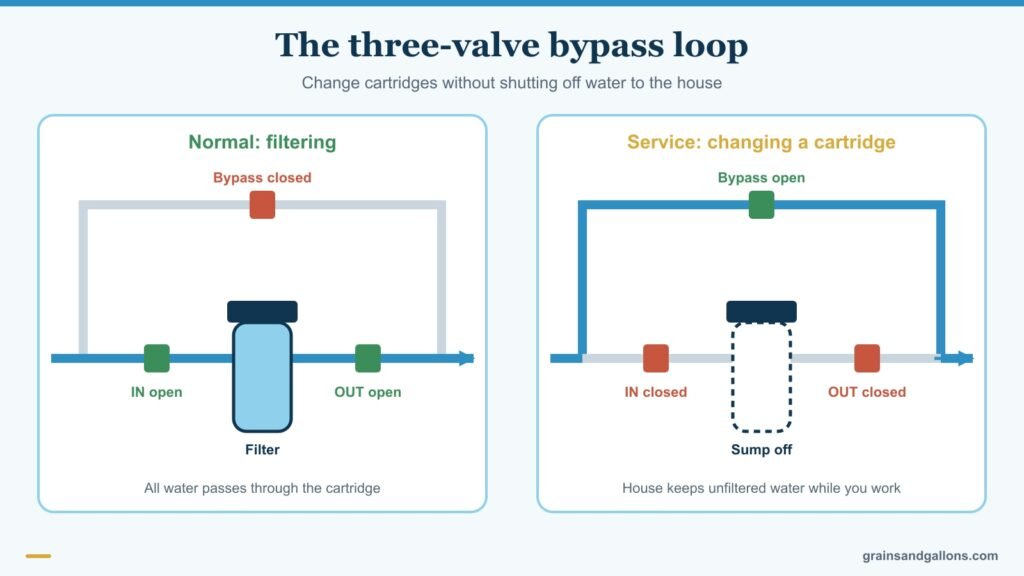
Two shutoffs isolate the housing, but the house is dry while the sump is off. A bypass loop adds two tees and a third valve on a pipe that jumps around the filter. Normally the bypass is closed and IN and OUT are open. To service it, open the bypass and close IN and OUT, and the house keeps water. That water is unfiltered, so close the bypass when you're done.
Bleed the air, flush the carbon, then watch it for a week
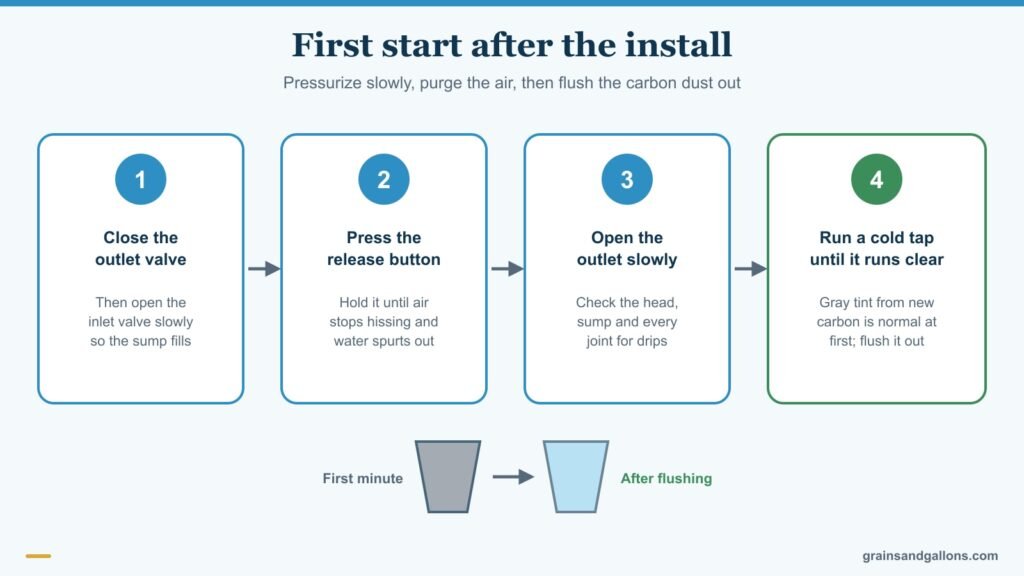
Close the outlet valve, open the inlet slowly, and press the pressure-release button until water spurts. Open the outlet slowly and run a cold tap for several minutes. New carbon sheds harmless black dust at first; if it lasts beyond a day, read black carbon fines after a new filter.
During the first week:
- Drips at the head or sump usually mean a dry or twisted O-ring or a thin tape wrap. See whole house filter housing leaking.
- Weak showers mean the housing is undersized for your flow. See pressure drop after a whole house filter.
- Write the date on the housing. Go by the cartridge maker's rating; the Minnesota Department of Health ties regular replacement to preventing bacterial buildup.
Plan the spot first and the plumbing is the easy part
Knowing how to install whole house water filter housings comes down to three decisions made before you cut: the plumbing order, room to service it, and how you'll isolate it. Add a bypass if you can and flush before drinking. When the first swap comes, changing a whole house filter cartridge takes minutes. To pick a certified system, start with the EPA's home filtration fact sheet.
Call a plumber if the main is corroded galvanized pipe, there's no room under the housing without moving pipe, local code requires a licensed plumber, or the filter must go outdoors.
FAQ
Can I install a whole house water filter myself?
Yes, if you can cut and join your pipe material. PEX and push-fit fittings make it an easy DIY job; soldering copper near a plastic head takes more care.
Where should a whole house water filter be installed?
On the main cold line after the shutoff or pressure tank and any regulator, before the softener and water heater.
Does a whole house filter go before or after a water softener?
Usually before, so sediment and carbon protect the resin from grit and chlorine. Some iron setups differ.
Do I need a bypass valve on a whole house filter?
It's optional but worth it: without one, the house loses water during every cartridge change.
Why is my water gray after installing a new filter?
Carbon fines from a new cartridge. Flush a cold tap until it runs clear.