


Quick Answer: Pink slime in shower grout, door tracks and drains is a bacterial biofilm, usually Serratia marcescens. It drifts in on air and dust and feeds on soap and shampoo residue. It isn't coming out of your pipes. Scrub it off with dish soap and a stiff brush, rinse, apply a bleach solution for 10 to 20 minutes, rinse again and dry the surface. Then run the fan and squeegee after every shower so it can't settle back in.
Pink slime in the shower shows up in the same places every time: a line along the door track, a ring around the drain, a blush in the grout corners and spots under the shampoo bottles. Wipe it off, and in a week or two it's back.
In this guide
What that pink film actually is
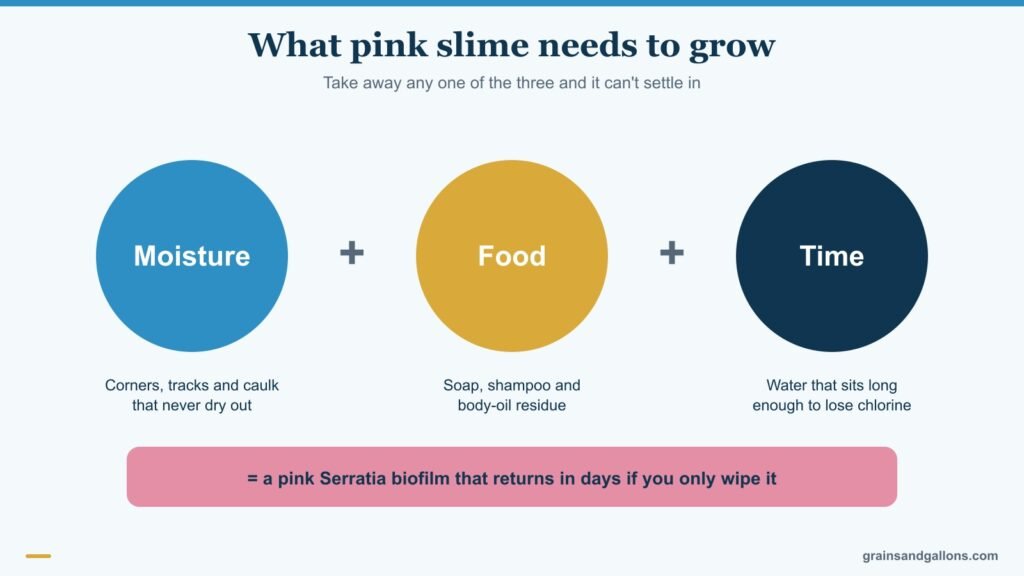
It's a biofilm, a thin layer of bacteria wrapped in the slime they produce. NDSU Extension identifies the usual culprit as Serratia marcescens, a red-pigmented bacterium that grows where phosphorus or fatty residue builds up. In a bathroom, that means soap, shampoo and body oils. People call it "pink mold," but it isn't a mold.
It needs three things:
- Moisture that hangs around. Corners, tracks, caulk and bottle bottoms stay wet longest.
- Food. Soap scum and product residue. Hard water adds to it by leaving more soap film behind.
- Time. Water that sits long enough to lose its residual chlorine.
The same organism makes the pink ring at the toilet waterline.
Why pink slime in shower corners keeps coming back
It's airborne, so a clean shower gets reseeded every day. Gwinnett County's water department says that once established it usually can't be eliminated entirely. The goal is control, not a one-time cure.
A few things make it worse:
- Removing chlorine at the tap. Both NDSU and Gwinnett note that an activated carbon filter, which strips chlorine, can make the problem worse. If the pink appeared after you added a whole-house carbon filter, that's probably why. Keep the filter (see running a carbon filter with a softener) and just clean more often.
- Open windows and remodeling. NDSU sees it more in summer and after construction.
- Scratches. Gwinnett warns that scratched fixtures are more susceptible.
Clean first, then bleach
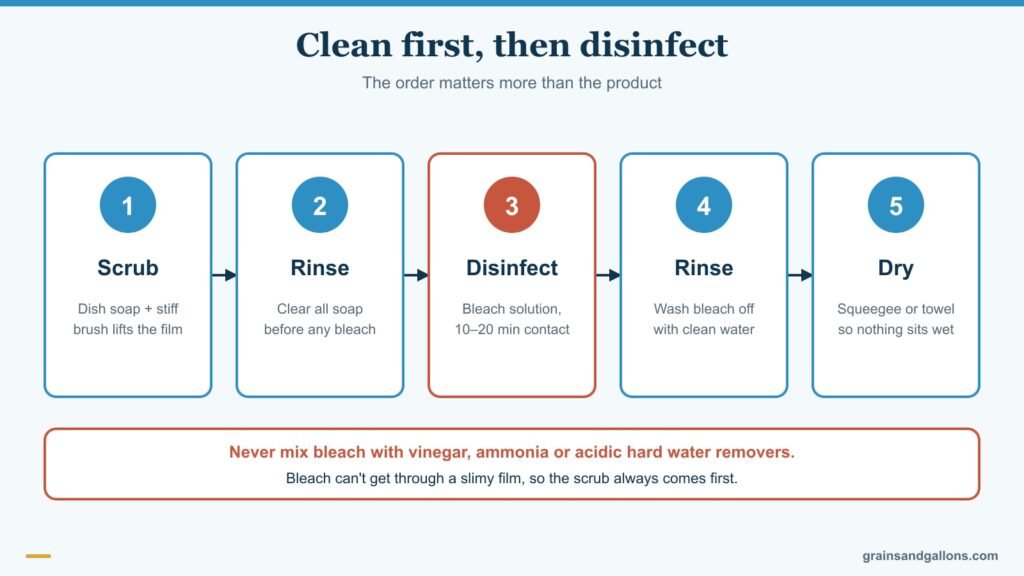
Bleach can't get through a slimy film, so scrub first. Wear gloves and ventilate.
- Scrub with warm water, dish soap and a stiff brush to lift the slime and the soap film it lives on.
- Rinse off all the soap.
- Disinfect with a household bleach solution. A common dilution is about 1/3 cup of regular unscented bleach per gallon of water (4 teaspoons per quart), but check your label. NDSU and Gwinnett both say to leave it on for 10 to 20 minutes.
- Rinse well with clean water.
- Dry with a squeegee or towel.
Never mix bleach with vinegar, ammonia or acidic hard water removers. Rinse any vinegar or mineral cleaner off completely before bleach goes on.
Grout, caulk, glass and curtains each need a different touch
- Tile and grout: a stiff grout brush. Skip bleach on natural stone and use a stone-safe cleaner. If the grout is also crusted with white mineral, a tile and grout cleaner for hard water removes the rough layer the bacteria hide in.
- Caulk: if the pink or black is under the surface, cleaning won't reach it. Cut the caulk out, let the joint dry and re-caulk with mildew-resistant silicone.
- Glass doors and tracks: an old toothbrush for the track. The slime wipes off glass easily; a cloudy film underneath is hard water, covered in removing hard water stains from glass shower doors and our shower door stain removers.
- Fiberglass and acrylic: a soft brush or non-scratch sponge, and check the care sheet before using bleach. Our fiberglass shower wall guide covers what's safe.
- Curtain and liner: machine-wash warm with a few towels to scrub, then hang to dry.
- Drain and bottles: scrub the drain flange under the cover, and wash bottle bottoms, then store them on a rack that drains.
Dry it out between showers

The pink returns when the conditions do, so make the shower dry out fully between uses:
- Run the exhaust fan during the shower and for at least 20 to 30 minutes after.
- Squeegee the walls and glass, which takes about a minute.
- Leave the door or curtain open so air gets in.
- Spray the track and drain once a week, alternating a chlorine cleaner with a non-chlorine one.
- Use less product. Less residue means less food, and soft water needs less soap to lather.
A gray or white toilet ring is more likely a hard water ring, and dark slime inside the tank is a different organism (see black slime in the toilet tank).
FAQ
Is pink slime in the shower dangerous?
For most healthy people it's a cleaning problem, not a health emergency. NDSU notes the bacterium isn't known to be waterborne, but some strains have caused pneumonia, wound and urinary tract infections in hospitals. Take more care if someone in the house has a weakened immune system.
Is pink slime coming from my water supply?
No. It's airborne and grows on wet, soapy surfaces. A carbon filter that removes chlorine can let it grow faster, but the source is still the air.
Does vinegar kill pink mold in the shower?
Vinegar removes soap scum and mineral film, but extension and utility guidance points to chlorine bleach for disinfecting. Never use the two together.
Why is there pink slime in my toilet too?
It's the same Serratia biofilm, feeding on residue at the waterline where water sits between flushes. NDSU suggests ¼ cup of bleach in the tank for 15 to 20 minutes, then flushing several times. Don't leave bleach in longer, since it can damage rubber valves and seals.
Scrub, disinfect, then keep it dry
Pink slime in shower grout and tracks is an airborne bacterium living on soap film, not a problem with your water. Scrub before you bleach, give the bleach 10 to 20 minutes, rinse and dry. After that, a fan, a squeegee and a weekly wipe of the usual spots keep it from coming back.