

Quick Answer: To find the water hardness in my area (or yours), start with your water utility's annual water quality report and search it for "hardness," or call the utility and ask for "total hardness as calcium carbonate." Divide a ppm or mg/L figure by 17.1 to get grains per gallon. On a private well, no one has your number, so test at the tap. A drop-count kit like the Hach 5-EP gives an accurate reading in a few minutes.
Disclosure: As an Amazon Associate, Grains & Gallons earns from qualifying purchases.
Maybe a softener dealer quoted you "around 20 grains" without testing anything. Maybe you just moved and the shower glass is already cloudy. Either way, you want the real number for your address, not a guess for the county. There are three ways to get it, and which one you need depends on whether you're on city water or a private well.
In this guide
- Start with the utility's annual water quality report
- Call the utility and ask the right question
- Convert ppm or mg/L to grains per gallon
- Are zip code lookups and hardness maps accurate?
- On a private well, nobody has your number
- Why the city's number and your test can disagree
- FAQ
- Get the real number before you buy anything
Start with the utility's annual water quality report
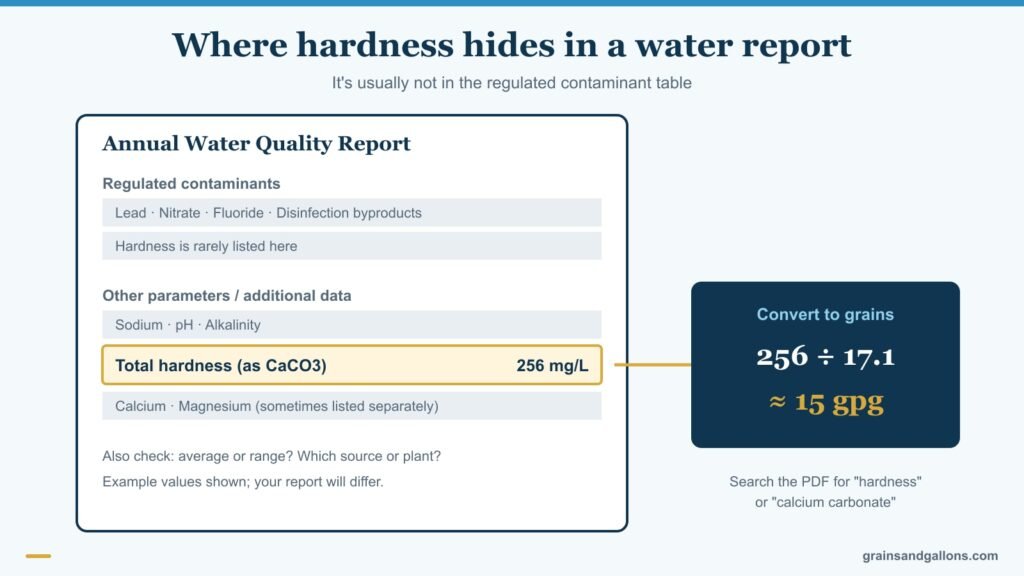
Every community water system has to send customers a Consumer Confidence Report (CCR) each year by July 1. EPA's CCR page for consumers says you can get yours by calling your water supplier or using EPA's online CCR search. Most utilities also post the PDF on their website: search for "[your city] water quality report."
Once you have it, search the file for "hardness" or "calcium carbonate." Hardness usually isn't in the main contaminant table, because it isn't a regulated health contaminant. Look in a section called something like "other parameters," "secondary" or "additional water quality data." Our guide to reading your city's consumer confidence report shows where it tends to hide, and how to read a water hardness report explains the columns.
Note three things next to the number:
- Units: mg/L, ppm or grains per gallon.
- Average or range: a range like 140–290 mg/L tells you hardness swings.
- Source or plant: larger cities may list several, and you need the one that feeds your neighborhood.
Call the utility and ask the right question

If the report doesn't list hardness, or lists several plants, call the number on your bill. Ask something like: "Can you tell me the total hardness for my address, as calcium carbonate, and whether it changes during the year?"
The second half matters. Some cities blend water from wells and surface sources, and hardness can shift between seasons or between pressure zones. A clerk may first give you a label like "moderately hard." Ask for the actual number; a label isn't enough to set or size a softener.
Convert ppm or mg/L to grains per gallon
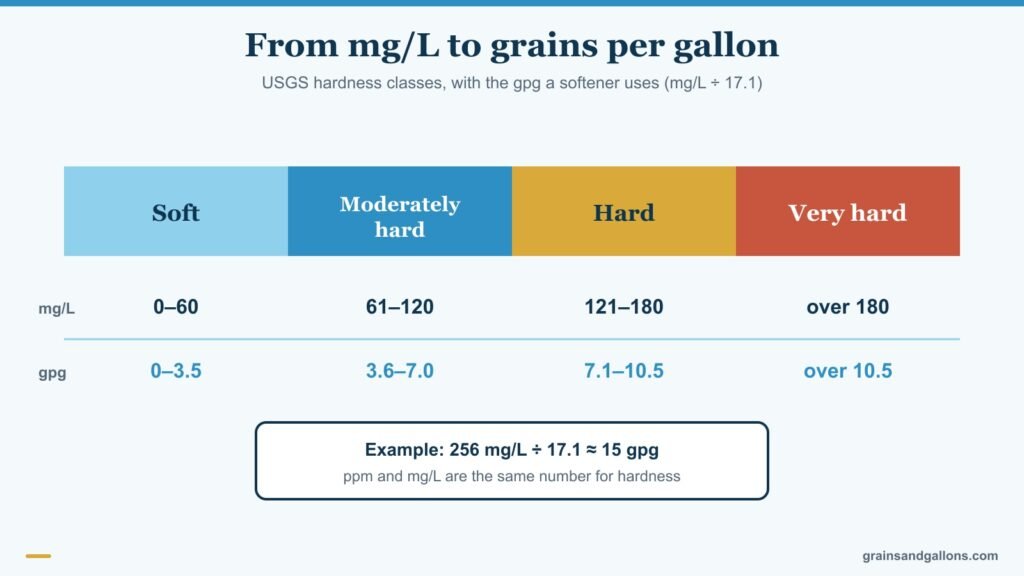
Softeners use grains per gallon (gpg). Reports usually use mg/L or ppm, which are the same number for hardness. The conversion is one step:
| What they give you | What to do with it |
|---|---|
| ppm or mg/L (as CaCO3) | Divide by 17.1 to get gpg |
| Grains per gallon (gpg) | Use as is |
| "Hard" or "very hard" | Ask for the number |
Example: your city says 256 mg/L. 256 ÷ 17.1 = about 15 gpg. That's what you'd enter in a softener's hardness setting, before any adjustment for iron. The U.S. Geological Survey classes water as soft up to 60 mg/L, moderately hard at 61–120, hard at 121–180 and very hard above 180. Our page on water hardness units covers the rarer units, such as German degrees, that show up on appliance manuals.
Are zip code lookups and hardness maps accurate?
They're good for a first guess and poor for sizing equipment. The USGS national hardness map shows why some regions have hard water (limestone and chalk geology, mostly groundwater supplies), but it's broad and built from older sampling. Zip-code lookup tools on seller and data sites pull from utility reports, often averaged across a city.
The trouble is that two neighbors in the same zip code can be on different sources or pressure zones. Use a map or lookup to know what to expect before you move, then confirm with the utility or a test before you buy or program anything.
On a private well, nobody has your number
Private wells aren't covered by CCRs, and hardness can differ between wells on the same road. You have two ways to get a number:
- Test it yourself. Test strips are fast and cheap but read in wide color steps. Drop-count (titration) kits add drops until the sample changes color, and each drop equals a set amount of hardness, so the result is more precise. Our guide on how to test water hardness at home walks through both, and we compare kits in the best water hardness test kits.
- Send it to a lab. A state-certified lab can run hardness alongside iron, manganese, pH and bacteria. EPA keeps a list of state certification programs and certified drinking water labs. If you get a full panel back, see how to read a well water lab report.
Test cold water from a tap that doesn't go through a softener or filter. An outdoor spigot often works, as long as it isn't on the softened line. Test for iron too. Penn State Extension's water softening guide notes that a softener removes dissolved iron, but iron that has been exposed to air or chlorine will clog the resin, so the iron result changes how you size and protect the softener.
Why the city's number and your test can disagree
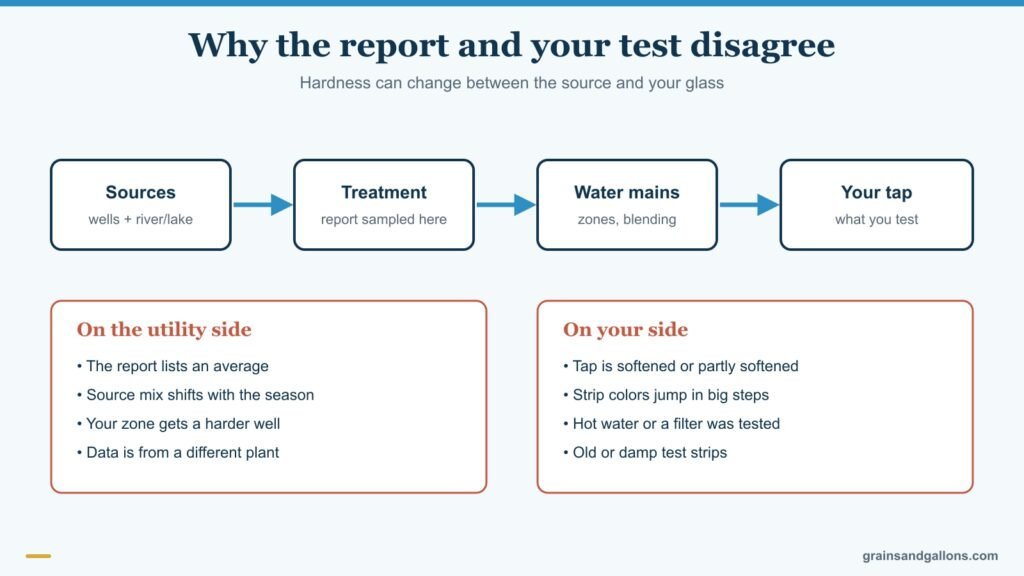
It's common to get one number from the city and another from a strip. The usual reasons:
- The report gave an average, and your zone gets water from a harder source.
- The source mix changed with the season, especially where cities blend wells and surface water.
- You tested a softened or partly softened tap. Kitchen sinks are sometimes plumbed to bypass the softener, sometimes not.
- The strip's color blocks jump from, say, 120 to 250 ppm, and you split the difference.
If two faucets in your own house disagree, our article on why hardness tests differ between faucets explains what that usually points to.
FAQ
How do I check the water hardness in my area for free?
On city water, it's free: download your utility's annual water quality report or call customer service and ask for total hardness as calcium carbonate. EPA's CCR search can also point you to the report. Only private well owners need to pay for strips, a kit or a lab test.
Is a zip code water hardness lookup reliable?
It's a reasonable starting point, but it's usually a citywide average from utility data. Neighbors on different sources or pressure zones can see very different numbers, so confirm with your utility or a home test before setting a softener.
What units will my utility use for hardness?
Usually mg/L or ppm as calcium carbonate, which are the same number for hardness. Some utilities also give grains per gallon. Divide mg/L or ppm by 17.1 to get gpg.
Does water hardness change during the year?
It can. Utilities that blend groundwater with river or lake water often see hardness rise or fall with the season and with which wells are running. Ask your utility whether your number varies, and retest in a different season if a softener setting seems off.
What hardness level means I need a softener?
Many people start noticing scale and soap problems above about 7 gpg, and above about 10 gpg a softener tends to pay off in appliance life and cleaning time. See our breakdown of what hardness level is too hard for the details.
Get the real number before you buy anything
Finding the water hardness in my area, or yours, comes down to one rule: use your utility's report or phone line on city water, and test the tap yourself on a well. Convert to grains per gallon, compare it with the hardness classes above, and only then size or program equipment. If yours is well into the high teens or beyond, our picks for softeners for very hard water focus on units with enough capacity to avoid regenerating every other day.