

Quick Answer: How much electricity does a water softener use? Very little. Many modern electronic softener valves average around 3 watts; Pentair lists "3 watts average" for valves in its Autotrol and Fleck lines. Run that all year and you get about 26 kWh, which is roughly $5 at the current U.S. average power price. Salt and water cost far more than the electricity. To get your own number, plug the adapter into a meter like the P3 Kill A Watt EZ P4460 and read the total kWh after a week.
Disclosure: As an Amazon Associate, Grains & Gallons earns from qualifying purchases.
Three watts is about what a phone charger draws while it trickle-charges. A water softener doesn't heat anything and doesn't pump anything. Your home's water pressure pushes water through the resin tank, and during regeneration that same pressure drives the brine draw and the rinse. The electricity runs a small controller and, a few times a week, a small motor that moves the valve from one cycle position to the next.
In this guide
- What the spec sheets actually say about watts
- Standby draw vs. the regeneration motor
- How much electricity does a water softener use in a year?
- Timer, metered and non-electric units compared
- Measure your own softener with a plug-in watt meter
- Outages, bypass and a motor that won't stop
- Salt and water, not watts, drive the running cost
- FAQ
What the spec sheets actually say about watts
We didn't want to guess, so we pulled manufacturer documents:
- Pentair Autotrol 368 valve: "Power Consumption 3 watts average," running on a 12-volt AC transformer (Pentair spec sheet).
- Pentair Fleck 255 Easy IQ (European spec): "Controller System Power Consumption 3 W average."
- Clack WS1 valve: The service manual lists the plug-in adapter's output (15 VDC at 500 mA) but no average draw. 500 mA at 15 volts is a maximum rating, about 7.5 watts, not what the valve pulls most of the time.
- Fleck SXT valves: Pentair's manual lists the transformer (for example, 120/24V, 40 VA on the 2510SXT) but no wattage. VA on a transformer label is its ceiling, not its average use.
So when you see a big number printed on a power brick, don't multiply it by 8,760 hours. The controller idles at a small fraction of that and only peaks briefly when the motor turns.
Standby draw vs. the regeneration motor
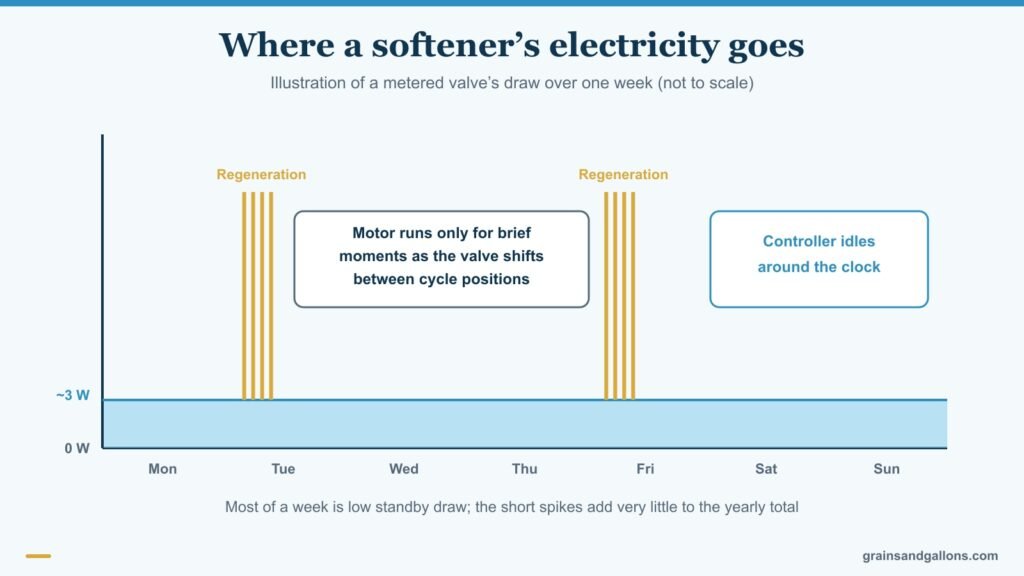
A plugged-in electronic softener has two power states. Most of the time it's in standby: the display, the clock, the controller board and, on metered valves, the sensor that counts gallons. That's the steady draw the spec sheets average out.
Then, a couple of times a week on a typical metered valve, it regenerates. The drive motor turns the piston or cam into backwash, brine draw, rinse and refill positions. Each move takes seconds. Between moves, the valve just sits there while water flows under line pressure, so most of a one- to two-hour regeneration uses no more power than standby.
Some softener retailers quote 30 to 60 watts during regeneration. Even if you take a figure like that at face value and assume it lasted the whole cycle, two regenerations a week would add only a few kWh a year. The standby line is what fills the bill, and it's small. Our explainer on how water softener regeneration works walks through what the valve is doing at each step.
How much electricity does a water softener use in a year?
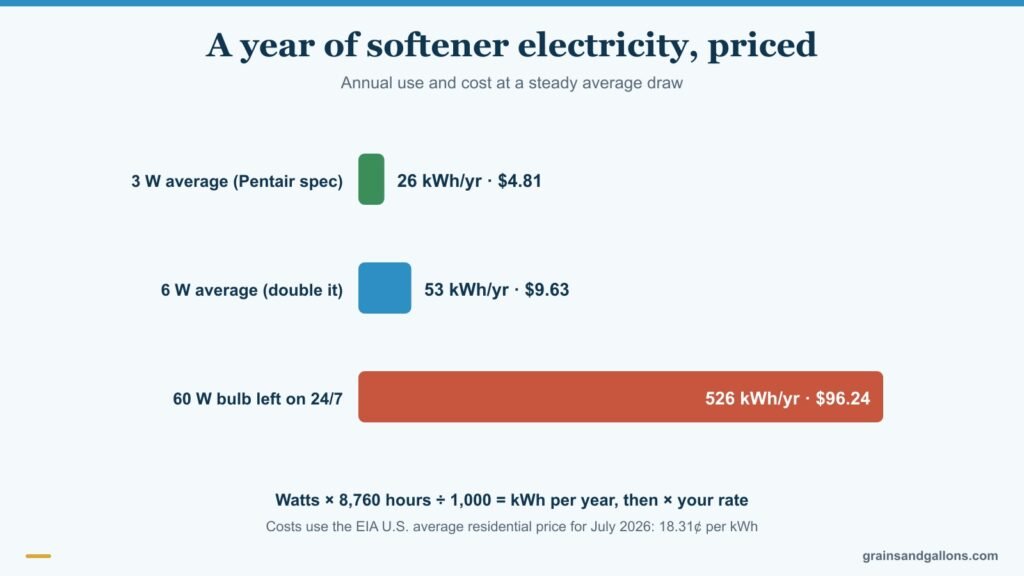
Here's the calculation for a softener averaging 3 watts:
- 3 watts × 24 hours = 72 watt-hours per day
- 72 Wh × 365 days = 26,280 Wh, or about 26 kWh per year
- At the U.S. average residential price of 18.31 cents per kWh for July 2026 (EIA Electric Power Monthly): 26.28 × $0.1831 ≈ $4.81 a year
Rates vary a lot by state, so swap in the per-kWh price from your own bill. Even if your valve averaged double that (6 watts), you'd be around 53 kWh and under $10 a year. A single 60-watt incandescent bulb left on around the clock uses the same 53 kWh in about 37 days.
For scale, the U.S. Energy Information Administration's breakdown of electricity use in homes puts the big loads in space cooling, water heating, space heating and refrigeration. A softener isn't in the same league as any of them.
Timer, metered and non-electric units compared
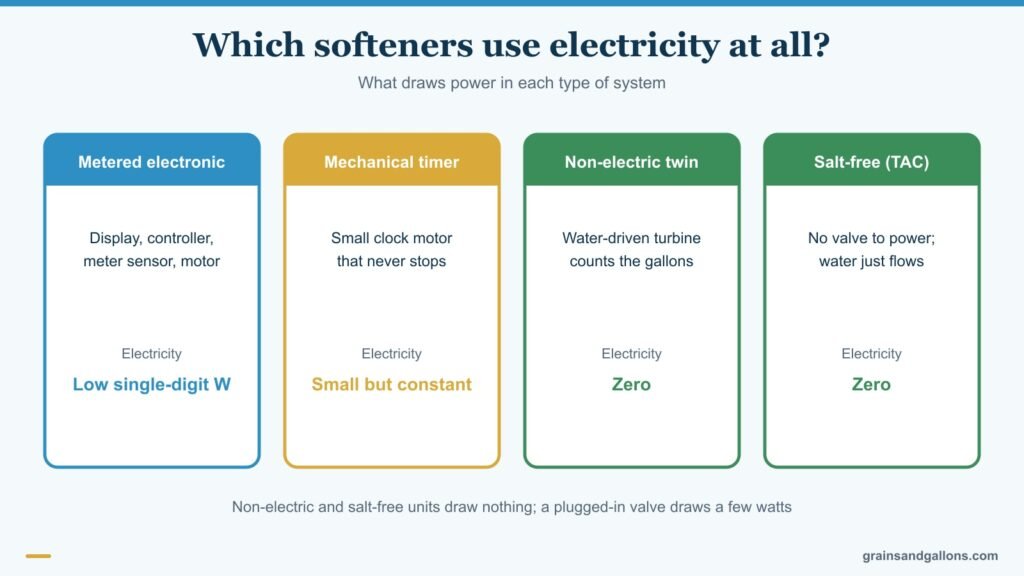
| Type | What uses power | Rough electricity use |
|---|---|---|
| Electronic metered valve (Fleck SXT, Clack WS1, most big-box cabinet units) | Display, controller, water meter sensor, small drive motor | Low single-digit watts on average; check your spec sheet |
| Mechanical timer valve (older clock-dial controls) | A small timer motor that runs all the time | Small but constant; the wattage is usually on the motor label |
| Non-electric twin-tank (water-powered meter) | Nothing; a turbine driven by water flow counts gallons and triggers regeneration | Zero |
| Salt-free conditioner (TAC/NAC media) | Nothing | Zero |
| Electronic "descaler" (wrap-around coil) | Signal generator that runs continuously | Low, but it isn't a softener at all |
Demand-initiated (metered) regeneration doesn't save much electricity compared with a timer, because standby dominates either way. What it saves is salt and water, since the softener only regenerates when it has actually used up its capacity.
If you're off-grid, at a cabin running on solar, or you just want nothing plugged in, water-powered softeners exist and work well. We cover them in the best non-electric water softeners.
Measure your own softener with a plug-in watt meter
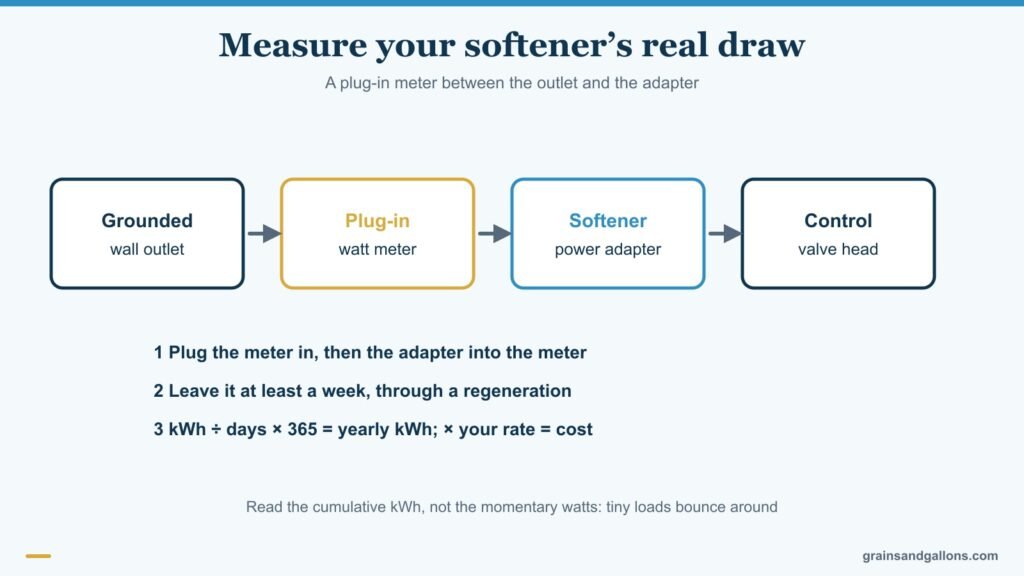
A plug-in watt meter gives you a real number for your house instead of a spec-sheet average.
- Find where the softener plugs in. Most use a small wall adapter. Follow the thin cable from the valve head back to the outlet.
- Plug the meter into the outlet, then the adapter into the meter. If the adapter is bulky, a short extension cord between the meter and adapter helps.
- Leave it for at least a week. A momentary watts reading bounces around and may not register well at very low loads. The cumulative kWh reading over several days, including at least one regeneration, is more useful.
- Divide the kWh by the number of days. Multiply by 365 for a yearly figure, then by your rate.
The softener's clock may reset when you unplug it, so check the time of day afterward. The clock decides when regeneration starts; our guide on what time a softener should regenerate explains why the middle of the night is the usual default.
Use a dry, grounded indoor outlet. Don't run the softener through a light-switch-controlled outlet or a chain of extension cords.
Outages, bypass and a motor that won't stop
A softener uses power in bypass, too. The controller stays on as long as it's plugged in; bypass only stops water flowing through the tanks.
Power outages rarely hurt a softener. Most electronic valves keep their settings in memory, but some lose the time of day, which shifts regeneration into the daytime until you reset the clock. If an outage hits mid-regeneration, the valve typically finishes or returns to service when power comes back; check your manual for your model. A completely dark display after an outage points to the adapter or outlet, which our blank display troubleshooting guide covers.
You also won't notice a softener on your power bill, but you might notice one making noise. If you hear the motor whirring for long stretches, or the display shows the valve stuck in a cycle, that's not normal electricity use. It's usually a stuck piston, a failed position switch, or a cam that can't find its home position, and it can send water to the drain nonstop. See water softener motor running constantly to narrow it down.
Salt and water, not watts, drive the running cost
So how much electricity does a water softener use? About 26 kWh a year for a typical 3-watt valve, or roughly the price of a sandwich. If you want to cut what your softener costs to run, look at salt and water instead. A softener that regenerates too often, uses a heavy salt dose, or runs on a plain timer can burn through extra bags of salt and thousands of extra gallons of water a year.
That's where efficiency settings pay off: metered regeneration, lower salt doses per cubic foot of resin, and proportional brining on valves that support it. If you're shopping, our list of the best high-efficiency water softeners focuses on units built to save salt and water.
FAQ
Does a water softener use a lot of electricity?
No. A typical electronic valve averages a few watts, which works out to roughly 25 to 50 kWh a year. That's less than many small always-on devices and a tiny fraction of what a refrigerator or water heater uses.
How much does it cost to run a water softener per year in electricity?
At 3 watts average and the July 2026 U.S. average price of 18.31 cents per kWh, about $4.81 a year. Multiply 26 kWh by your own rate for a local figure.
Does a water softener use electricity when not regenerating?
Yes. The controller, display and clock stay powered all the time, and that standby draw makes up most of the yearly total. The motor only adds brief spikes during regeneration.
Can a water softener work without electricity?
Some can. Water-powered twin-tank softeners use a turbine to count gallons and trigger regeneration, so they need no outlet. A standard electronic softener stops regenerating during an outage, though water still flows through it.
Should I unplug my water softener to save power?
No. The savings would be a few dollars a year, and an unplugged softener won't regenerate, so hardness breaks through once the resin is spent. Use bypass or vacation mode if you're away for a long time.