


Quick Answer: Hard water baby clothes come out stiff, scratchy and dull because calcium and magnesium tie up detergent and leave a mineral-soap film in the cotton. Use a fragrance-free detergent made for hard water, such as Rockin' Green Hard Rock Unscented, at the label's hard water dose, add an extra rinse, and skip fabric softener. Strip clothes that are already crunchy, and if your baby gets a rash, ask your pediatrician before changing everything at once.
Disclosure: As an Amazon Associate, Grains & Gallons earns from qualifying purchases.
The first load of newborn clothes came out fine. Six weeks in, the sleepers feel scratchy, the white bodysuits have gone a bit gray, and the burp cloths could stand up on their own. You're doing a load a day, sometimes two, and none of it feels clean. Baby laundry shows hard water fast: small, frequent loads of soft cotton, and you notice every bit of stiffness against a baby's skin.
In this guide
- Signs your baby laundry is fighting hard water
- Why hard water baby clothes come out stiff and gray
- Test your water, then set the detergent dose
- A wash routine for hard water baby clothes
- Softening boosters and cloth diapers
- Already stiff? Strip the residue once
- Rashes, eczema and when to call the pediatrician
- FAQ
- Less detergent, more rinse, softer clothes
Signs your baby laundry is fighting hard water

- Bodysuits and sleepers feel stiff or crunchy, especially after line drying.
- Whites and pastels drift toward gray or yellow.
- Burp cloths and towels absorb less than they used to.
- Detergent barely suds, so you keep adding more.
- Your kettle, faucets and shower glass have white scale.
- With cloth diapers: lingering ammonia smell after washing, or a rash that clears up when you switch to disposables.
Two or three of these together point to the water rather than your detergent brand.
Why hard water baby clothes come out stiff and gray
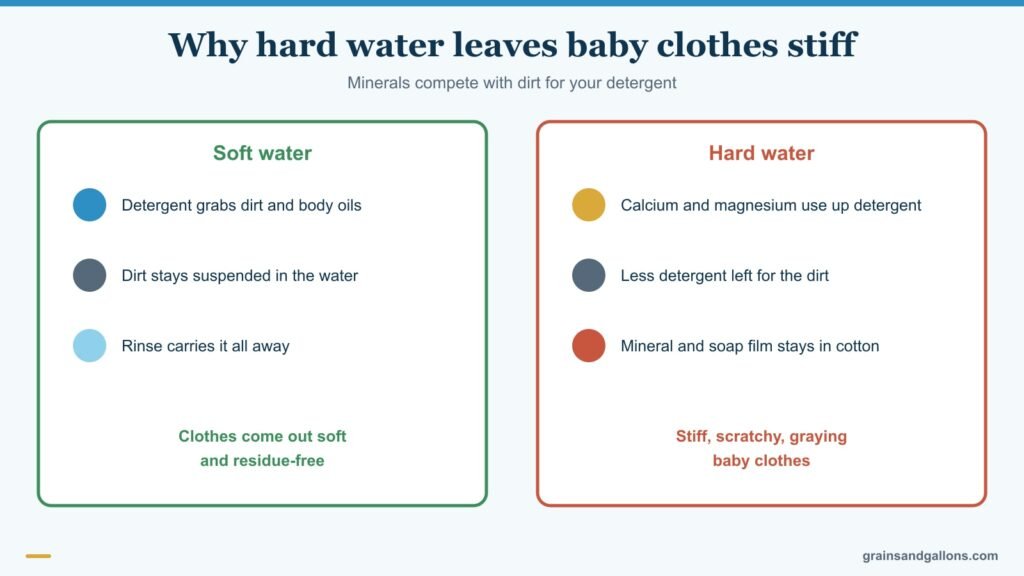
Detergent needs to grab dirt and oils and carry them away in the rinse water. Calcium and magnesium get in the way:
- They use up the detergent. Some cleaning ingredients bind with the minerals instead of dirt, so less is left for the actual cleaning.
- They leave deposits. Minerals combine with soap and residue to form an insoluble film that settles into cotton fibers. That's the stiff, crunchy feel.
- They trap dirt. Over many washes the film holds onto soil, and whites drift toward gray. Our guide to gray, dingy laundry from hard water covers that side in more depth.
The usual response, adding more detergent, can make it worse. More detergent without enough rinsing means more residue left behind.
Test your water, then set the detergent dose
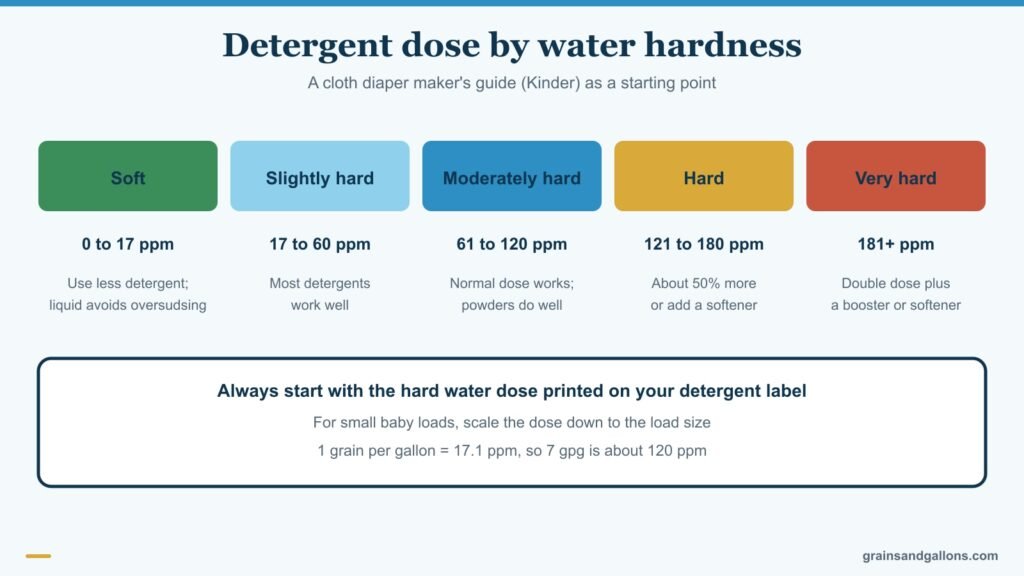
Find your hardness first. Your water utility's annual report lists it, or a test strip gives a number in minutes. Above about 7 grains per gallon (120 ppm), treat your water as hard for laundry.
Then dose for your hardness, not for the cap line. Many labels print a higher dose for hard water; use that, scaled down for small baby loads. Kinder, a cloth diaper maker, suggests about 50% more detergent or an added softener at 121 to 180 ppm, and a double dose plus a booster above 181 ppm. In soft water it's the opposite problem, and our guide to how much detergent to use with soft water explains why less is more.
A wash routine for hard water baby clothes
Each load:
- Wash new clothes before the first wear. The AAP's HealthyChildren.org generally recommends it, since newborn skin is sensitive and you don't know who has handled the items.
- Separate the messy stuff. Diapers, bibs and spit-up cloths with heavy soil go in their own load or get a cold pre-rinse.
- Use a fragrance-free, dye-free detergent made for hard water or one with water-softening builders. Our picks for the best laundry detergents for hard water include several. Nemours KidsHealth notes liquid detergents may be gentler because they rinse out more easily than powders.
- Use warm water for most loads, hot for diapers and heavily soiled items if the care labels allow.
- Don't overload. Clothes need room to move for the rinse to work.
- Turn on extra rinse. For regular baby clothes in hard water, it's the single most useful setting.
- Dry fully. Line drying is fine but makes hard water laundry stiffer; a few minutes in the dryer afterward softens it.
What to leave out
- Fabric softener and dryer sheets. KidsHealth advises avoiding them because their chemicals and fragrances can irritate skin, and they reduce how absorbent towels and diapers are.
- Vinegar as a rinse habit. It can help occasionally, but repeated use can be hard on some washer seals and cloth diaper materials. Check both manuals.
- "Baby" detergent just because it says baby. What matters is fragrance-free, dye-free and suited to your water.
Softening boosters and cloth diapers
Laundry boosters bind calcium and magnesium so the detergent can work. Non-precipitating softeners keep minerals dissolved so they rinse away; precipitating ones such as borax and washing soda turn them into solids that agitation removes. Our guide to laundry water softener additives compares the options.
Cloth diapers need this most. Minerals build up in diaper fibers, trap odor and cut absorbency, and diaper makers commonly suggest starting with about 1/4 cup of borax per load and increasing if needed. Use one booster, not several, keep it in the wash rather than the rinse, and follow your diaper brand's care instructions. Borax is an eye and skin irritant, so store it out of reach.
Already stiff? Strip the residue once

- Wash the load with no detergent on hot (where labels allow) and an extra rinse. If the water turns sudsy, detergent has built up in the fabric.
- Repeat until rinse water runs clear and suds-free.
- Go back to your normal routine with the hard water adjustments above.
Our guide to laundry stiff after washing covers stripping in more detail, including when it helps and when it doesn't.
Rashes, eczema and when to call the pediatrician
Laundry residue can irritate sensitive skin, but rashes in babies have many causes. If a rash doesn't settle, spreads, oozes, or comes with fever or fussiness, call your pediatrician. Don't change detergents, soaps and lotions all at once, because then you can't tell what helped.
If eczema runs in the family, you may have heard hard water plays a role. The research is mixed; we summarize it in hard water and eczema. Softened water isn't an eczema treatment, but reducing irritants is part of good skin care.
FAQ
Can hard water cause a rash from baby clothes?
Indirectly, possibly. Residue left in fabric can irritate sensitive skin, but most baby rashes have other causes. Rinse thoroughly, use fragrance-free detergent and see your pediatrician if a rash persists.
Should I wash baby clothes separately?
It's often recommended, but KidsHealth says washing with family laundry is unlikely to cause irritation unless your baby has allergies, eczema or sensitive skin. Cloth diapers are the exception and should always be washed separately.
Is borax safe for baby clothes?
It's widely used as a laundry booster in hard water, especially for cloth diapers. Use the dose on the box, keep it in the wash cycle, rinse well and store it away from children.
Why are my baby's clothes stiff after line drying?
Mineral and detergent residue stiffens cotton, and air drying lets fibers set without tumbling. A few minutes in the dryer, an extra rinse and a hard water detergent fix most of it.
Will a water softener help baby laundry?
Yes. Softened water lets detergent work properly, so clothes stay softer. Cut your detergent dose sharply after a softener goes in, or you'll get too many suds and new residue.
Less detergent, more rinse, softer clothes
Hard water baby clothes don't need special baby products, just a routine that fights minerals: a fragrance-free hard water detergent at the right dose, room in the drum, an extra rinse and no fabric softener. Strip anything already crunchy once, and if you're fighting scale everywhere else in the house too, a whole-house softener fixes laundry along with everything else.