

Quick Answer: Laundry stiff after washing usually means residue in the fibers: hard-water minerals bound up with detergent, too much detergent that never rinsed out, or fabric softener buildup. Re-wash one load of towels in hot water with no fabric softener, half your usual detergent and a water conditioner such as Calgon Water Softener Powder, plus an extra rinse. Softer towels mean hardness was the problem.
Disclosure: As an Amazon Associate, Grains & Gallons earns from qualifying purchases.
Towels that scrape instead of absorb, jeans that stand up on their own, crunchy T-shirt collars: laundry stiff after washing has a handful of causes, and they feel slightly different. Start with what's in your hands.
In this guide
Match the stiffness to its cause
| What you notice | Most likely cause | First fix |
|---|---|---|
| Rough, colors dull or grayish, towels don't absorb | Hard-water minerals and soap curd | Water conditioner every load, strip-wash the worst |
| Stiff but slightly waxy, towels repel water | Fabric softener or dryer sheet buildup | Stop softener for several washes, hot wash, extra rinse |
| Perfume smell lingers, white streaks on darks | Too much detergent | Cut the dose, add a rinse |
| Stiff only when line-dried | Fibers set as water evaporates | Shake out, tumble 5–10 minutes after |
| Started after a water softener went in | Same detergent dose in soft water | Cut detergent sharply |
Many homes have two at once, usually hard water and too much detergent. The fixes don't conflict.
Why is laundry stiff after washing in hard water?
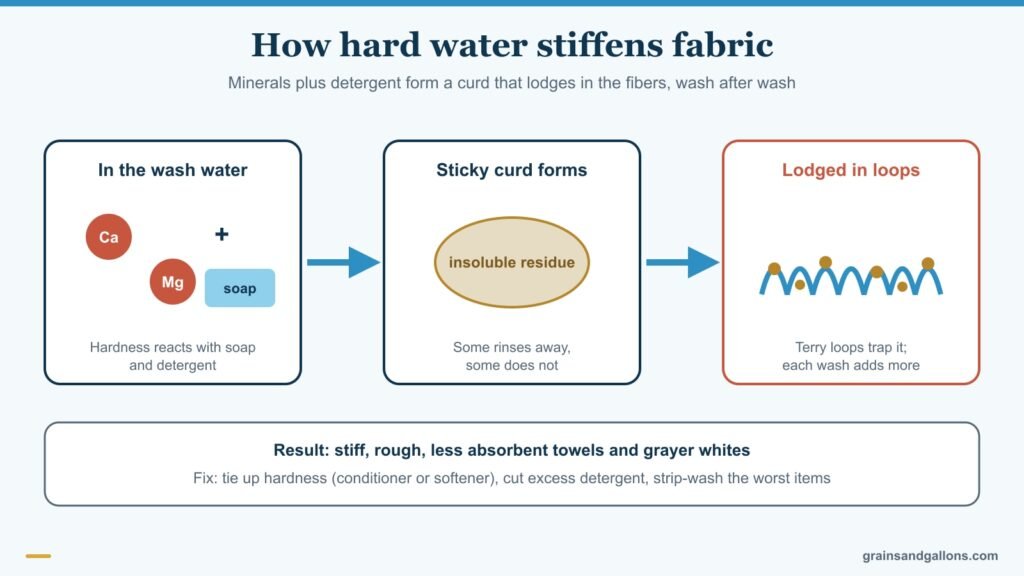
Calcium and magnesium react with soap to form a sticky curd. The University of Nebraska–Lincoln Extension puts it plainly: in hard water, soap curds lodge in fabric during washing and make it stiff and rough, and incomplete soil removal grays whites and dulls colors. Terry loops trap the most, and each wash adds a little. If your whites are also going gray, see dingy, gray laundry from hard water.
What helps, easiest first:
- Add a water conditioner to every load. Calgon or a borax booster ties up hardness before it reacts with detergent. Our picks for the best laundry water softener additives explain how the types differ.
- Use a detergent built for hard water. Formulas with stronger builders cope better; see the best laundry detergents for hard water.
- Wash towels hot if the label allows.
- Soften the water at the source. A whole-house softener ends it for good.
Fabric softener and extra detergent make it worse
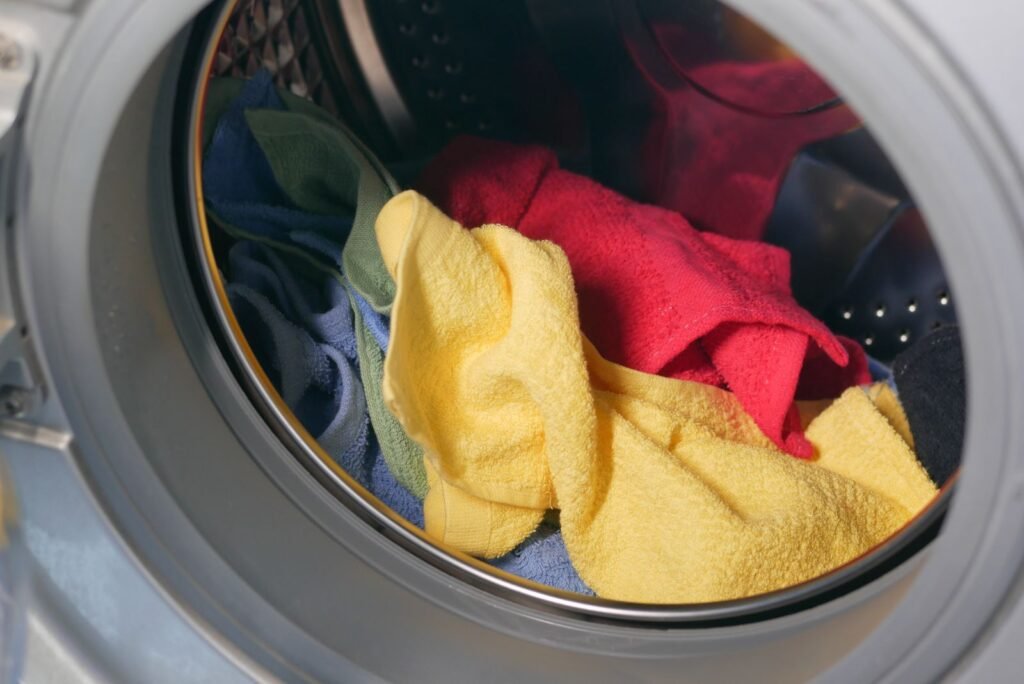
It sounds backward, but liquid fabric softener and dryer sheets coat fibers in a waxy film that traps mineral residue and blocks absorbency. Skip softener on towels for at least three or four washes.
Too much detergent is the other half. Detergent that doesn't rinse out dries into the fabric, and Electrolux's support guide names the wrong detergent amount as the most likely cause of stiff laundry. The same guide flags overloading, especially with towels and jeans, and recommends tumble-drying towels to loosen the fibers.
Quick test: wash a stiff towel with no detergent. Suds in the drum mean leftover detergent in the fabric. Use less and add a second rinse for a few weeks.
Strip-wash towels that won't soften
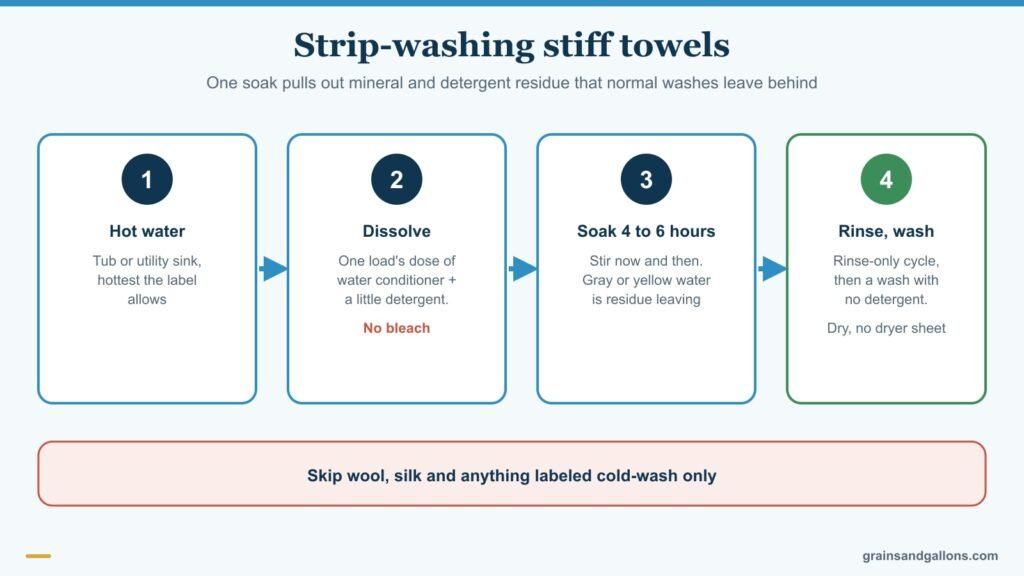
For towels or sheets a normal wash won't fix:
- Fill a tub or utility sink with the hottest water the label allows.
- Dissolve one load's dose of water conditioner and a little detergent. No bleach or other cleaners.
- Soak clean towels four to six hours, stirring now and then. Gray or yellow water is residue coming out.
- Run a rinse-only cycle, then a wash with no detergent. Dry without dryer sheets.
Skip wool, silk and anything labeled cold-wash only. White vinegar in the rinse is a popular alternative, but some washer makers advise against frequent use on rubber seals, so check your manual, and never mix vinegar with bleach.
Line-dried and newly softened laundry
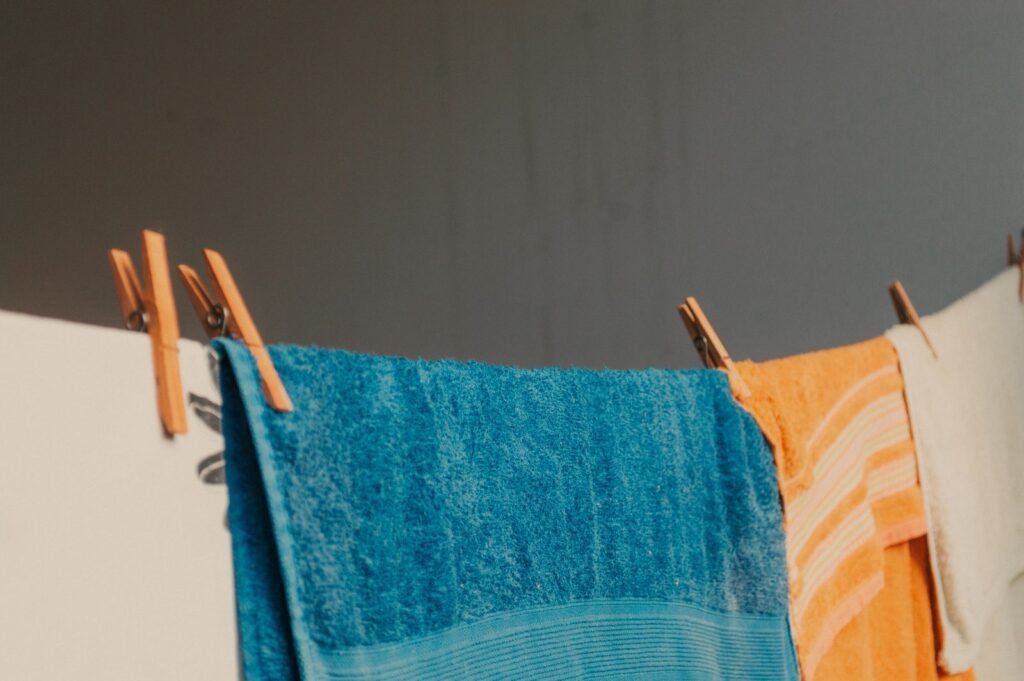
Line-dried clothes are always a bit stiffer, because fibers set in place as water evaporates, and hard water makes it worse. Shake each item before hanging and, if you have a dryer, tumble on low for five to ten minutes afterward.
If stiffness started right after a softener went in, it's almost always detergent. Soft water lets detergent work much harder, so the old dose is now far too much. Our guide on how much detergent to use with soft water has starting amounts, and softened water and washing machines covers other adjustments.
FAQ
Why are my towels stiff after washing even with fabric softener?
Fabric softener is often the cause. It coats fibers with a film that traps mineral residue and blocks absorbency, so towels get stiffer over time. Stop using it for a few washes and use a hot wash with an extra rinse.
Does vinegar soften stiff towels?
It can dissolve some mineral and detergent residue. Add it to the rinse occasionally rather than every load, check your washer's manual about seals, and never combine it with bleach.
How do I know if my water is hard enough to stiffen laundry?
Clues include gray whites, rough towels and scale on faucets. A test strip gives a number; if it's high, a water conditioner in each load or a whole-house softener will help.
Can a water softener make laundry stiff?
Not directly. Stiffness after a softener install is usually too much detergent, since soft water needs far less. Cut the dose and add a rinse for a couple of weeks.
Fix the water and the dose, and towels soften up
Laundry stiff after washing is nearly always residue: minerals, detergent or softener left in the fibers. Tie up hardness, cut the detergent, drop fabric softener on towels, and strip-wash anything that's already cardboard. If hard water keeps winning, softening it at the source fixes laundry along with the rest of the house.