


Quick Answer: Do you need a water softener on city water? Only if your city's water is hard. Treatment makes municipal water safe to drink, but most utilities don't remove hardness, and there's no federal limit on it. Find your hardness in your utility's annual water quality report or test a tap with strips such as WaterWorks Total Hardness Test Strips. Under about 7 grains per gallon, most homes don't need a softener. Above about 10, most do.
Disclosure: As an Amazon Associate, Grains & Gallons earns from qualifying purchases.
Your water comes from the city, it passes every safety test, and yet the shower door is cloudy and the kettle is crusted. That's not a contradiction, and it's why "do you need a water softener on city water" has no blanket answer. The real question isn't "city or well." It's how hard your city's water is, whether that's causing problems you care about, and what equipment you're trying to protect. Three numbers settle it.
In this guide
- Why treated city water can still be hard
- Number 1: your hardness
- Number 2: what it's doing in your house
- Number 3: what you're protecting
- Do you need a water softener on city water at 5 gpg or 12 gpg?
- The chlorine side of city water
- When a softener isn't the right answer
- FAQ
- Let your hardness number make the call
Why treated city water can still be hard

Utilities treat water to make it safe: filtration, disinfection and corrosion control. Hardness is a nuisance, not a health issue, so most cities leave it alone. Calcium and magnesium aren't regulated by the EPA, and a utility can legally deliver 20-grain water. Whether your city's water is hard depends mostly on its source: water drawn from limestone aquifers or mineral-rich rivers tends to be hard, while some surface supplies are naturally soft.
City water does differ from well water in ways that make a softener's job simpler. You rarely deal with iron, manganese or sediment, and pressure is steady. What you do get is a disinfectant residual, chlorine or chloramine, which matters for resin (more below). Some cities also blend several sources, so hardness can shift by neighborhood or season.
Number 1: your hardness

You can get this two ways.
From the utility. Search for your provider's "Consumer Confidence Report" or "water quality report." EPA requires every community water system to send customers one each year, and its CCR information for consumers explains how to find yours. Hardness is often listed under "secondary" or "other" parameters, sometimes only as calcium and magnesium separately. If it's not there, call and ask. Our guide on reading your city's consumer confidence report shows where to look.
From your tap. Test strips give you a number in about a minute; a titration kit counts drops to a color change for more precision. Our guide to the best water hardness test kits compares both styles. Test your own tap even if the report has a number, since a report may give a citywide average or range.
Converting the number you found
Reports usually give hardness in mg/L (same as ppm) "as calcium carbonate." Softeners are set in grains per gallon. Divide mg/L by 17.1 to get gpg. More on units in hardness units: gpg vs ppm.
Penn State Extension's water softening guide uses these classifications and notes that water below about 7 gpg probably won't cause major scaling or soap film:
| mg/L as CaCO₃ | gpg | Category |
|---|---|---|
| Under 17 | Under 1 | Soft |
| 17–60 | 1–3.5 | Slightly hard |
| 60–120 | 3.5–7 | Moderately hard |
| 120–180 | 7–10.5 | Hard |
| Over 180 | Over 10.5 | Very hard |
Number 2: what it's doing in your house

Hardness on paper doesn't tell you whether you'll care. A few questions do:
- Do you see white crust on faucets, showerheads or the dishwasher door?
- Do glasses come out spotted even with rinse aid?
- Does soap feel like it never lathers, or leave a film in the tub?
- Is the kettle or coffee maker scaling up within weeks?
If you're nodding at two or more and your hardness is in the "hard" range or above, a softener will make a visible difference. If you have mild water and none of these bother you, you're probably fine without one. Our guide on what hardness level is too hard helps if you're on the fence.
Number 3: what you're protecting

This is the part people underweight. Scale builds fastest where water gets hot.
- Tankless water heaters are the most sensitive. Manufacturers often specify a maximum hardness in the installation manual and may require descaling on a schedule above it. Check yours, and see softened water and tankless water heaters.
- Tank water heaters collect scale at the bottom, which can make them noisy and less efficient over time.
- Dishwashers, coffee makers and humidifiers all pay a hardness tax too.
If you have a tankless heater and water above roughly 7 gpg, a softener (or at least scale protection) is often worth it even if the cosmetic stuff doesn't bother you.
Do you need a water softener on city water at 5 gpg or 12 gpg?
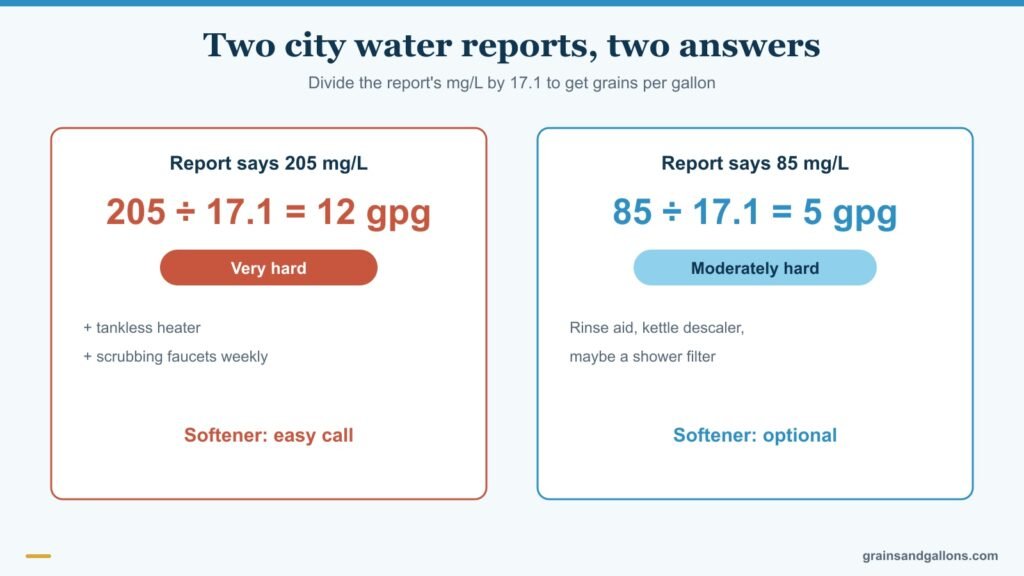
Say your report lists hardness as 205 mg/L. 205 ÷ 17.1 = 12 gpg. That's "very hard." If you also have a tankless heater and you're scrubbing faucets every week, a softener is an easy call.
Now say it's 85 mg/L. That's 5 gpg, moderately hard. Many people in that range skip a whole-house softener and handle it with rinse aid, a descaler for the kettle, and maybe a shower filter for the feel of the water. A softener would still work, but the payoff is smaller.
The chlorine side of city water

City water carries a disinfectant: chlorine or chloramine. That matters in two ways if you add a softener:
- A softener doesn't remove it. If taste or smell bothers you, you need carbon too. Our list of the best whole house water filters for city water covers that side.
- It's slowly hard on resin. Chlorine and, more slowly, chloramine age softener resin. Putting carbon in front of the softener protects it. We explain the chloramine side in how chloramine affects a water softener.
The usual order on city water is carbon filter first, then softener, then the house. If you need both, packaged systems exist; see the best softener systems for hard water with chlorine odor.
When a softener isn't the right answer
- Hardness is low and you're chasing taste. That's a carbon problem, not a hardness problem.
- You rent and can't modify plumbing. Point-of-use options (shower filter, filter pitcher, kettle descaler) are realistic substitutes, though none truly soften the whole house.
- Your town restricts softener discharge. A few areas, mostly in parts of California, regulate self-regenerating softeners. Check before you buy.
- Someone on a strict low-sodium diet drinks from every tap. Penn State Extension puts the added sodium at 7.5 mg per quart for each gpg removed. A bypassed kitchen tap or potassium chloride salt are common workarounds; more in sodium in softened water.
- You only want scale reduction, not soft water. A salt-free conditioner is an option for mild hardness, but it doesn't remove minerals; read does a salt-free system actually soften water first.
FAQ
Is city water usually hard?
It depends entirely on the source. Some cities deliver soft water, others deliver water well above 10 gpg, and utilities aren't required to soften it. Your utility's annual Consumer Confidence Report or a home test kit tells you where yours falls.
Does chlorinated city water damage softener resin?
Slowly, yes. Chlorine oxidizes resin over years, and chloramine does the same more slowly. A carbon filter installed before the softener removes most of it and extends resin life.
Will a water softener remove chlorine taste from city water?
No. Ion exchange removes calcium and magnesium, not chlorine or chloramine. For taste and smell you need activated carbon, either as a separate whole-house filter or as a combined carbon-and-softener system.
Is a salt-free conditioner better for city water?
Not better, just different. A salt-free conditioner doesn't remove hardness, so you won't get soft-water feel or spot-free glasses. It can reduce scale in mild to moderate hardness without salt or a drain, which suits some homes and renters.
How hard does city water need to be before a softener pays off?
Around 7 gpg is the common threshold where scale and soap film become noticeable; above 10.5 gpg ("very hard") a softener is almost always worth it, especially if you have a tankless water heater.
Let your hardness number make the call
Do you need a water softener on city water? Look up or test your hardness first. Under about 7 gpg with no complaints, skip it. Above 7 gpg with scale, spotty dishes or a tankless heater, a softener earns its keep, and on chlorinated city water it should sit behind a carbon filter.