

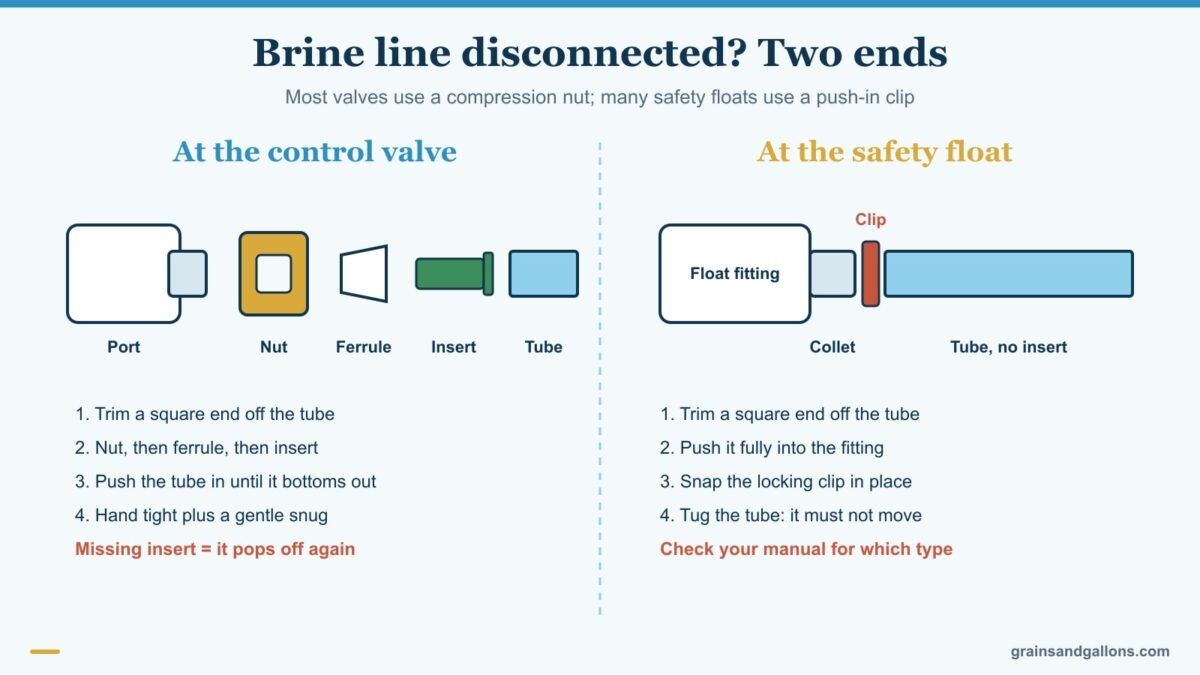
Quick Answer: A brine line disconnected from the softener is a quick fix. Put the softener in bypass and unplug it. Find the nut, the cone-shaped ferrule and the plastic insert, trim a clean square end off the tube, slide on the nut and ferrule, push the insert into the tube, seat it fully and tighten by hand plus a gentle snug. At a push-in safety float fitting, push the tube in fully and snap the locking clip back on. Then run a manual regeneration and watch for drips and a steady brine draw.
You were hauling a bag of salt over the rim of the tank, it brushed the little tube on the back of the valve, and now it's hanging loose. Or you came downstairs to a puddle and found the tube on the floor. A brine line disconnected from the softener is one of the easier repairs, as long as you rebuild the fitting in the right order. Most "it popped off again" stories come from a missing insert or a ragged tube end.
In this guide
Was water spraying, or just air?

Brine lines only carry flow during regeneration. Two moments matter:
- During brine draw, the valve sucks brine up the line. Disconnected, it sucks air instead. No mess, but no brine either.
- During brine refill, many softeners push fresh water down the line into the tank under household pressure. If the line was off then, water may have sprayed from the valve's brine port.
If the floor is wet, shut off the water and unplug the softener first, then dry the area. A slow drip around the base can soak into flooring without much showing. Our guide to a puddle under the brine tank helps track down any leak that isn't from the loose line.
Reconnect it at the control valve
Parts and tools you need
- A sharp utility knife or plastic tube cutter
- A towel and a small bucket
- Possibly a replacement nut, ferrule and insert if the old ones are lost or cracked
- Possibly new tubing if the old line is brittle, kinked or too short to trim. Clack's WS1 service manual specifies 3/8" or 1/2" OD poly tube; match what you have.
Your valve manual's parts list names the small pieces. The Fleck 5600SXT service manual, for example, shows the 3/8-inch insert as its own part number. Our roundup of water softener installation kits covers kits that bundle common fittings and tubing.
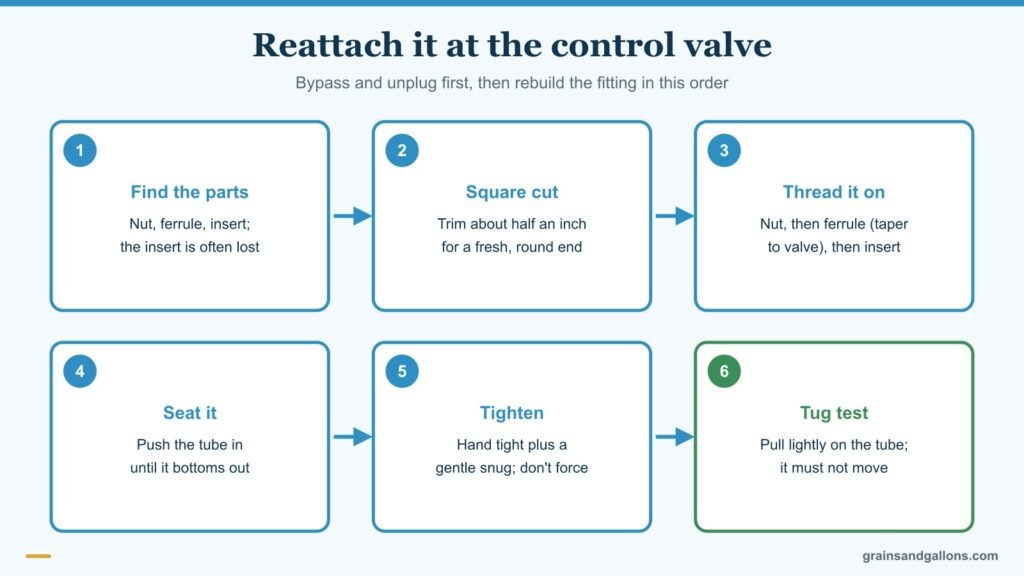
1. Shut it down
Put the softener in bypass and unplug it.
2. Find the parts and see what failed
The fitting at the valve's brine port has three pieces:
- Nut: threads onto the port.
- Ferrule: a small plastic or brass ring with a tapered end that squeezes the tube.
- Insert: a short plastic or brass sleeve inside the tube that keeps it round. U.S. Water Systems ships its brine line with a brass stiffener already installed.
Look on the floor and inside the nut. Often the ferrule is still on the tube and the insert is missing, which is exactly why it slipped: without it, the soft tube collapses under the nut and has nothing to grip.
3. Trim the tube end
Cut off about half an inch so you have fresh, round tube. Make the cut square. An angled or crushed end won't seat, leaks air during brine draw and tends to pop out again.
4. Assemble in the right order
Slide the nut onto the tube first (threads facing the valve), then the ferrule with its taper facing the valve, then push the insert fully into the tube. Getting the order wrong is the most common mistake.
5. Seat and tighten
Push the tube into the port until it bottoms out. Thread the nut on by hand, then snug it gently. Plastic nuts crack if forced. On brass fittings, U.S. Water Systems' installation guide says hand tight plus about half a turn with a wrench, holding the brass fitting with a second wrench so the valve body isn't damaged. Tug the tube lightly; it shouldn't move.
The float end: push-in fittings and locking clips
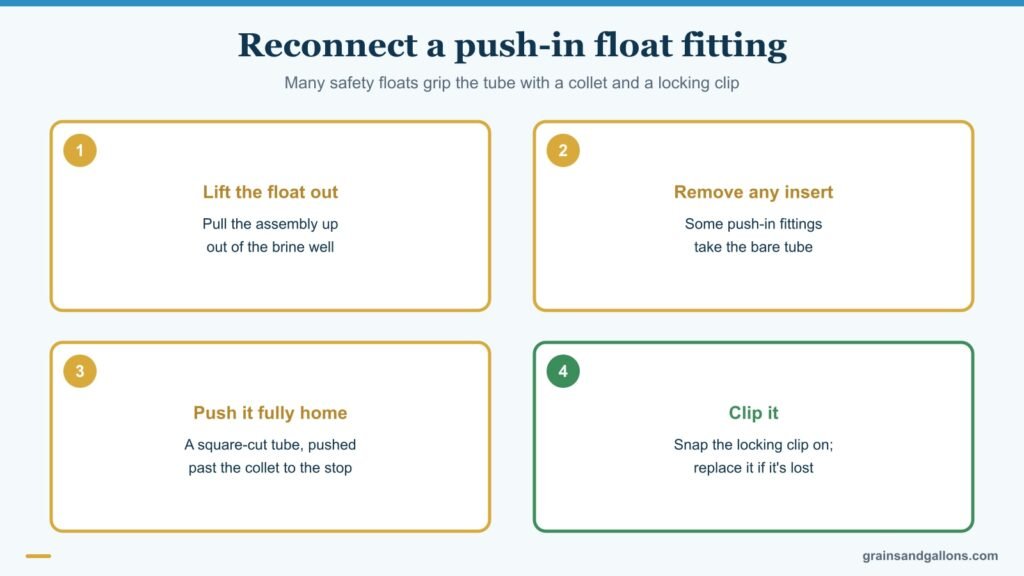
The other end of the line connects to the brine valve or safety float inside the brine well. Lift the assembly out and look at the fitting. Some use the same nut, ferrule and insert, so rebuild them the same way. Others are push-in fittings held by a locking clip. On U.S. Water Systems' float, the brass insert comes out for this connection, the tube is pushed fully into the safety valve, and a red locking clip snaps around the fitting. If the clip is lost, the tube can work loose every time the float moves, so replace it rather than skipping it.
If the float looks cracked or its check ball sticks, now is a good time to swap it. Our roundup of replacement brine tank safety floats covers common fits.
Run a test regeneration
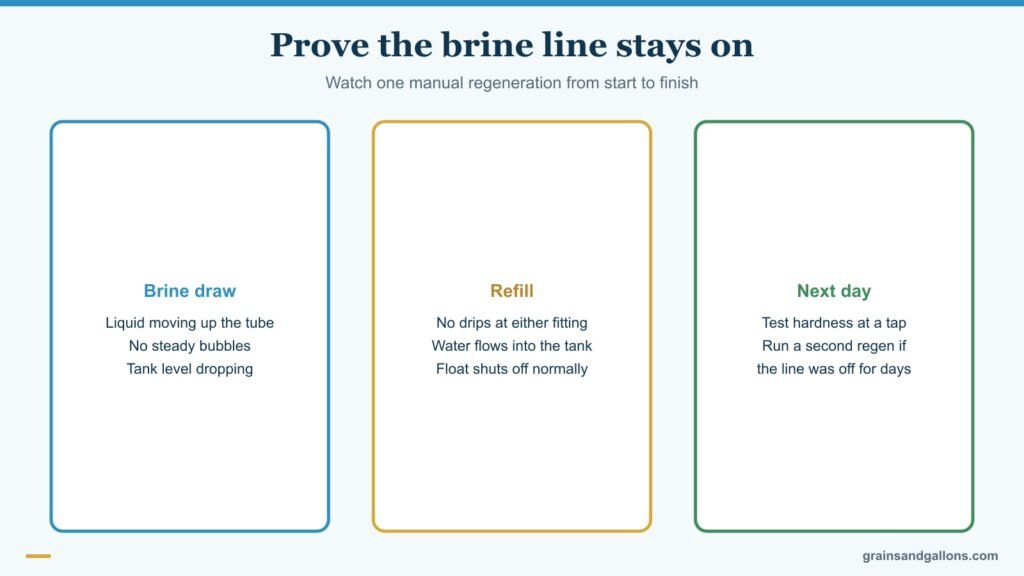
- Take the softener out of bypass and plug it in.
- Reset the clock if the display lost the time.
- Start a manual regeneration. Our guide to manually regenerating a softener covers the common buttons.
- During brine draw, watch the tube near the valve: liquid moving, no steady stream of bubbles. Steady bubbles mean the fitting still leaks air; see air leak in the brine line.
- During refill, check both fittings for drips.
If the line was off for days, the resin is likely exhausted, so run a second regeneration a few hours later. The brine tank may also have overfilled, since each refill added water and nothing was drawn. The next proper draw should bring it down; if it's near the overflow, see our guide to a brine tank full of water.
Why it came loose, and how to keep it on
- No slack. A line pulled tight between valve and tank pops loose when the tank shifts or gets bumped while adding salt. Leave a gentle loop.
- Bad routing. Keep the line away from where you pour salt.
- Brittle tubing. If it feels stiff or shows white stress marks, replace it.
- A missing insert or clip. Both are cheap; without them the fitting will let go again.
FAQ
Is it safe to run a water softener with the brine line disconnected?
Not for long. Without the line, the softener can't draw brine, so the resin stops softening within days, and a refill step can spray water from the brine port. Put it in bypass until you reconnect it.
Why does my brine line keep popping off?
Usually the insert is missing, the tube end is angled or crushed, or the line is pulled tight. Recut the tube, fit a new insert and leave some slack.
Do I need a new insert when I reconnect the brine line?
Only if the old one is lost, cracked or stuck inside a section you cut off. A reused insert is fine if it's intact and fits snugly inside the tube.
Can I use any tubing to replace a brine line?
Use poly tubing with the same outside diameter as the fitting, typically 3/8" or 1/2" on residential valves. The wrong size won't seal in a compression or push-in fitting.
Should I add Teflon tape to the brine line fitting?
No. The ferrule or push-in collet makes the seal on the tube, not the threads, and tape can stop the nut seating properly.
Rebuild the fitting in order and it stays put
A brine line disconnected from the softener is a quick fix: bypass the unit, trim a square end, rebuild the nut, ferrule and insert (or push-in clip) in the right order, and prove it with a manual regeneration. Leave slack in the line and replace any missing insert or clip, and it won't come off again.