

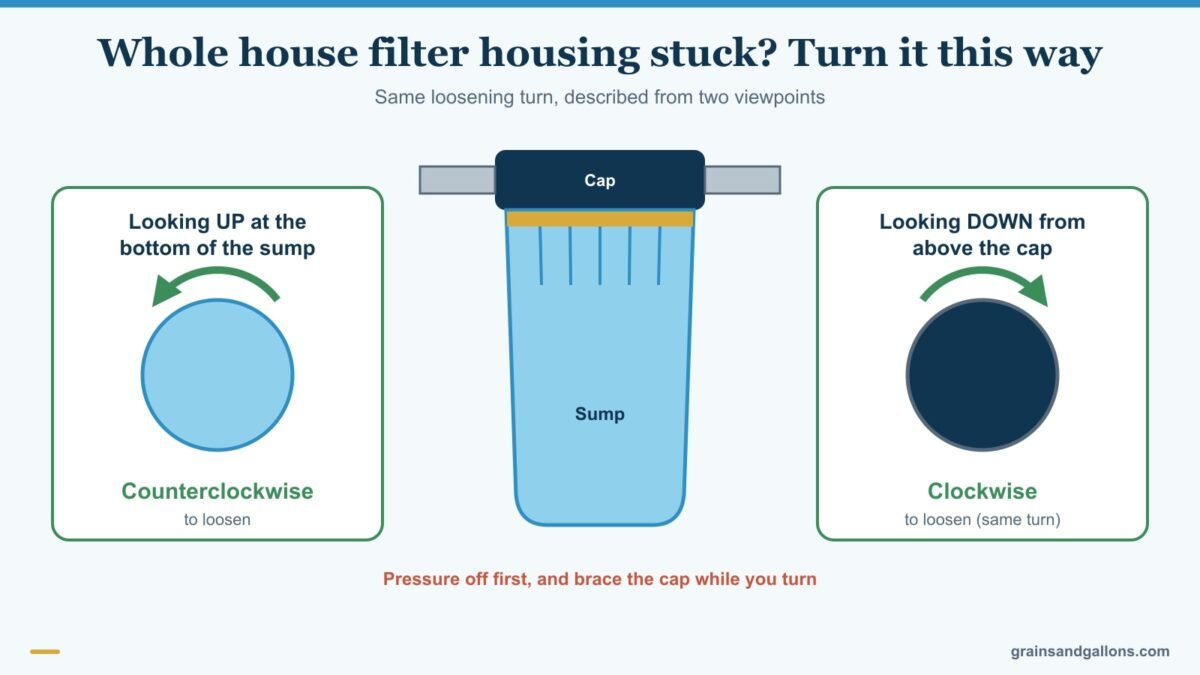
Quick Answer: A whole house filter housing stuck on its cap is usually held by trapped pressure or an overtightened, dried-out O-ring. Close the inlet valve, open a faucet downstream, close the outlet valve and hold the red relief button until it stops hissing. Then use a housing wrench that matches your sump, such as the Culligan SW-1 Housing Wrench for standard 10-inch housings, brace the cap, and turn counterclockwise as you look up at the bottom of the sump.
Disclosure: As an Amazon Associate, Grains & Gallons earns from qualifying purchases.
You're crouched in the basement with a new cartridge in one hand, and the sump won't budge. You've pulled hard enough that the pipes are flexing. Stop for a second: forcing a whole house filter housing stuck this tight is how people crack caps and twist soldered joints. Work through the steps below in order. Most housings come loose once the pressure is fully off and the right wrench is on.
In this guide
Why sumps seize in the first place
Knowing the cause tells you which step will free it:
- Trapped pressure. Water pressure pushes the sump down against its threads and the O-ring up into its groove. Even a little left inside makes the sump much harder to turn.
- Overtightening. Cranking the sump on with the wrench flattens the O-ring and binds the plastic threads. It's the most common reason sumps stick.
- A dry or swollen O-ring. Without a film of silicone grease, the rubber grabs the plastic. Petroleum products can make it swell.
- Time and minerals. A housing left closed for a year or two, especially on hard water, can collect scale and sediment in the threads.
- Cold or heat. Plastic in a cold garage or a hot, sunny spot changes shape slightly and can lock up.
Whole house filter housing stuck? Release the pressure first
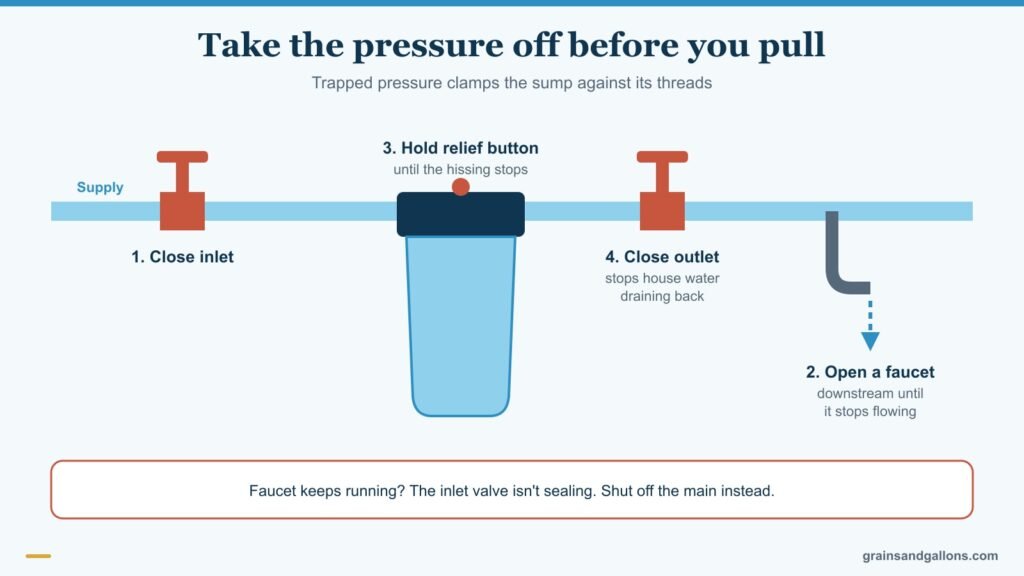
- Close the inlet valve on the supply side of the filter.
- Open a cold faucet downstream (a laundry sink is easiest) until it slows to a trickle and stops.
- Hold the red pressure-relief button on top of the cap until it stops hissing. A few drops will come out.
- Close the outlet valve, if you have one, so water in the house plumbing can't drain back through the housing when the sump comes off. Boshart's cartridge change guide recommends exactly this order: open a faucet near the outlet valve to drop the pressure, then close the outlet valve.
If the faucet keeps running, your inlet valve isn't sealing; shut off the main instead. If your housing has no relief button, draining the downstream faucet gets you most of the way. Put a bucket and towel underneath before going further.
Grip it with the right wrench, turning the right way

The ribs on a sump are made to be gripped by a matching plastic spanner wrench. A pipe wrench, pliers or channel locks will slip, scar or crack the plastic.
- Standard 10-inch housings: an SW-1 style wrench, like the Culligan SW-1.
- Big Blue (4.5-inch) housings: the larger wrench made for that sump. Check the model number on the cap; many ship with one, so look on the shelf near the filter first.
- No matching wrench? A large rubber strap wrench grips almost any sump without crushing it. For a lightly stuck sump, rubber gloves or a dish towel around the ribs may be all you need.
Slide the wrench up as high on the sump as it goes, right under the cap, where the sump is strongest.
Which way? Looking up at the bottom of the sump, turn it counterclockwise to loosen. Boshart's guide gives the same direction: counterclockwise, to the left, viewed from the bottom. Seen from above the cap, that same turn is clockwise, which is why so many people heave the wrong way for five minutes.
Brace the cap so the pipes don't take the force
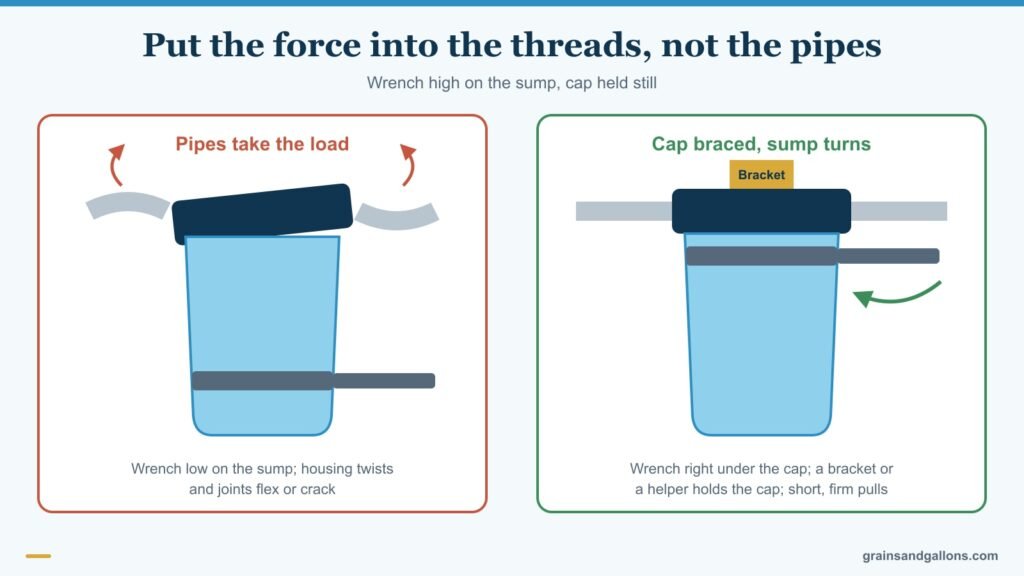
If the whole housing rotates or the pipes flex when you pull, your force is going into the plumbing, not the threads. That's how fittings crack.
- If the cap is screwed to a wall bracket, you're in good shape.
- If it hangs only from the pipes, have a helper grip the cap firmly with both hands while you turn the sump.
- Use short, firm pulls rather than slowly building force. A sharp tug can break a seal that steady pressure won't.
Still stuck? Escalate in this order
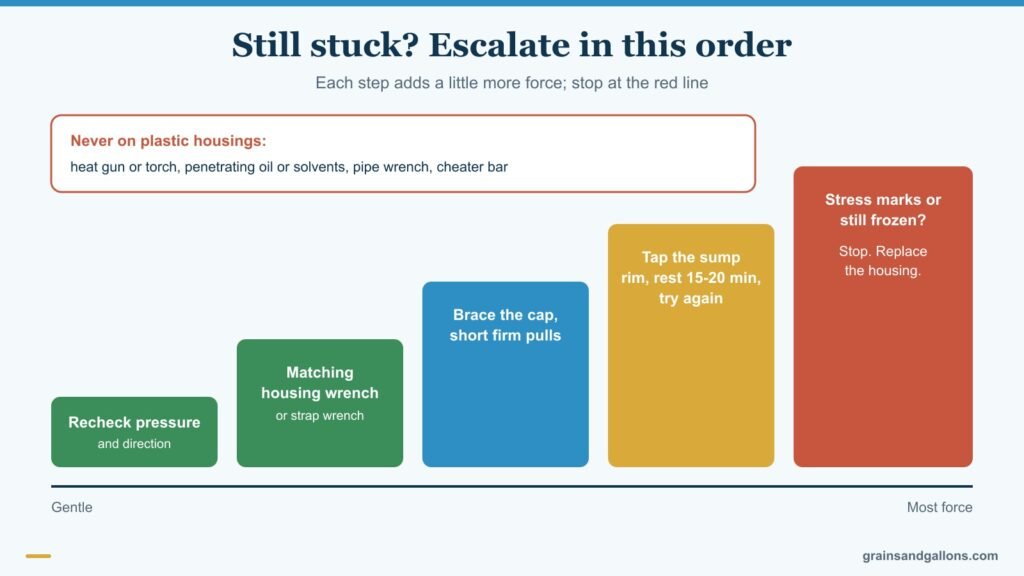
- Recheck the basics. Press the relief button again and confirm you're turning the right way.
- Tap around the top of the sump with a rubber mallet or the wrench handle, then try again. This can break scale in the threads.
- Let it sit unpressurized for 15 to 20 minutes. The O-ring sometimes relaxes a little once the water's been off.
- Don't use a heat gun, torch or penetrating oil. Heat can warp plastic, and solvents and oils can attack both the plastic and the O-ring.
- Don't add a cheater bar to a plastic wrench. The wrench or the sump will snap.
A cartridge stuck inside the sump
Sometimes the sump comes off but the cartridge stays jammed inside it, swollen with sediment. Pour out the water, grip the cartridge's end cap with pliers and twist while pulling straight out. A badly clogged cartridge is also a sign it was overdue; our guide to whole house filter pressure drop explains how to spot that earlier.
When to replace the housing instead
If the sump still won't turn, or you see white stress marks or cracking near the threads, replace the housing. Sumps that were overtightened for years, or that live in a hot garage or a sunny spot, sometimes fuse. Shut the water off, unscrew or cut the housing out, and fit a new one with a bracket and relief button. Our roundup of the best whole house filter housings is a good place to start, and if you want to add stages while the pipes are open, compare our 3-stage whole house filter picks.
Stop it seizing next time
Once it's open:
- Clean the O-ring and groove. Replace the O-ring if it's flat, nicked or stretched.
- Lube the O-ring lightly with silicone grease such as Molykote 111. Pentair's Dura-Series manual says to lubricate the O-ring with clean silicone grease, and that a wrench may be used to install the sump but not to overtighten it. Boshart adds: never a petroleum-based lubricant or jelly.
- Hand-tighten, then stop. Pentair notes the sump is fully installed when it engages against the cap; add at most a small turn with the wrench. The O-ring seals with water pressure, not brute force.
- Change cartridges on schedule. A housing opened every few months rarely seizes; one left for two years usually does. Our guide on when to replace whole house filter cartridges helps you set the interval.
Then turn the water on slowly, press the relief button to bleed air, and check for drips. If it weeps at the seam, see our guide to a leaking filter housing. For the full cartridge swap from start to finish, see how to change a whole house filter.
FAQ
Which way do you turn a whole house filter housing to open it?
Counterclockwise when you look up at the bottom of the sump. Seen from above the cap, that's clockwise. Both describe the same turn.
Why won't my filter housing unscrew even with a wrench?
Usually there's still pressure inside, or the sump was overtightened onto a dry O-ring. Close the inlet, open a faucet, hold the relief button until it stops hissing, then brace the cap and try short, firm pulls with a matching housing wrench.
Can I use WD-40 on a stuck filter housing?
It's best not to. Penetrating oils and solvents can attack the plastic and the rubber O-ring, and they're not something you want near your drinking water. Use pressure release, the right wrench and bracing instead.
Can I use heat to loosen a stuck filter housing?
Avoid heat guns and torches; they can warp or weaken the plastic and make the housing unsafe under pressure. If it won't come loose without heat, replacing the housing is the safer move.
How do I keep the housing from getting stuck again?
Clean and lightly grease the O-ring with silicone, hand-tighten only, and change the cartridge on schedule so the housing gets opened regularly.
Pressure off, cap braced, then a firm turn
A whole house filter housing stuck on its cap almost always comes free once every bit of pressure is out, the matching wrench sits right under the cap, the cap is braced, and you turn counterclockwise from below. If it still won't move or shows stress marks, replace it rather than forcing it, and grease the O-ring and hand-tighten the new one so it opens easily next time.