


Quick Answer: When a water softener stopped softening after resin change, the new resin is rarely the problem. The usual causes are a riser tube that didn't seal into the valve's O-ring (so water skips the resin), no full regeneration after startup, a brine line knocked loose, or the bypass left partly open. Run a manual regeneration, confirm the brine level drops, and test a cold softened tap with an accurate kit like the Hach 5-EP hardness test. Still hard? Pull the valve and check the riser.
Disclosure: As an Amazon Associate, Grains & Gallons earns from qualifying purchases.
You spent a Saturday hauling wet resin out in buckets, poured in a fresh bag, and put the valve back on. The water should be softer than it's been in years. Instead it's as hard as before, or harder.
New resin almost never arrives defective. If your water softener stopped softening after resin change, something in the job itself is off, and since you just did the job, you can retrace it. Start with the checks that need no tools, then work back into the tank.
In this guide
- Water softener stopped softening after resin change? Start at the bypass
- The riser seal is the usual culprit
- Run a full regeneration and prove the brine draw
- Wrong resin, too little, or too much
- Hot taps can stay hard for days
- Retest the raw water before blaming the new bed
- FAQ
- Most rebeds fail at the riser, not the new resin
Water softener stopped softening after resin change? Start at the bypass

It sounds obvious, but after a rebed the bypass is the first suspect. Pentair's Fleck 5600SXT downflow service manual lists "by-pass valve is open" as the first cause of hard water in its troubleshooting table. Make sure the handle is fully in service, not halfway. On a three-valve loop, the middle valve should be closed and both softener-side valves open. A handle that won't turn all the way is covered in water softener bypass valve stuck.
Then check power and settings. Unplugging the softener for hours can reset older timers and some digital valves, and Pentair notes a power failure means resetting the time of day. Confirm:
- Time of day, so regeneration happens when it should
- Hardness in grains per gallon, plus any iron adjustment
- Capacity, if your valve asks for it, matched to the new resin volume
- Regeneration schedule or days override
If you went from 1 cubic foot of resin to 1.5, or the other way, the capacity setting has to change too. How to set hardness on a water softener walks through the numbers. Finally, make sure the display isn't parked mid-cycle or showing an error.
The riser seal is the usual culprit
In a downflow softener, water enters the top of the tank, passes down through the resin, and comes back up the riser (distributor tube) into the center of the valve. An O-ring inside the valve seals that connection. If the riser is too short, off-center, or the O-ring is missing or rolled, raw water flows from the top of the tank straight into the riser and out to your house without touching the resin. The result is water nearly as hard as raw, exactly what the featured diagram above shows. The same Fleck table lists "leak at distributor tube" as a hard-water cause, with the fix: make sure the tube isn't cracked and check the O-ring and tube pilot.
Put the softener in bypass, relieve pressure, and lift the valve off. Then check:
- Height. Did you cut a new riser or reuse the old one? The Fleck manual says to follow the dimensional drawing for cutting height and, if there isn't one, cut the tube flush with the top of the tank. Other valves use a different reference, so check yours.
- Centered. The riser drifts when you pour resin. If it leans, the valve may have threaded on without the riser entering the O-ring.
- O-ring. Present, undamaged, and lubricated with silicone grease? It's small and easy to lose during a rebed.
- Bottom basket. A riser that popped off its basket while you poured lets resin into the outlet, so you'll also see beads in aerators. See water softener riser tube broken and distributor basket broken.
While the valve is off, look at the piston area too. If the old resin was fouled, debris can get into the seals during the teardown. Water running to drain during service, a valve that won't change position, or new noises during regeneration point to valve seals or the piston, a separate repair from the resin.
Run a full regeneration and prove the brine draw
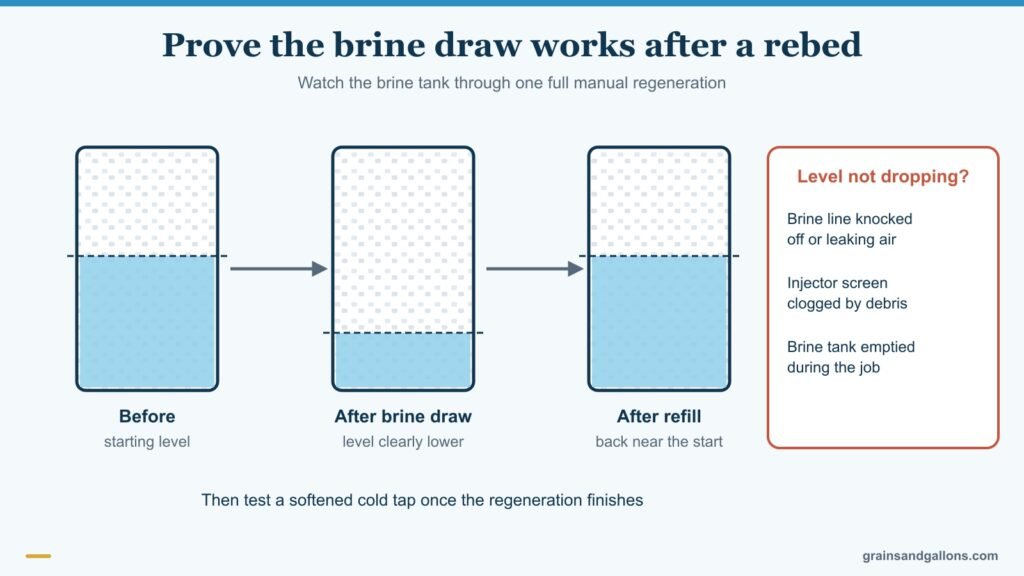
Most softener resin ships ready to work, but after a rebed the bed is loose and full of air, and the brine tank may be dry. Pentair's 5600SXT system manual starts a new system with a manually cycled regeneration: backwash until the drain runs clear, then confirm the unit is actually drawing from the brine tank. Our water softener startup procedure covers the slow fill and air purge in order.
The rebed often disturbs the brine side, too. The brine line gets bumped off its fitting, the brine tank gets emptied, or the injector screen picks up debris. If the softener can't draw brine, the new resin is used up after one cycle and never recharges. The Fleck troubleshooting table lists a plugged injector screen, no salt, and too little water going into the brine tank as hard-water causes.
Watch the brine tank during the brine draw step. The level should drop clearly, then come back up during refill. If it doesn't drop, reseat the brine line connections, make sure there's water and salt in the tank, and clean the injector screen. When the regeneration finishes, test a softened cold tap. Use a drop-count kit that reads in single grains; our roundup of water hardness test kits separates those from strips.
One more check during backwash: if a lot of resin comes out the drain, the drain line flow control may be missing or the tank is overfilled.
Wrong resin, too little, or too much
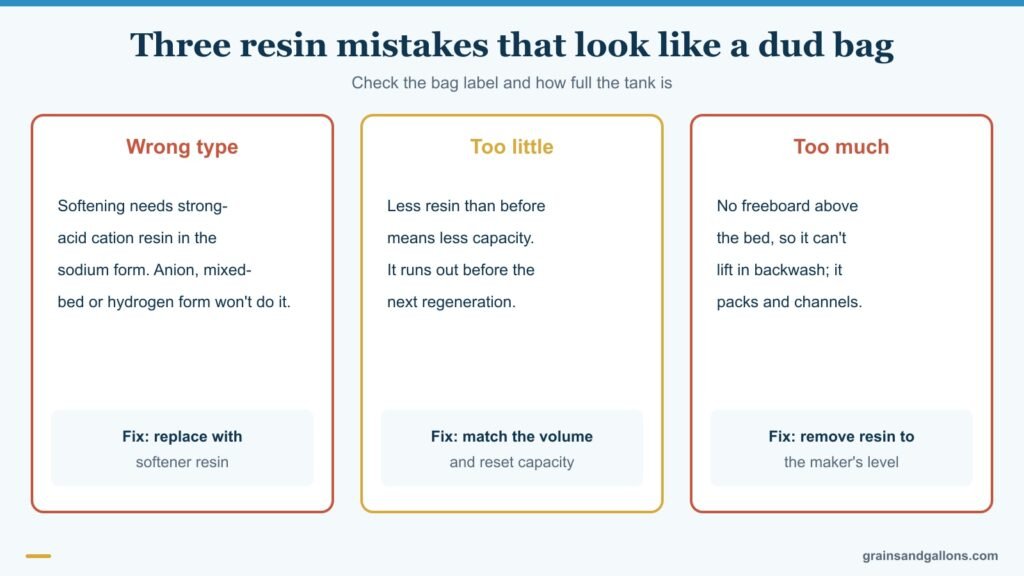
Type. Softener resin is a strong-acid cation resin in the sodium form. Other resins look nearly identical in the bag: anion resin for nitrate or tannin removal, mixed-bed resin for deionization, and hydrogen-form cation resin. A wrong type won't soften properly and can do odd things to pH and taste. Our guide to replacement water softener resin explains what to look for on the label.
Amount. Less resin than before means less capacity, so the softener runs out before its next regeneration. Overfill the tank and the bed has no room to lift during backwash, so it packs and channels. How to load resin into a mineral tank covers measuring and freeboard.
Gravel. If your tank was built with a gravel underbed and you didn't replace it, resin sits right against the basket and channeling gets worse. If your system never had gravel, don't add it.
Hot taps can stay hard for days
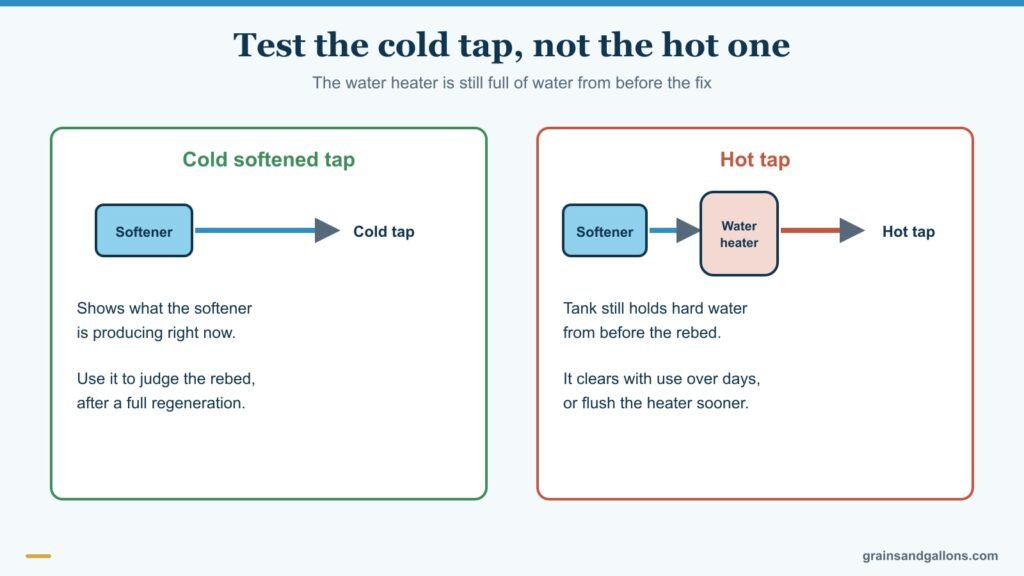
If the old resin had been failing for weeks, your water heater is full of hard water. Testing at a hot tap, or judging by spots on dishes from the dishwasher, will make the rebed look like a failure even when the softener is fine. The Fleck table lists "hot water tank hardness" as a cause and says repeated flushings of the hot water tank may be needed.
Judge the job at a cold softened tap. The hot side catches up as you use hot water, or sooner if you flush the heater following its manufacturer's instructions.
Retest the raw water before blaming the new bed

The resin change is a good time to retest your raw water, especially if you replaced the resin because the softener "stopped keeping up." If hardness rose, the new resin will run out on the same schedule the old one did, and the fix is a new hardness setting or a bigger softener.
Iron matters even more. Purolite, a resin maker, explains that iron binds strongly to softening resin, isn't removed well by brine, and builds up slowly to cut capacity for calcium and magnesium. It also notes that chlorine and other oxidants shorten resin life. If iron or chlorine killed the old bed, they will foul the new one too; see water softener resin fouling. Test raw and softened water side by side so you're comparing the right things.
FAQ
Why is my water still hard after replacing the resin?
Most often the riser tube isn't sealed into the valve O-ring, so water bypasses the resin. Next come skipping a full regeneration, a brine line knocked loose, a bypass left partly open, or settings that reset when the unit was unplugged.
Do you need to regenerate after replacing softener resin?
Yes. A manual regeneration settles the new bed, purges air, rinses out fines, and proves the brine draw works. Run it before you test.
How long after a resin change should water be soft?
Cold softened water should test soft once the first full regeneration finishes. Hot water can take days, because the water heater still holds hard water from before the rebed.
Can you put too much resin in a softener tank?
Yes. Without freeboard above the bed, the resin can't expand during backwash, so it packs, channels, and can push beads toward the valve. Fill only to the level your tank maker or resin supplier gives.
How do I know I bought the right resin?
The bag should say strong-acid cation resin in the sodium form, sold for water softening. Anion, mixed-bed, or hydrogen-form resins are for other jobs and won't soften properly in a household softener.
Most rebeds fail at the riser, not the new resin
A water softener stopped softening after resin change is almost always a job detail, not a bad bag. Check the bypass and settings, prove the brine draw with a full regeneration, then pull the valve and look at the riser height, centering and O-ring. If all of that checks out, confirm the resin type and amount and retest your raw water for hardness and iron.