

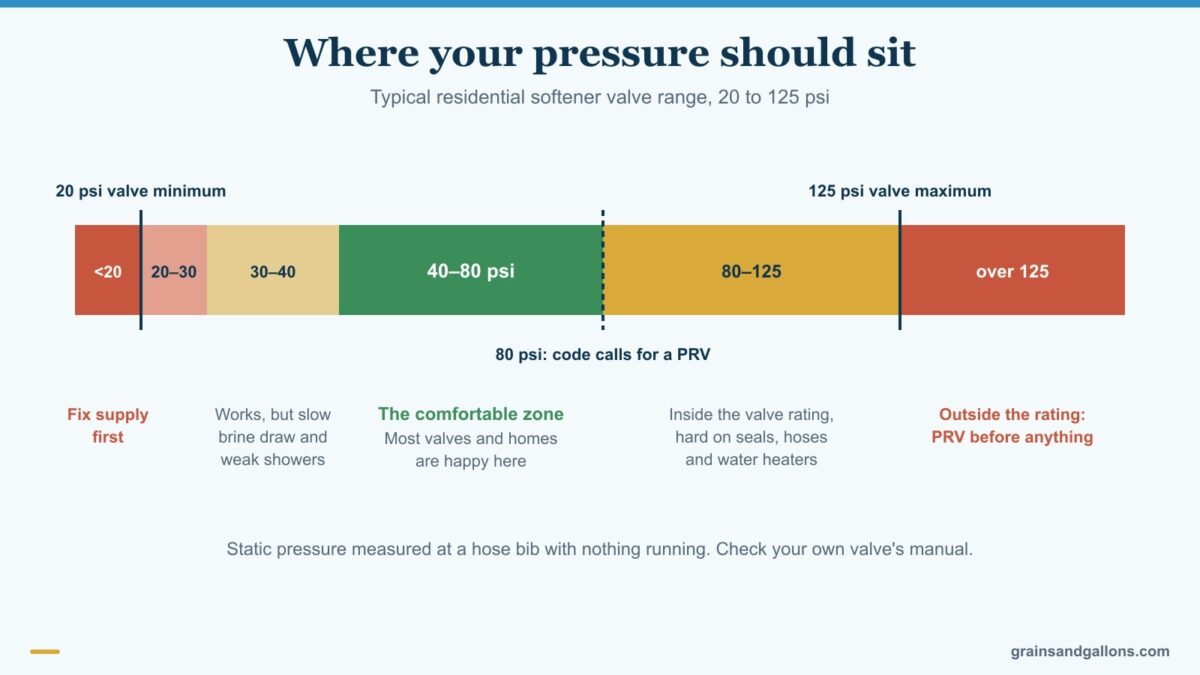
Quick Answer: Typical water softener pressure requirements are 20 to 125 psi: that's the operating range in both the Fleck 5600SXT and Clack WS1 manuals. In practice, aim for 40–80 psi. Below about 30–40 psi, brine draw and household flow both suffer, and most plumbing codes require a pressure-reducing valve when static pressure tops 80 psi. Check yours with an inexpensive hose-bib pressure gauge before you install.
Water softener pressure requirements printed in a manual aren't the range you want to live in. They're the range where the valve won't fail. Comfortable plumbing sits well inside it; the edges are where weak brine draw and leaking seals show up.
In this guide
- Water softener pressure requirements in the valve manuals
- Pressure bands and what each means for a softener
- How to check your pressure in five minutes
- On well water, your minimum is the cut-in pressure
- Pressure problems that look like softener problems
- FAQ
- Get three pressure numbers before you install a softener
Water softener pressure requirements in the valve manuals
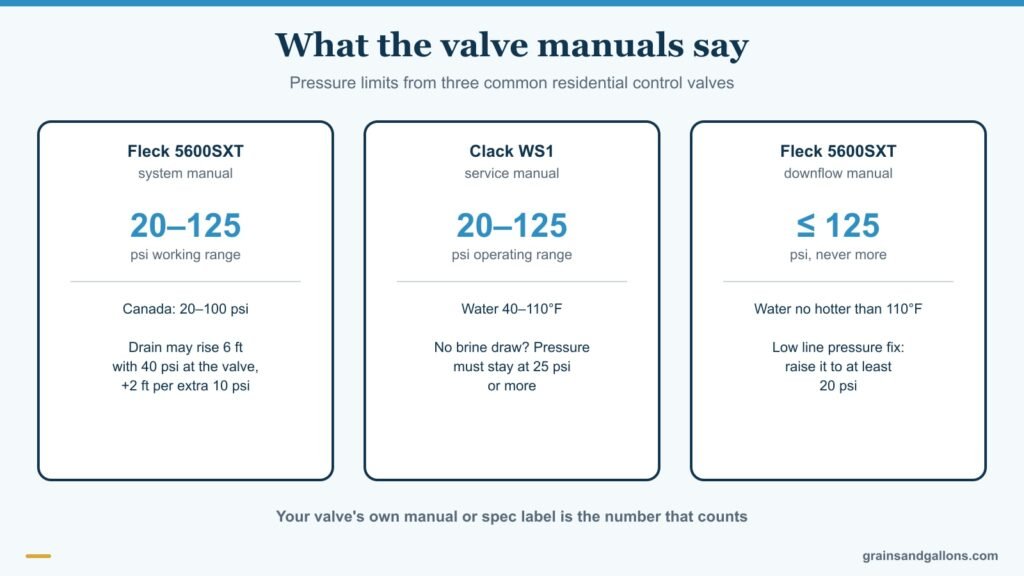
The numbers come from the control valve, not the tank, so look up the manual for your valve. Three common examples:
- Pentair Fleck 5600SXT system manual. The installation manual gives a working pressure range of 20 to 125 psi (20 to 100 psi in Canada). It also ties pressure to the drain: the drain line can rise up to 6 feet on a run of 15 feet or less if there's at least 40 psi at the softener, plus 2 feet for each extra 10 psi.
- Clack WS1. The WS1 service manual lists 20 psi minimum and 125 psi maximum, with water temperatures of 40–110°F. Its troubleshooting table for a softener that won't draw brine says pressure must stay at 25 psi or more.
- Fleck 5600SXT downflow manual. The downflow manual warns that pressure must not exceed 125 psi or water temperature 110°F, and its fix for low line pressure is to raise it to at least 20 psi.
Cabinet softeners and dealer brands publish their own ranges, often on a label inside the lid. Don't assume they match.
Pressure bands and what each means for a softener
| Static pressure at a hose bib | What to expect | What to do |
|---|---|---|
| Under 20 psi | Below most valves' minimum. Weak or failed brine draw, incomplete regeneration. | Fix the supply before adding a softener. |
| 20–40 psi | The valve works, but the injector draws brine slowly and household flow already feels weak. Every psi of softener drop is noticeable. | Size the softener generously for flow; check well pump settings or consider a booster pump. |
| 40–80 psi | The comfortable zone. Most homes and most valves are happy here. | Nothing. |
| 80–125 psi | Inside the valve's rating, but above what most plumbing codes allow inside a house. Harder on seals, fittings, water heaters and appliance hoses. | Install or repair a pressure-reducing valve. |
| Over 125 psi | Outside the valve's rating. Risk of leaks, cracked housings and a voided warranty. | PRV before anything else. |
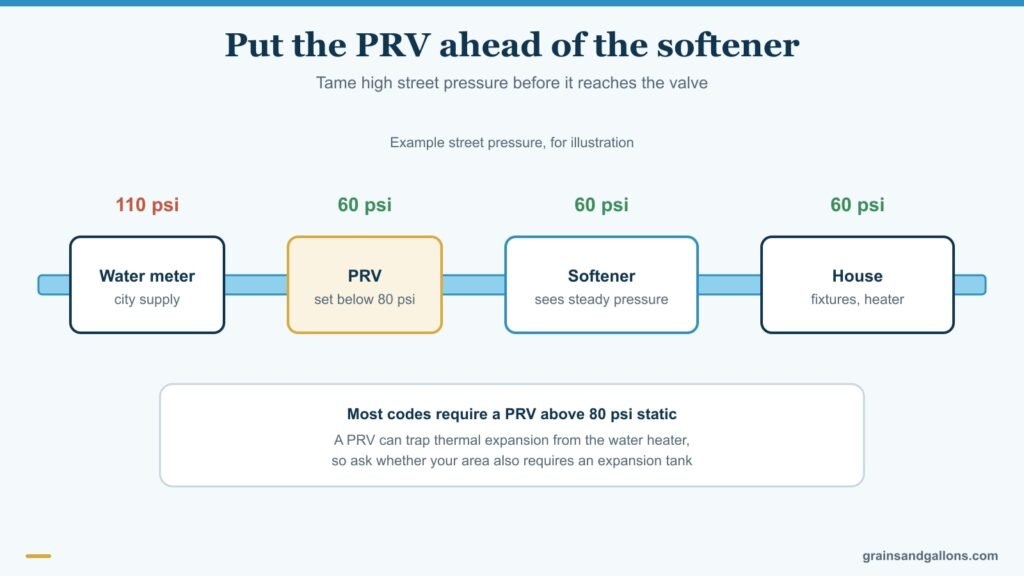
Building codes are the reason for that 80 psi line. The International Residential Code, International Plumbing Code and most state and local codes require a pressure-reducing valve (PRV) when static pressure is above 80 psi. The PRV usually goes ahead of the softener so the valve sees steady pressure. Because a PRV can trap thermal expansion from the water heater, ask whether your area also requires an expansion tank. Our guide to the best water pressure reducing valves for homes with softeners covers sizing and placement.
How to check your pressure in five minutes
- Buy a basic water pressure test gauge with a hose thread. Any hardware store has them.
- Screw it onto an outdoor faucet or the laundry faucet, ideally one near where the water enters the house.
- Make sure nothing else in the house is running: no toilet refilling, no ice maker cycling.
- Open the faucet fully and read the gauge. That's your static pressure.
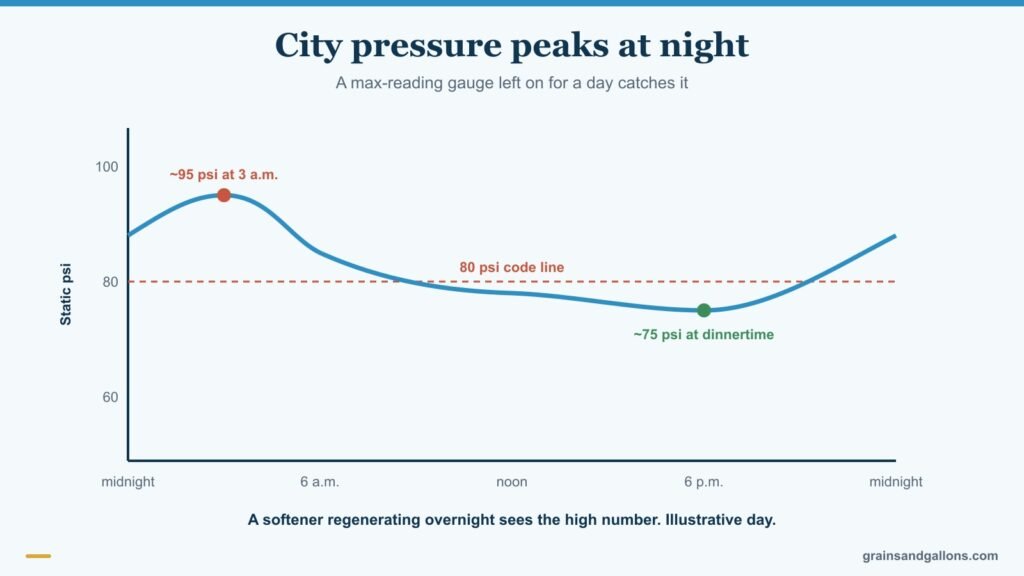
- Leave it on for a day if you can. Some gauges have a "lazy hand" that records the highest reading, which catches nighttime spikes on city water when demand is low.
That last step matters. City pressure can be 75 psi at dinnertime and 95 psi at 3 a.m., and a softener regenerating overnight sees the 3 a.m. number. Once the softener is in, a second gauge on a fixture after it shows how much the unit costs at flow; our water softener pressure drop guide explains the two-gauge test.
On well water, your minimum is the cut-in pressure
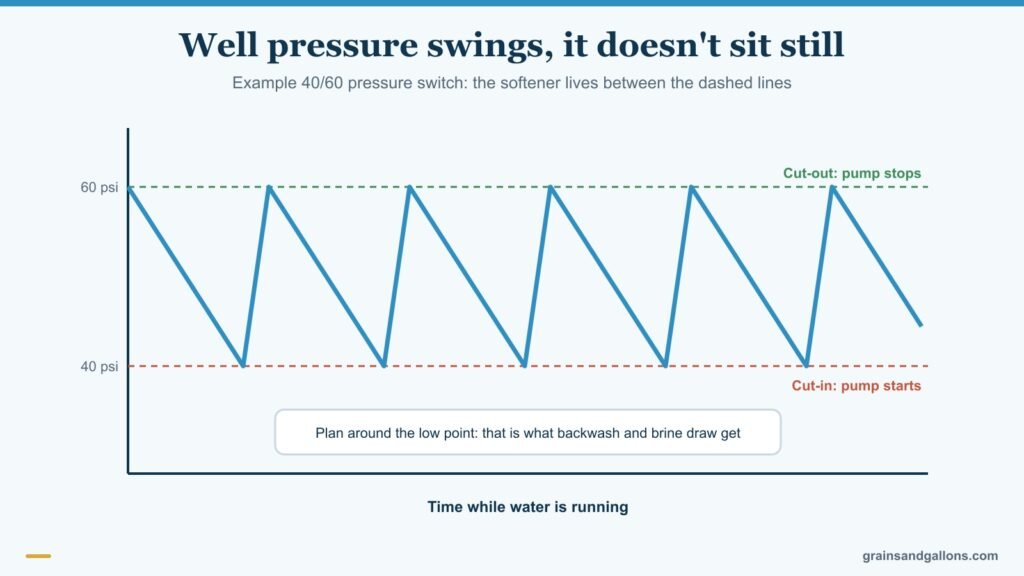
With a private well, pressure isn't constant. It swings between the pressure switch's cut-in (pump turns on) and cut-out (pump turns off) points. Common settings are 30/50 or 40/60 psi.
The low point is what your softener has to work with when it matters. During backwash, the softener sends a steady flow to drain for several minutes, and the well pump has to keep up. If it can't, pressure sags toward cut-in and the backwash is weaker than designed. Our guide to well pump flow and backwashing shows how to measure what your pump actually delivers.
A 30/50 switch is workable for most softeners. If the house already feels weak at 30 psi, raising the switch to 40/60 (if the pump and tank are rated for it, and with the tank precharge adjusted to match) often helps more than anything else. That's work at a live electrical device, so turn off power at the breaker first, or hire a well contractor.
Pressure also limits where the softener can drain. If you plan to run the drain line uphill to a laundry standpipe, check the elevation rule in your manual and our drain line requirements guide first.
Pressure problems that look like softener problems
- Banging pipes after installation. The softener valve moving between cycles, or fast-closing fixtures, can make water hammer worse, especially at high pressure. See water hammer after a water softener.
- Pressure that surges and dips. Often a well pressure tank that's lost its air charge, or a failing PRV, not the softener. Water pressure fluctuating with a softener separates the causes.
- Pressure that's just lower everywhere when water runs. That's usually pressure drop through the softener at your peak flow, a sizing question rather than a supply one.
FAQ
What is the minimum water pressure for a water softener?
Most residential valves list 20 psi as the minimum, including the Fleck 5600SXT and Clack WS1. That's the floor for the valve to cycle; brine draw and household flow work much better at 40 psi or more.
What is the maximum water pressure for a water softener?
Many residential valves are rated to 125 psi, though some cabinet units list lower limits. Codes generally want household static pressure at or below 80 psi anyway, so a PRV is the fix long before you reach the valve's limit.
Do I need a pressure reducing valve before my water softener?
If static pressure is above 80 psi, most codes require a PRV regardless of the softener, and it usually goes ahead of the softener. Below 80 psi, you generally don't need one.
Can a water softener work with low well pressure?
Usually, if the cut-in pressure stays above the valve's minimum and the pump can supply the backwash flow. If pressure regularly sags below about 30 psi, adjust the pressure switch or add a booster pump before blaming the softener.
Does a water softener lower water pressure?
A little, while water is flowing. A properly sized softener costs only a few psi at normal flow. Static pressure, measured with nothing running, shouldn't change at all.
Get three pressure numbers before you install a softener
Water softener pressure requirements boil down to three numbers: your highest static pressure over a day, your valve's rated range, and on a well, your pressure switch settings and pump flow. If static pressure sits between 40 and 80 psi and your valve is rated 20–125, you're done thinking about pressure. If it's outside that, fix the supply first. A softener can't compensate for a pressure problem, and a pressure problem will shorten the softener's life.