

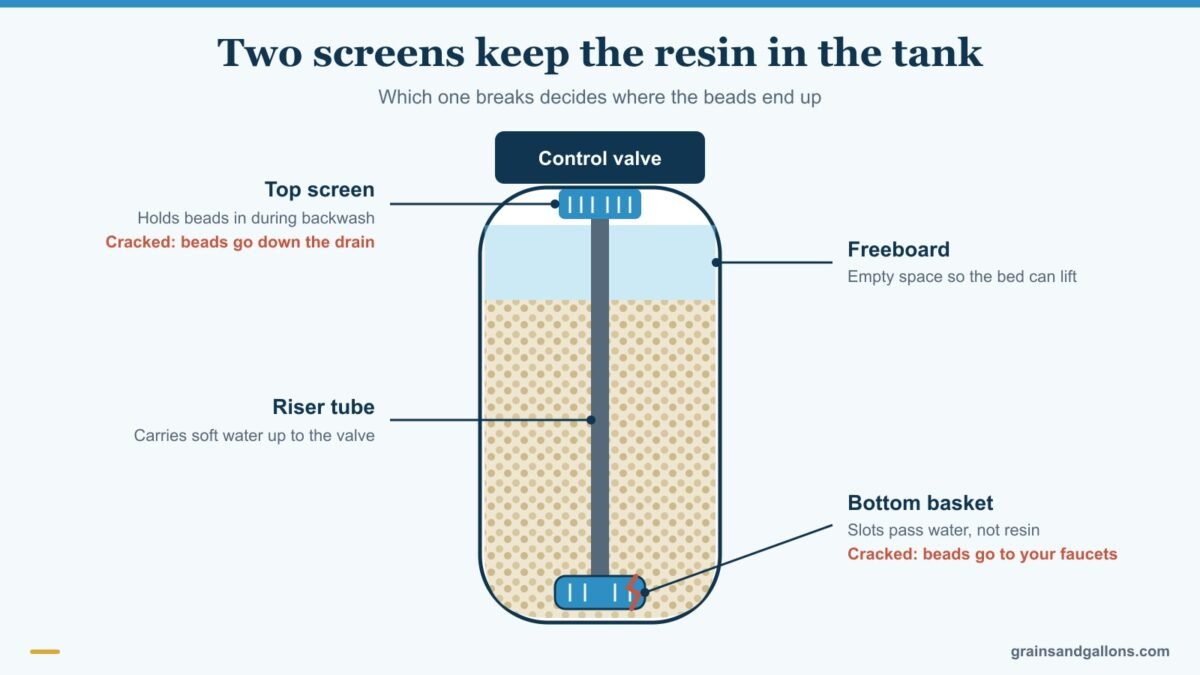
Quick Answer: If you suspect a water softener distributor basket broken inside the tank, look at where the resin beads end up. Round amber beads in faucet aerators, toilet tanks or appliance screens almost always mean the bottom basket (or the riser tube it sits on) has cracked or come loose. Put the softener in bypass right away. The fix is to remove the valve, empty the tank, replace the basket and riser as a set, refill, and restart slowly. Beads that only show up in the drain during regeneration point to the top screen or the backwash flow instead.
A softener's mineral tank has two screens. The bottom basket (also called the lower distributor) snaps or threads onto the end of the riser tube and sits on the floor of the tank. Its slots let water in and out but keep the resin back. The top screen, or upper distributor basket, sits just under the control valve and stops resin from washing out the top during backwash.
Treated water in a downflow softener leaves through the bottom basket and travels up the riser to the valve outlet. That's why a broken bottom basket sends resin into your house plumbing, while a broken top screen sends it down the drain. Which one has failed decides the repair, and you can usually tell from where the beads are going before you open anything.
In this guide
- Follow the beads to the failed part
- Why bottom baskets crack after years under the bed
- Stop the damage in the first hour
- Gravel, riser size and resin: decide before you open the tank
- Rebuilding the tank around a new distributor
- Flush escaped beads out of fixtures and the water heater
- Repair cost compared with buying a new softener
- FAQ
- A cracked basket is a cheap part worth replacing
Follow the beads to the failed part
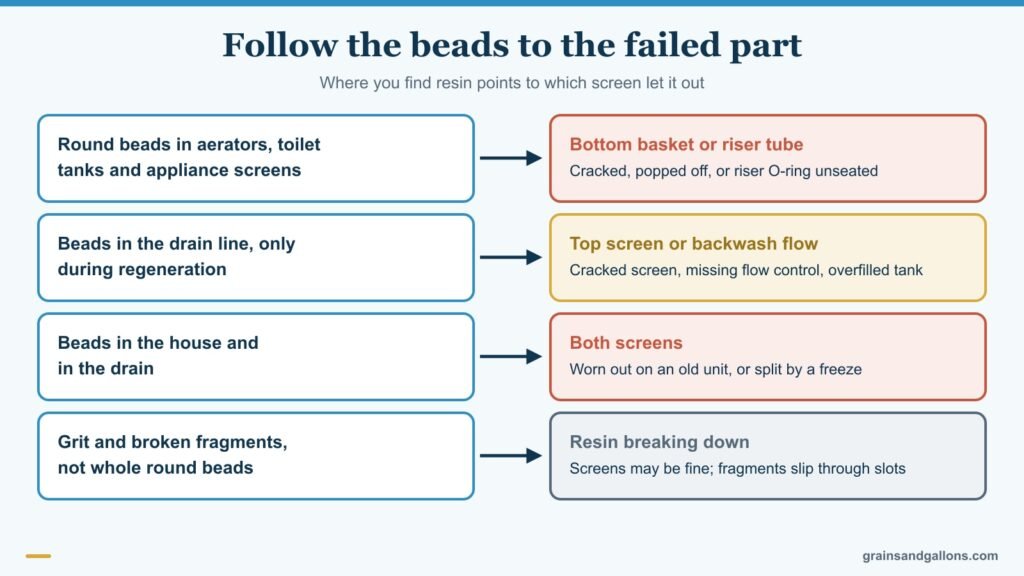
Collect a few of whatever you're finding on a white paper towel and look closely. Whole, round, glossy beads about the size of a pinhead are escaped resin. Then check where they turned up.
Beads in the house plumbing. Aerators, showerheads, toilet tanks, and the inlet screens on the washer, dishwasher and fridge. Resin is leaving through the outlet, which means a cracked bottom basket, a basket that popped off the riser, a cracked riser, or a riser O-ring that isn't seated in the valve. Many people first notice it as low pressure at one faucet or a toilet that fills slowly.
Beads in the drain line or floor drain, only during regeneration. Resin is lifting out the top during backwash. The usual causes are a cracked or missing top screen, a missing or wrong-size drain line flow control (too much backwash flow), or a tank filled so full the bed can't expand. That's covered in resin beads in the softener drain line. The bottom basket is rarely the problem here.
Beads in both places. Both screens may be worn out, which is common on very old units, or a freeze cracked everything at once.
Water softener distributor basket broken, or just worn resin?
Small sandy grit and broken half-beads, rather than whole round beads, usually mean the resin itself is falling apart. Fragments can slip through intact slots, so the screens may be fine. Chlorine damage and age are the usual culprits; see water softener resin cracked before you buy a basket you don't need. A quick check: put the softener in bypass for a day. If new beads stop appearing at the faucets, the leak is definitely coming from the softener tank.
Why bottom baskets crack after years under the bed

Bottom baskets are slotted plastic, and they spend their whole life under the weight of the resin bed and the push of every backwash. They fail from:
- Age. Plastic goes brittle. Tanks that have been in service 15 to 20 years often have baskets that crumble when you touch them.
- Freezing. Ice expanding in a garage or crawl space splits slotted plastic easily, and often cracks the riser and top screen at the same time.
- Pressure shocks and water hammer. Fast-closing valves and high supply pressure pound the bed against the basket. If your pressure runs high, a pressure-reducing valve protects the new parts.
- Installation damage. Dropping resin and gravel straight onto a dry basket, or forcing a riser that's cut too long, can crack it on day one.
- Hot water back-feed. Heat from a water heater backing up into the softener softens and deforms the plastic.
A basket can also come off the riser without breaking, especially snap-on types. The symptom is the same: beads at the faucets.
Stop the damage in the first hour
Put the softener in bypass as soon as you see beads in the house. Every gallon you run through it pushes more resin into the pipes. If your bypass is a set of old gate valves that won't fully close, now is the time to fix that, because you'll need to isolate the tank for the repair. Our picks for the best water softener bypass valves cover the common valve brands and pipe types.
Next, go easy on hot water until the softener is fixed. Beads that reach the water heater settle in the bottom of the tank and can later clog the drain valve or work their way to hot-side fixtures. Taking a few minutes to drain a couple of gallons from the heater's drain valve into a bucket tells you whether resin got that far.
Finally, unscrew one kitchen aerator and one bathroom aerator. If they're full of beads, plan on cleaning every fixture after the repair.
Gravel, riser size and resin: decide before you open the tank
Find out what's in your tank. Some softeners have a layer of gravel under the resin. Others are gravel-free and rely on a wider bottom basket or a hub-and-lateral distributor. Your manual or the old parts will tell you. Don't add gravel to a system designed without it, and don't leave it out of one designed with it.
Match the riser to the valve. Risers and baskets are sized to the tank opening and the control valve. Clack's WS1 valve, for example, takes a 1.05-inch OD (3/4-inch NPS) distributor tube, according to the Clack WS1 service manual. Many suppliers sell the lower basket and riser as a set. Replacing both together costs little and means you won't have to empty the tank twice.
Decide about the resin now. You have to take the resin out anyway. If it's around ten years old, mushy, iron-fouled or full of fragments, re-bedding with new resin is the efficient move. Our guide to the best replacement water softener resin explains crosslink and how much to buy. Check the old top screen too, and replace it if it's brittle or cracked.
Rebuilding the tank around a new distributor

Softener lower basket replacement comes down to four stages.
Stage 1: Get the valve off
Unplug the softener, open a softened tap to release pressure, and disconnect the plumbing, drain line and brine line. Unscrew the valve and lift it straight up so you don't snap the riser in the valve. Look at the riser O-ring while it's off.
Stage 2: Empty the tank
Scoop or siphon out the water and resin; a wet/dry shop vac speeds it up. If you're keeping the resin, put it in a clean bucket and keep it covered with water. Gravel goes in its own bucket and should be rinsed. Tip the tank carefully for the last of it. A full tank is heavy, and a dropped fiberglass tank can crack (see mineral tank cracked for what that looks like).
Stage 3: Install the new basket and riser
Look at the old basket. You'll often spot the crack or missing section right away, which confirms the diagnosis. Fit the new basket on the new riser, set it in the center of the tank floor, and tape or cap the top of the riser. Add a few gallons of water as a cushion, then any gravel, then the resin, keeping the riser centered. Leave the empty freeboard your manual calls for. Cut a new riser to the height your valve specifies; for the Clack WS1 it's within half an inch above or below the top of the tank thread. How to load resin into a water softener tank covers the filling details, and water softener riser tube broken covers O-rings and length.
Stage 4: Restart without blasting the bed
Lubricate the riser and tank O-rings with silicone grease only; the Fleck 5600SXT service manual specifies silicone lubricant. Reinstall the valve and reconnect everything. Put the valve in backwash and open the inlet a little at a time so air escapes without lifting resin violently. Then run a full manual regeneration. Water softener startup procedure walks through the order for common valves.
Flush escaped beads out of fixtures and the water heater
Fixing the tank doesn't remove the resin already in your plumbing. Work through the house one zone at a time:
- Cold lines. With aerators removed, run each cold faucet at full flow for a minute or two, then clean and refit the aerator.
- Toilets. Shut off the supply, take the cap off the fill valve and flush out its screen. Beads in a toilet tank are harmless, but they can stop the fill valve from shutting off.
- Showers. Unscrew showerheads and rinse their inlet screens.
- Appliances. Clean the inlet screens on the washing machine hoses, the dishwasher and the fridge water line.
- Water heater. Drain and flush the tank until the water runs clear of beads, then run the hot side of each fixture.
Watch the outlet for the first few days. If beads keep showing up at the faucets after the repair, the riser O-ring may not be seated or the riser may be too short to reach into the valve.
Repair cost compared with buying a new softener
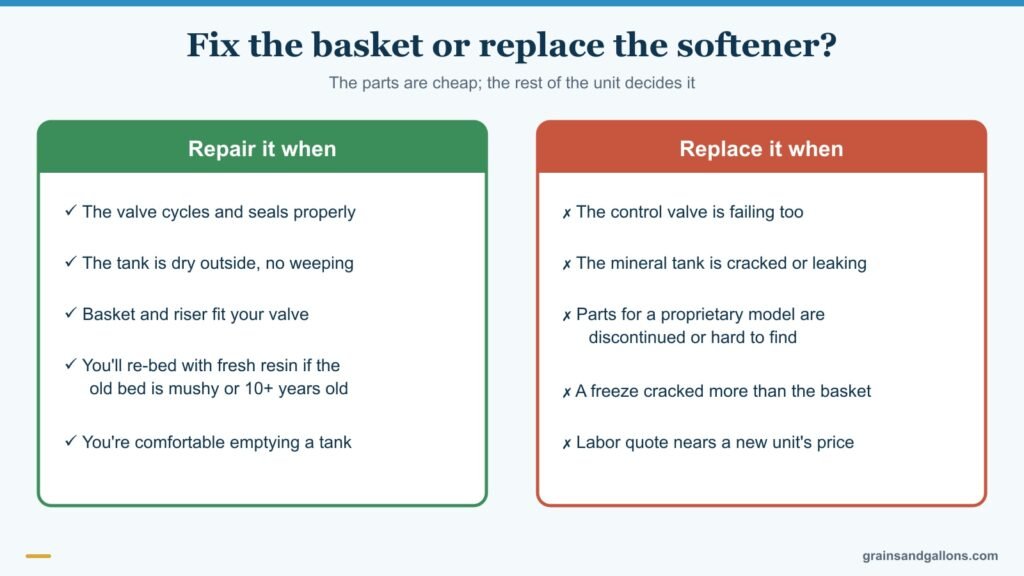
A lower basket and riser are inexpensive parts, often well under the cost of a single service call. The real cost is labor: emptying and refilling a tank takes a homeowner an afternoon. Add new resin if the old bed is tired, and you've effectively rebuilt the softener for a fraction of a new unit's price.
The decision changes when the basket isn't the only problem. If the control valve is also failing, the tank is weeping, or parts for an older proprietary model are hard to find, price a new system before you start. Penn State Extension's overview of water softening is a good refresher on how the resin and regeneration cycle work if you're weighing a new unit. Our guide to whether you should repair or replace an old water softener goes through the full checklist.
FAQ
Can a softener keep running with a broken distributor basket?
It will still soften water, but it keeps pushing resin into your plumbing and slowly empties the tank. Each lost bead is lost capacity, so hardness will creep back while fixtures clog. Bypass it until it's repaired.
Are resin beads in drinking water harmful?
Softener resin is an inert plastic designed for potable water contact, and stray beads aren't considered a health risk. They're a nuisance: they clog aerators, valves and appliance screens. Fix the leak and flush the fixtures.
How do I know if it's the basket or the riser tube?
You often can't tell until the valve is off. A cracked riser and a broken basket cause the same symptom, which is why most people replace them together. Once the tank is empty, inspect both; a crack may be obvious on one.
Do I need to replace the resin when I replace the basket?
Not always. If the resin is a few years old and the beads are whole and firm, rinse it and put it back. If it's around ten years old, mushy, or full of broken fragments, replace it while the tank is already open.
How long does a distributor basket last?
Many last the life of the softener, often 15 to 20 years. Freezing, water hammer, hot water back-feed and rough installation shorten that, and an old basket can crack the first time it's disturbed during a resin change.
A cracked basket is a cheap part worth replacing
Finding a water softener distributor basket broken after years of service is normal wear, not a reason to scrap the system. Read where the beads show up, bypass the unit, replace the basket and riser as a pair, refill with care, and clean every fixture the resin reached. If the valve and tank are sound, you'll get many more years out of the softener for the price of a couple of plastic parts and an afternoon's work.