

Quick Answer: A water softener chlorine smell during regeneration is normal if your softener has a built-in chlorinator, a small cell on the brine line with two wires running to it. It makes a little chlorine from the brine to sanitize the resin, so a faint bleach smell near the drain during the brine stage is expected. A smell that fills the house, or chlorine you can taste at the taps after the cycle ends, isn't normal. Check the chlorinator setting, the rinse and the drain's air gap.
Disclosure: As an Amazon Associate, Grains & Gallons earns from qualifying purchases.
You walk past the utility room at 2 a.m. and it smells like a swimming pool. Nobody added bleach to anything. If the timing lines up with the softener's cycle, a water softener chlorine smell during regeneration is the likely explanation, and on some models it's doing exactly what it was designed to do.
In this guide
- Find out whether your softener makes its own chlorine
- Why the smell peaks while brine is being drawn
- Faint at the drain is normal; strong in the house isn't
- Bleach taste at the taps after the cycle ends
- Bleach smell from a softener with no chlorinator
- Never mix cleaners with a chlorinating brine
- FAQ
- A faint drain smell is fine; tap chlorine needs a fix
Find out whether your softener makes its own chlorine

Most budget and big-box softeners don't have a chlorinator. Some dealer-sold systems include one, and add-on cells exist for standard valves. Look for:
- A small cylindrical fitting on the brine line between the brine tank and the control valve, or inside the brine well.
- Two thin wires running from that fitting to the control board or a small box on the wall.
- The words "chlorinator," "chlorine generator" or "self-sanitizing" in the manual or on the spec sheet.
No cell? Skip to the section on bleach smells without a chlorinator below.
Why the smell peaks while brine is being drawn
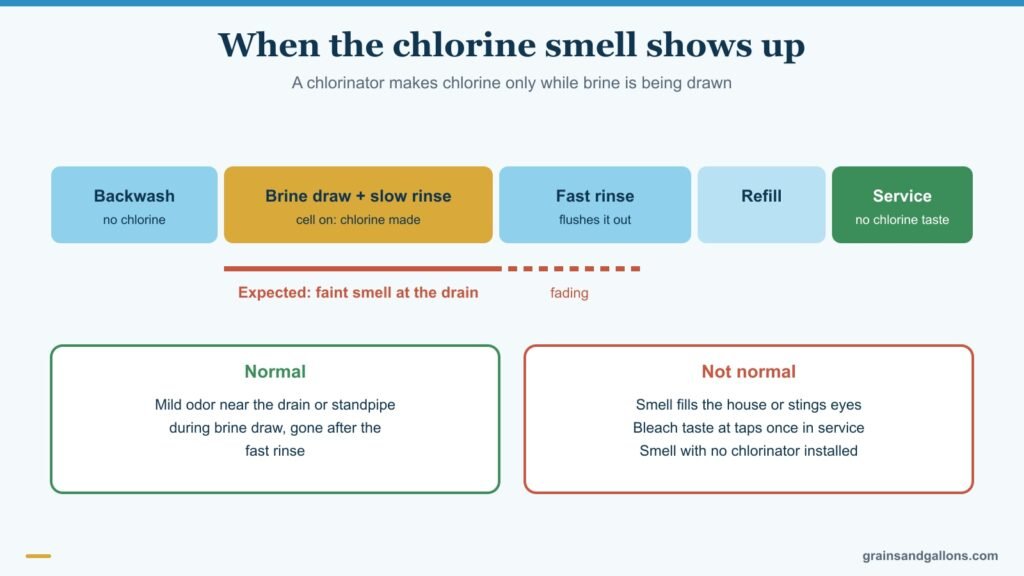
Salty brine flows past two electrodes inside the cell, and a small current turns some of the chloride into chlorine: in effect, a weak bleach made on the spot. That chlorine travels with the brine through the resin, knocking back bacteria, then rinses to the drain with the rest of the regeneration water.
Pentair's Steril-Soft Pro technical sheet describes a typical setup. The electrode cell sits in the brine line and runs "only during the brine draw cycle." Output is set with two dials, current from 0.2 to 2.5 amps and run time from 2 to 20 minutes, and "chlorine in excess is eliminated during the regeneration process." Designs vary by brand, but the principle is the same. So the smell's source is predictable: the drain line or standpipe, during the brine stage, fading through the rinse.
Faint at the drain is normal; strong in the house isn't
Normal: a faint chlorine odor at the floor drain, laundry sink or standpipe during the brine stage that fades after the cycle. Good ventilation in the utility room helps.
Not normal: a smell you notice upstairs, or one that makes your eyes water. Either the chlorinator is set too high for your unit or something else is adding chlorine. Some controllers let the owner adjust current or run time. On dealer-sealed units, call the dealer.
Check the drain, too. A drain line without a proper air gap can let odor back into the room, and a drain that empties inside a closet with no airflow concentrates it. Most codes call for an air gap at the softener drain anyway, so it's worth fixing either way.
Bleach taste at the taps after the cycle ends

Chlorine made during regeneration should leave with the rinse water. If the first water in the morning smells like bleach, something isn't rinsing it out:
- The cycle didn't finish. A power blip or stuck valve can stop the softener partway, before the rinse. Make sure the display shows it back in service.
- The rinse is too short. If someone shortened the fast-rinse time to save water, chlorine and salt can remain. Compare cycle times to the manual's defaults.
- The drain is restricted. A kinked drain line or clogged drain flow control slows the rinse.
A pack of free and total chlorine test strips settles it. Test the first cold water after a regeneration, then again after running the tap a few minutes. High at first and gone after flushing points to a rinse or timing problem. High in both points to your supply.
Bleach smell from a softener with no chlorinator

If there's no cell, the softener probably isn't making the chlorine. The usual suspects:
- Someone sanitized it recently. Bleach poured into the brine well will smell during the next regeneration. Our softener sanitizing guide covers dose and rinse.
- The well was shock-chlorinated. Heavily chlorinated well water running through a softener smells strongly, and it's hard on resin. See shock chlorination and your softener for when to bypass.
- Your city changed its disinfectant. Utilities using chloramine often switch to free chlorine for a few weeks a year, which smells stronger. EPA's chloramines page explains the two disinfectants. You'd smell it at every tap, not only during regeneration. See tap water smells like bleach.
- Drain splash. Backwash sends a lot of city water to the drain fast. Chlorinated water splashing into a laundry sink in a small room releases a noticeable smell.
Never mix cleaners with a chlorinating brine
- Don't add an acid resin cleaner or anything with ammonia to the brine tank on a cycle that also runs a chlorinator or a bleach sanitize. Chlorine mixed with acids or ammonia can release harmful gases.
- If the smell causes coughing or headaches, ventilate the room, unplug the softener and call the dealer.
- Cells scale up and lose output. Pentair recommends annual maintenance on its cell for that reason. If the smell disappeared on a unit that used to produce it, the cell may need cleaning or replacing.
FAQ
Is a water softener chlorine smell during regeneration harmful?
A faint odor at the drain during regeneration is a small amount of chlorine leaving with waste water. A strong smell that irritates your eyes or throat isn't something to live with. Ventilate, unplug the unit and have the chlorinator setting checked.
Does a softener chlorinator damage the resin?
The contact is brief and designed for resin. Constant exposure is different: resin sitting in chlorinated city water around the clock slowly swells and breaks down over years. Our explainer on how chlorine damages softener resin covers the signs.
Why does my water softener smell like bleach only at night?
Most softeners regenerate around 2 a.m., so a chlorinator's odor shows up then. If you smell it at other times, the cause is more likely your water supply, a recent sanitize or a drain problem.
Can I turn off the chlorinator?
On many add-on cells you can turn down the current or run time, and some can be unplugged. Check the manual first, since the chlorinator is there to keep bacteria out of the resin and brine tank.
Will a carbon filter stop the chlorine smell?
A carbon filter removes chlorine from incoming water, but it won't affect chlorine made inside the softener during regeneration. For city water with strong chlorine, a carbon stage ahead of the softener helps both your taste and your resin. Compare options in our guides to softener systems for hard water with chlorine odor and whole house carbon filters.
A faint drain smell is fine; tap chlorine needs a fix
A water softener chlorine smell during regeneration is expected when the unit has a chlorinator and the odor stays faint, near the drain, and gone by the end of the cycle. Chlorine at the taps afterward means the rinse isn't doing its job. A smell with no chlorinator points to your supply, a recent sanitize or a drain issue. The EPA caps disinfectant in public water at 4 mg/L under its drinking water regulations, so a strong smell at every tap is worth a call to your utility.