

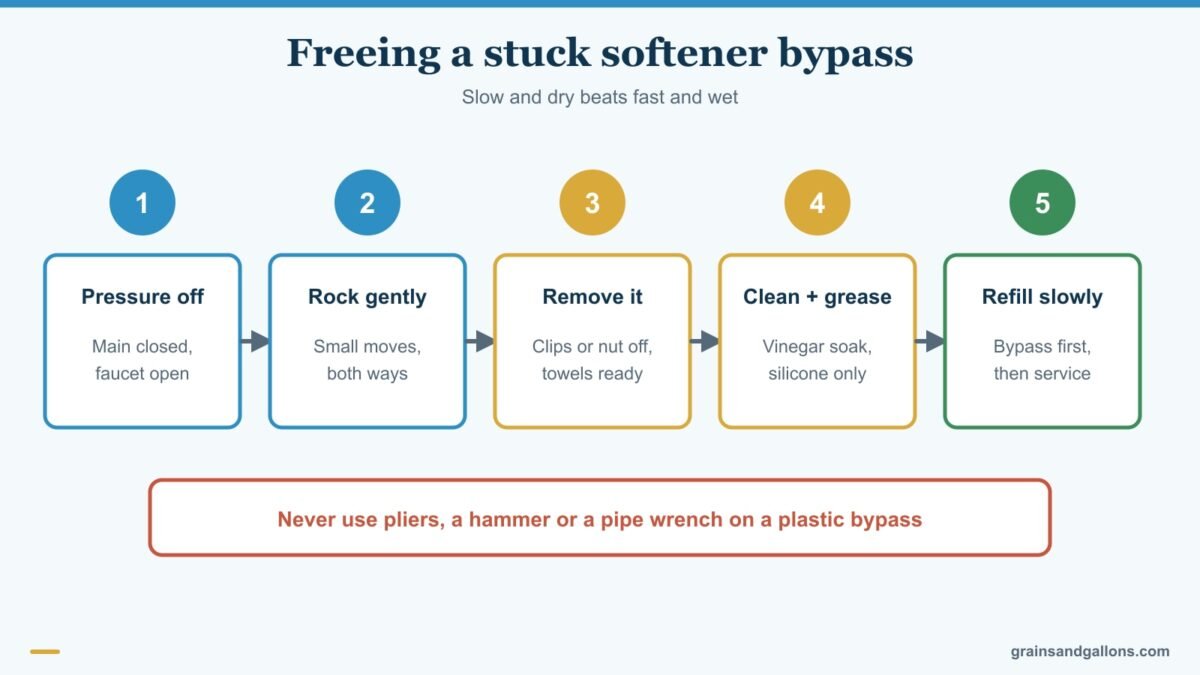
Quick Answer: For a water softener bypass valve stuck in place, shut off the main water supply and open a nearby faucet to drop the pressure, then try it again by hand. Line pressure pushes the O-rings hard against the bore, and that alone can make a dry valve feel welded. If it still won't move, take the bypass off the valve, clean it, and coat the O-rings with a silicone valve grease such as Molykote 111. Never use pliers or a hammer on a plastic bypass.
Disclosure: As an Amazon Associate, Grains & Gallons earns from qualifying purchases.
A water softener bypass valve stuck in place always seems to happen when you need the softener out of the loop right now, maybe to fix a leak or change salt. Before you reach for a wrench, know this: most bypass valves are plastic, and a cracked bypass under line pressure is a fast way to flood the room. Culligan's advice is the same: if it feels stuck, don't force it, because that can damage the valve (Culligan bypass guide). Slow and dry beats fast and wet.
In this guide
Why bypass valves seize
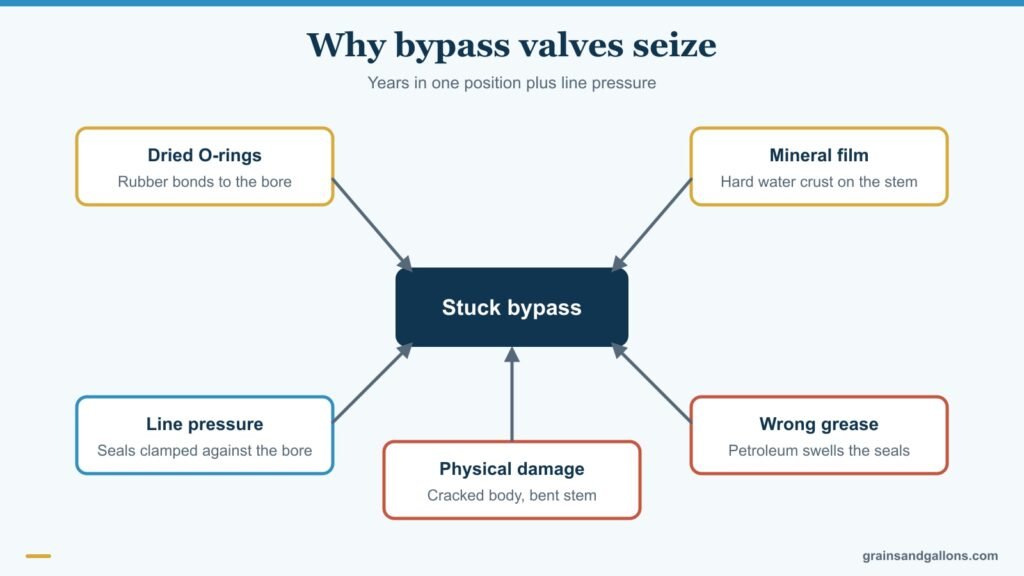
Bypasses sit in one position for years. Over that time:
- The O-rings dry out and stick to the plastic body. Rubber that hasn't moved in five years can bond surprisingly well.
- Hard water leaves mineral film around the stem or rotor, especially on the inlet side, which sees untreated water.
- Line pressure clamps everything. With 50 to 70 psi behind it, the seals press hard against the bore.
- Someone used the wrong grease. Clack's service manual warns that hydrocarbon lubricants such as petroleum jelly and WD-40 damage O-rings and plastic parts (Clack WS1 service manual). Swollen, gummy seals bind.
- The valve is physically damaged. A cracked housing, bent stem or broken handle won't free up with lube.
Some designs resist this better than others. Clack's WS1 bypass, for example, uses self-lubricating EPDM seals specifically to help prevent seizing after long periods in one position.
Know which bypass you're dealing with
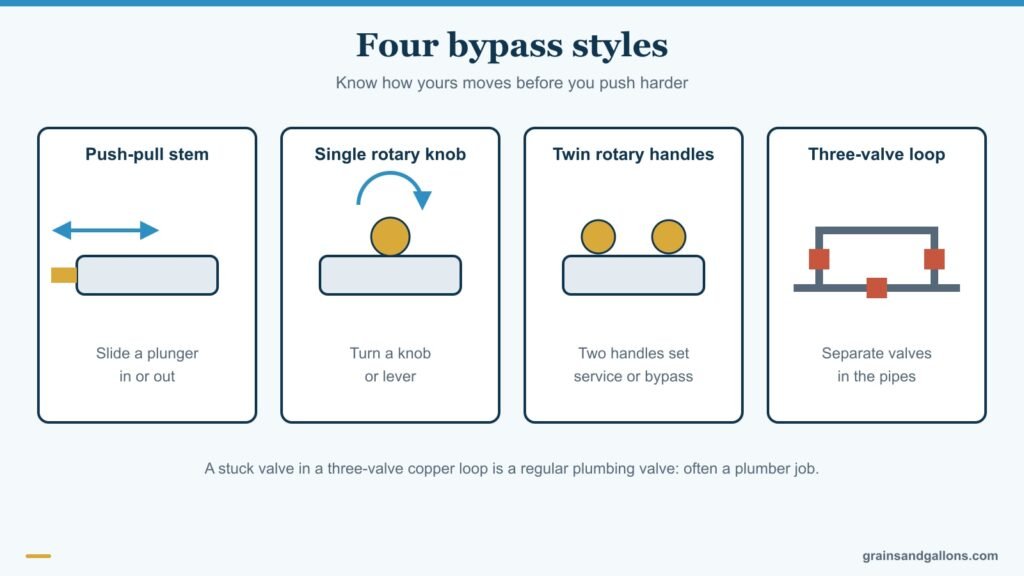
Bypasses come in a few styles. Look for arrows, a "service/bypass" label, or a push button.
| Style | How it moves | Common on |
|---|---|---|
| Push-pull stem | Slide a plunger or knob in or out | Many all-in-one cabinet softeners, some metal bypasses |
| Single rotary knob | Turn a knob or lever 90° or so | Many plastic bypasses on two-tank softeners |
| Twin rotary handles | Turn two handles to set service, bypass or shutoff | Some Clack-style bypasses |
| Three-valve copper loop | Three separate ball or gate valves in the pipes | Older installs and plumber-built loops |
If yours is a three-valve copper loop, the stuck part is a regular plumbing valve, and a seized gate valve is a plumber's job. The steps below are for the plastic or stainless bypass mounted on the softener.
How to free a water softener bypass valve stuck in place
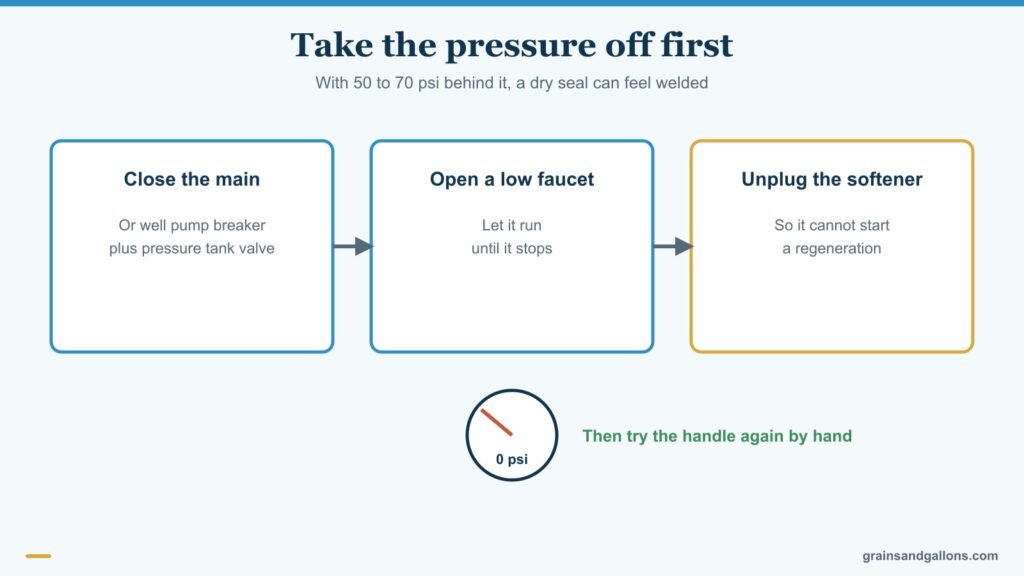
1. Take the pressure off
Close the home's main shutoff (or the well pump breaker plus the pressure tank valve on a well). Open a cold faucet on the lowest floor until it stops. Unplug the softener so it can't start a regeneration while you work.
Now try the bypass again with firm, steady hand pressure. A lot of stuck valves move at this point.
2. Work it gently, both ways
For a push-pull stem, push and pull a little in each direction rather than forcing it all the way. For a rotary knob, rock it slightly back and forth. You're breaking the O-ring's grip, not muscling the stem.
If the handle has a slot or flats, a wide flat-blade screwdriver used as a gentle lever is fine. Pliers on a plastic knob are not. They crack the knob, then the stem. Before adding any more force, look closely at the body for hairline cracks.
3. Pull the bypass off the valve
If it still won't move, remove it so you can work on the bench:
- Most bypasses are held to the control valve by retaining clips, a large nut, or a pair of clamps. Note how they come apart, and photograph them before you start. Clack designs its nuts and caps to be turned by hand or with its plastic service wrench.
- Have a bucket and towels ready. Even with pressure off, the softener and pipes will drain some water.
- On units connected with flexible connectors, removal is easy. On rigid plumbing, you may need to loosen the connectors on both sides.
Our guide on how to install a water softener bypass valve shows typical connections if you need a reference.
4. Clean and lubricate
With the bypass off:
- Remove the stem or rotor if it comes out (many do, with a clip or cap).
- Soak mineral-crusted parts in white vinegar or a citric acid solution for 20 to 30 minutes, then rinse well.
- Inspect the O-rings. Replace any that are flattened, cracked or stuck to the plastic.
- Coat the O-rings and bore with a thin film of silicone grease made for potable water valves. Molykote 111 is a common choice among plumbers; check the package for an NSF 61 listing before using any grease on drinking water parts. Skip petroleum-based products and spray lubricants.
Reassemble, work the stem or knob through its full travel a few times, and reinstall.
5. Turn the water back on slowly
Put the bypass in the bypass position first. Open the main shutoff partway and check for drips around the bypass and connectors. Then switch to service slowly to let the softener refill without a slam of air and water. If the house has no pressure once you're done, no water pressure after bypass covers the common mix-ups.
Stuck in bypass or stuck in service?
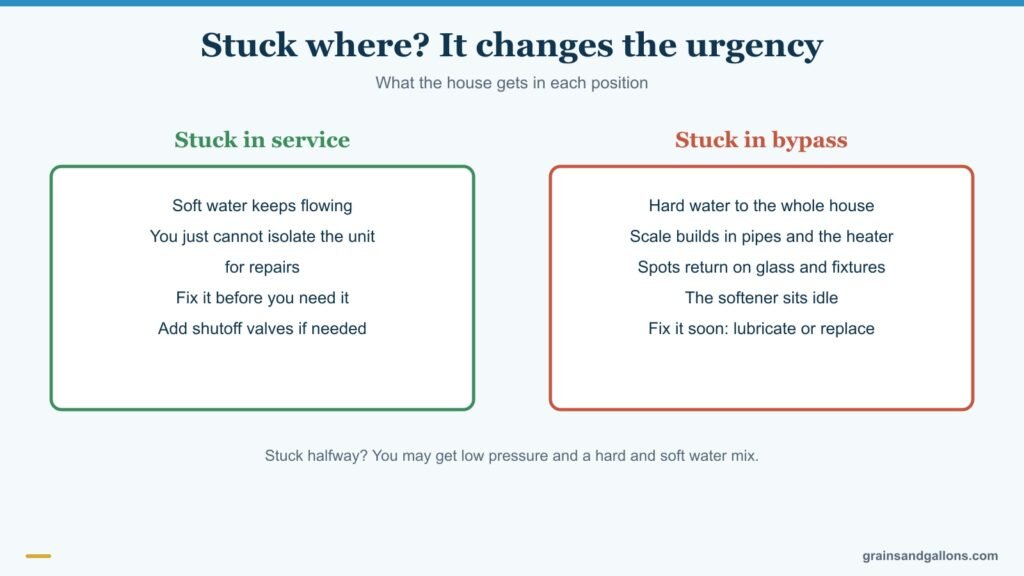
Where it's stuck decides how fast you need to act.
- Stuck in service. The house still gets soft water; you just can't isolate the softener. There's no rush, but free it before you actually need it for a repair.
- Stuck in bypass. The whole house is on hard water and the softener is sitting idle. Scale starts building in pipes and the water heater, and spots come back on glass and fixtures. Fix it soon.
A handle frozen halfway can mean low pressure and a mix of hard and soft water; treat it like stuck in bypass.
When a stuck bypass needs replacing
Replace the bypass if:
- The housing is cracked, even a hairline at a nut or clip.
- The stem is bent or the handle sheared off.
- It leaks around the stem after new O-rings. See bypass valve leaking for that specific problem.
- Replacement O-rings aren't available for your model.
- It seizes again within months even after cleaning and greasing, which points to worn internal parts.
Bypasses are usually inexpensive compared to the cost of water damage. Match the brand and model of your control valve, because bypass connections aren't universal. Our list of the best water softener bypass valves groups replacements by valve type, and if your connectors are old too, a water softener installation kit can replace the whole set in one go.
Call a plumber if the main shutoff itself won't close fully, if water is spraying from a cracked bypass, or if removing the bypass means cutting rigid pipe you're not comfortable re-joining.
Keep it from seizing again
Move the bypass to bypass and back to service a couple of times a year, ideally while you're doing other softener maintenance. That keeps the seals from bonding to the bore and tells you early if a seal is going.
If you're installing a new softener, consider adding a separate three-valve loop or a full-port ball valve on each side. Then a stuck bypass never leaves you without a way to isolate the unit.
FAQ
Can I use WD-40 on a stuck softener bypass valve?
No. WD-40 and other hydrocarbon products can swell and damage the O-rings and plastic in softener valves; Clack's manual names WD-40 and petroleum jelly specifically. Use a silicone grease meant for potable water O-rings instead.
Can I free a stuck bypass without removing it?
Often, yes. Shutting off the main and relieving pressure frees many valves on its own. Rock the handle gently both ways. If it still won't budge, removing it for cleaning is safer than adding force.
Which way does a softener bypass valve turn?
It depends on the design. Look for arrows or "service" and "bypass" labels on the knob or body. Push-pull styles usually push in for one position and pull out for the other; check your owner's manual if there are no markings.
What happens if I leave my softener stuck in bypass?
Your house gets untreated hard water, so scale builds up in pipes, fixtures and the water heater, and the softener doesn't regenerate. It won't damage the softener, but fix the bypass soon.
Turn it twice a year so it never sticks again
A water softener bypass valve stuck in one position is usually dry O-rings and line pressure, not a broken part. Take the pressure off first, rock it gently, and if that fails, remove it, soak off the scale and regrease the O-rings with silicone. Replace it only when the body is cracked or the stem is damaged, then cycle the new one a couple of times a year so you're never stuck again.