

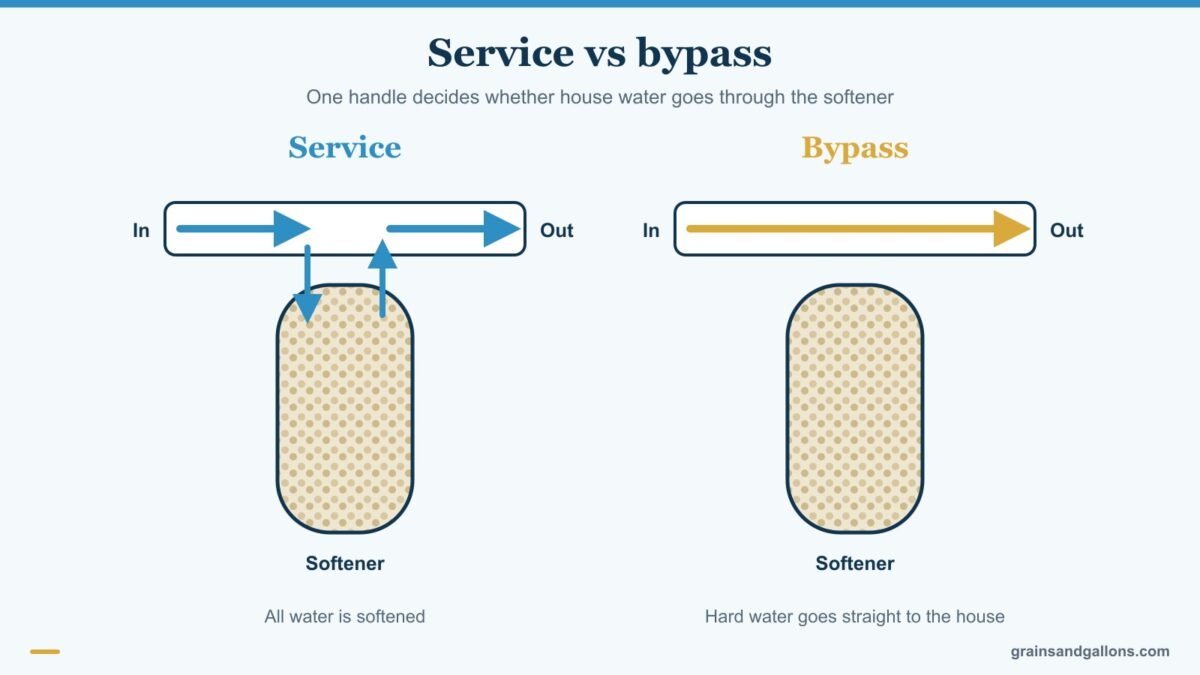
Quick Answer: Buy the bypass made for your control valve. Universal bypasses that bolt onto any softener aren't really a thing. For a Fleck 5600SXT, 2510 or 9100, the Fleck 60041SS stainless bypass is the most durable choice, and the 60049 plastic bypass is the budget replacement. A Clack WS1 takes the V3006. Whirlpool, GE, Kenmore and Morton cabinet units use the 7129871-style assembly.
Disclosure: As an Amazon Associate, Grains & Gallons earns from qualifying purchases.
Your softener's control valve already chose your bypass valve for you. Every major valve family has its own bolt pattern and O-ring layout where the bypass meets the valve body. A Fleck bypass won't seal on a Clack, and a Clack bypass won't clip onto a Whirlpool. "Best" really means three things here: the right fit, the right material, and how easy it is to turn when you need it in a hurry.
Most people searching for this are in one of three situations:
- The old bypass is leaking or cracked. That's common on 15-year-old plastic bypasses.
- The handle won't turn, which usually means scale has seized it.
- You're installing a softener that didn't come with a bypass, or replacing a plastic one with stainless.
If you're in situation 1 or 2, check whether new O-rings fix it before you buy a whole bypass. Our guides to a leaking bypass valve and a stuck bypass valve cover the cheap fixes first.
In this guide
Find your valve, then your bypass
The label on the control head says Fleck or Pentair (5600, 5600SXT, 2510, 9000, 9100)? Go to the Fleck section. Decide between plastic and stainless.
It says Clack, or it's a WS1 (common on many online "upflow" and premium softeners)? Get the V3006.
It says Autotrol or Performa? Get the 1265 bypass. Check your manual's parts list first.
It's a one-piece cabinet softener from a big-box store (Whirlpool, GE, Kenmore, Morton, NorthStar, EcoPure)? Get the 7129871-type assembly.
It's a dealer brand (Culligan, Kinetico, RainSoft)? Call the dealer or find the valve model in your paperwork. These often use proprietary bypasses that aren't on this list.
Fleck: plastic 60049 or stainless 60041SS?
Both fit the common residential Fleck valves. The listings name the 5600, 2510 and 9000 for the plastic bypass, and the 2510, 5600/56SXT, 5800, 6700, 9000 and 9100 for the stainless one. The difference is in how they connect to your plumbing and how long they last.
Fleck 60041SS stainless steel bypass
This is the one to buy if you're replacing a cracked plastic bypass and never want to do it again. The body is stainless with 1" NPT threads on the plumbing side, so you thread fittings or flex connectors straight in. No separate yoke is needed. Listings describe it as compatible with hot and cold water.
Downsides: it costs more than the plastic version, and since it's metal, you'll need to deal with grounding (see below). It's also heavier, so support the plumbing so the bypass isn't hanging off the valve.
There are cheaper "60041SS-style" copies from other brands on Amazon. They may be fine, but we'd buy the Fleck-branded part for something that holds back full line pressure in your basement.
Fleck 60049 plastic bypass
This is the standard Noryl plastic bypass that ships on many Fleck softeners. The listing title spells out the catch: it's sold "less in/out yoke." You get the bypass body only. The yokes or adapters that connect to your pipes are separate parts. If your old plastic yokes are in good shape, reuse them. If they aren't, budget for new ones.
Choose plastic when: the original plastic bypass simply wore out after many years, you're reusing good yokes, and you want an exact like-for-like swap.
Clack WS1: the V3006
Clack's WS1 bypass is a thoughtful design. Its two rotating handles let you set normal service, full bypass, a diagnostic mode that sends water through the softener while it's isolated from the house, or a complete shutoff. The V3006 is that bypass, and the listing here is sold as a genuine Clack part.
It doesn't include the 1" connection fittings (the V3007 series). Those come in plastic, brass, PEX and sweat versions, and you'll reuse the ones you have or buy them separately.
If the handles have just gotten stiff, the bypass itself may not need replacing. The O-rings usually need cleaning and silicone grease. Some V3006 listings come bundled with a silicone lubricant for exactly that reason.
Autotrol: the 1265 bypass kit
Many Autotrol valves use the 1265 bypass. This listing is part 1040930, the bypass valve itself. The listing says it fits Autotrol Performa 263 and 268 series valves and the Technetics 1100, and it includes two gaskets for the valve-side seal. Adapters aren't included, so you'll need the right pipe adapter kit, such as Autotrol's 1" sweat copper adapter, unless you're reusing your old one.
This is a niche part. Only buy it after confirming your valve model in the manual. Autotrol's line has changed names a few times over the years.
Big-box cabinet softeners: the 7129871-style assembly
The Whirlpool, GE, Kenmore, Morton and NorthStar softeners sold at home centers share a family of push-in bypass valves held on with clips. This aftermarket kit is listed as a direct replacement for 7129871 (and 7370286), and it comes with the bypass valve body, two O-rings, four rubber washers and PTFE tape. The contents list doesn't mention adapters, so plan to reuse your existing adapters and clips. Per the listing, it fits standard 3/4" valve heads on Kenmore 625 and 350 series, Whirlpool WHES20, WHES30 and WHES33, GE GXSH, GXSF, GNSF and PNSF series, Morton M20 through M34, plus NorthStar, EcoPure and EcoWater units.
Downside: this is an aftermarket part, not an OEM one. Check your softener manual's parts list and make sure the part number matches before ordering. The listing says it won't fit 1" high-flow models like the Whirlpool WHES40 and WHES44, which use a high-flow version (often listed as 7345396) instead.
What a bypass swap actually involves
On most valves, this is a 30-minute job if nothing is seized. It goes about like this:
- Shut off the main and open a faucet downstream to relieve the pressure. If the bypass is the thing leaking, the main shutoff is your only shutoff.
- Unplug the softener, or at least make sure it won't start a regeneration while you work.
- Disconnect the plumbing side. On Fleck plastic bypasses, that means pulling the clips on the yokes. On a stainless Fleck, you'll unthread the fittings. On a Clack, you'll unscrew the nuts on the V3007 fittings.
- Remove the bypass from the valve body. Fleck bypasses are held on with clips and screws. Clack uses large nuts. Cabinet units use U-shaped clips.
- Lube the new O-rings with silicone grease (never petroleum jelly, which swells rubber), push the bypass on straight, and reinstall the clips or nuts.
- Turn the water back on slowly with the bypass in "bypass," check for drips, then switch to service and let air bleed out at a faucet.
Where people run into trouble:
- Seized fittings on old copper. Hold the bypass body firmly so you don't twist the valve while you loosen the plumbing side. A cracked valve body is a much bigger repair than a bypass.
- Mismatched yokes. Fleck yokes come in several sizes and types (3/4" and 1", plastic and brass, NPT, sweat and quick-connect). Match the one you're replacing, or check the part number printed on it.
- Missing O-rings. Some listings ship the bypass with O-rings already seated and some don't. Look at the old bypass before you throw it away.
If the plumbing around your softener is already a mess of old, scaled fittings, it may be worth replacing the connections at the same time.
What about a three-valve copper bypass loop?
Plumbers often build a bypass out of three ball valves: one on the inlet, one on the outlet and one across the loop. It works, it lasts forever, and it means you can pull the whole softener out without touching the house plumbing. The downside is that it takes three valves to switch, and when someone gets them in the wrong order you end up with no water, or with hard water feeding into the soft side.
Our take: keep the valve-mounted bypass for everyday use. Add a single shutoff ball valve upstream if you don't already have one, so you can isolate everything if the bypass itself starts leaking.
A bypass valve isn't the same as plumbing certain lines to skip the softener permanently. If you're re-plumbing anyway, now is a good time to decide whether hose bibs and the kitchen cold tap should get hard water. Our guides on whether outdoor faucets should bypass the softener and whether a kitchen tap should bypass it walk through the trade-offs. If you're putting in a brand-new bypass rather than replacing one, the step-by-step is in how to install a water softener bypass valve.
Don't forget the ground
When a softener and plastic bypass sit in a run of copper pipe, they break the electrical continuity of the plumbing. In homes where the water pipe is part of the electrical grounding system, you need a bonding jumper across the softener. That holds whether your bypass is plastic or stainless. A licensed electrician can confirm what your home needs.