


Quick Answer: Scale in tankless water heater heat exchangers shows up as temperature swings, weaker hot water flow and, on some models, a service code. The fix is a flush: circulate undiluted white vinegar through the unit's service valves with a small pump. Rinnai's procedure uses 4 gallons for up to about 45 minutes, at least once a year, and more often on hard water. A kit like the DrainX tankless flush kit supplies the pump, hoses and bucket.
Disclosure: As an Amazon Associate, Grains & Gallons earns from qualifying purchases.
Scale in tankless water heater units is the first thing to suspect on hard water when the shower runs hot, goes lukewarm for a few seconds and comes back, or when the hot tap feels weaker than it used to. If the heater hasn't been flushed in a year or more, the heat exchanger is probably carrying a mineral coat.
In this guide
Why scale in tankless water heater passages builds so fast

A tankless heater heats water in seconds by running it through a compact heat exchanger with narrow passages. Two things work against it:
- Heat drives scale out of water. Noritz's engineers put it simply: scale forms when the heat energy inside the heater separates calcium from the water. Calcium carbonate gets less soluble as water gets hotter, so the hottest surface in the house collects it first. We explain the chemistry in why hot water causes more scale.
- The passages are small. In a tank heater, flakes fall to the bottom of a 40- or 50-gallon tank. In a tankless unit the same deposit coats the walls of a narrow tube, choking flow and insulating the metal.
Scale acts like insulation. Noritz notes that it slows heat transfer, so the unit works harder to reach the set temperature, wastes energy and can wear out early. Rinnai warns that mineral buildup can erode the walls of the heating chamber.
Five signs it's scale and not something else
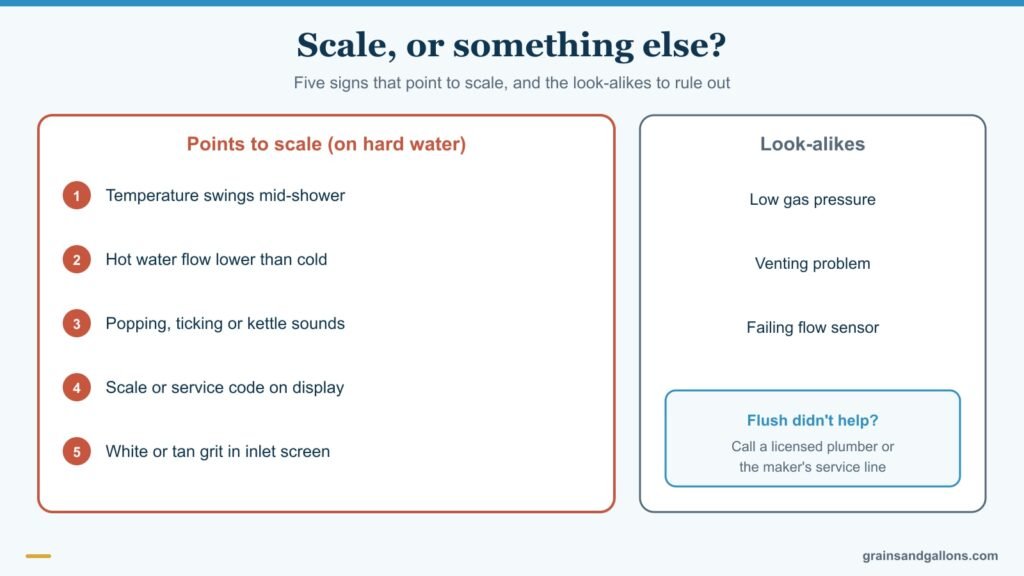
These point toward scale, especially on hard water:
- Temperature swings mid-shower, or water that never quite reaches the set point.
- Lower hot water flow than cold at the same fixture.
- New noises such as ticking, popping or a kettle-like sound while it fires.
- A scale or service code. Some Noritz models measure changes in heat transfer and display a message when it's time to descale. Codes vary by brand and model, so look yours up in the manual rather than trusting a generic list.
- White or tan grit in the cold-water inlet screen.
Some of these have other causes. Low gas pressure, a venting problem or a failing flow sensor can mimic scale. If a flush doesn't help, call a licensed plumber or the manufacturer's service line.
How often to flush a tankless heater

The manual sets the minimum. Rinnai says to flush at least once a year. Noritz suggests a maintenance check one year after installation and descaling at least yearly if the plumber finds significant buildup. Hard water usually means more often:
- Softened, soft or moderately hard water: once a year is usually enough.
- Hard water, untreated: consider every six months. Plumbers commonly recommend twice-yearly service on hard water or high temperature settings.
- Very hard water, untreated: check the manual's water quality section. Many makers set limits above which they expect treatment, and scale damage is commonly excluded from warranty.
If you don't know your number, test your water hardness at home or pick a kit from our list of the best water hardness test kits that reads in grains per gallon rather than a color range.
Flush it with vinegar in 12 steps

This follows the general flushing procedure Rinnai publishes. Your model's manual has the final word, especially on startup. If you're not comfortable working around gas appliances and hot water under pressure, hire a plumber.
You'll need a flush kit or small submersible pump, two hoses that fit the service valves, a 5-gallon bucket and 4 gallons of undiluted white vinegar. Rinnai says never to use chemical solutions, because the water runs through to your taps and showers.
- Turn off power to the heater, then shut off the gas (or the breaker for an electric unit).
- Close the cold, hot and main water valves so nothing enters or leaves the heater.
- Slowly remove the purge-port caps on the cold and hot service valves to release pressure. Confirm the hot valve is fully closed first; hot water under pressure can spray. Keep the rubber sealing discs in the caps.
- Attach the hoses. The cold-side hose runs from the pump outlet; the hot-side hose returns to the bucket.
- Open the purge valves. On most designs the handles turn perpendicular to the valve body.
- Pour the vinegar into the bucket and start the pump.
- Let it circulate for the time your manual gives. Rinnai says the procedure can take up to 45 minutes; Noritz suggests running vinegar through for about an hour. The vinegar often turns cloudy or carries flakes.
- Stop the pump, close the purge valves and remove the hoses.
- Rinse with fresh water to push the vinegar out before returning to service, as your manual describes.
- Replace the purge-port caps, snug but not overtightened.
- Clean the cold-water inlet filter screen if your unit has one. The manual shows where it sits.
- Open the water valves, restore gas and power, then run a hot tap slowly. Rinnai says purging the air takes about 2 to 3 minutes, until the sputtering stops.
Pour the used vinegar down a drain with plenty of water, not on plants. You should notice steadier temperature and better flow right away. If not, run a second flush before calling for service; the problem may be a flow sensor, gas supply or scale beyond what one flush clears.
Slow the buildup between flushes
Flushing treats the symptom. To reduce how much scale forms:
- A water softener removes calcium and magnesium entirely and is the most reliable protection. See softened water and tankless water heaters and our picks for the best water softeners to protect a tankless heater. Make sure its service flow rate keeps up with the heater's peak demand.
- A salt-free (TAC) conditioner on the cold line reduces scale formation without removing hardness. It can work in the right water; read salt-free conditioning for tankless and boilers first.
- Lower the set temperature if you can. Scale forms faster at higher temperatures, but follow your manual's guidance on the low end.
Even with treatment, keep flushing on the manual's schedule. You'll just find less in the bucket.
FAQ
How do I know if my tankless water heater has scale?
Temperature swings, lower hot water flow than cold, new popping or ticking sounds, white grit in the inlet screen and a service code are the usual signs. On hard water, assume scale if the unit hasn't been flushed in a year.
Can I use CLR or another descaler instead of vinegar?
Rinnai says to use undiluted white vinegar and never chemical solutions of any kind, because the water flows to your faucets afterward. Check your own manual before using anything else.
How long does a tankless water heater flush take?
Rinnai puts the procedure at up to about 45 minutes, and Noritz suggests circulating vinegar for about an hour. Allow extra time for setup, rinsing and the 2 to 3 minutes of air purging at the end.
Does a water softener eliminate the need to flush?
It reduces scale dramatically, but manufacturers still call for flushing on schedule. With softened water you'll typically find far less in the bucket.
What happens if I never flush a tankless water heater?
Scale keeps insulating the heat exchanger, so efficiency drops, temperature control gets worse and the unit runs hotter than it should. Over time that can shorten its life, and scale damage is often excluded from warranty.
Flush yearly, sooner on hard water, and treat the cause
Scale in tankless water heater heat exchangers is predictable on hard water and easy to clear before it does damage. Flush with 4 gallons of undiluted vinegar at least once a year, every six months or so on untreated hard water, and clean the inlet screen each time. Then cut the buildup at its source with a softener or a suitable conditioner, so each flush has less to remove.