


Quick Answer: Here's how to replace shower filter cartridges: turn the shower off, unscrew the filter housing by hand (or open the compartment in a filtered showerhead), drop in the matching cartridge with its arrow or mesh end facing the incoming water, check that every washer sits flat, hand-tighten, and run the water for one to two minutes to flush out carbon dust. Swap when the chlorine smell returns or you hit the maker's date. For AquaBliss SF100-style housings, that's the AquaBliss SFC100 cartridge.
Disclosure: As an Amazon Associate, Grains & Gallons earns from qualifying purchases.
If you're wondering how to replace shower filter cartridges, the swap itself takes five minutes. The shower just starts to feel like it did before you bought the filter: a faint pool smell, hair that won't rinse clean, maybe a bit less pressure. The cartridge isn't broken. The media inside has soaked up as much as it can hold. Most problems people hit afterward (drips at the arm, a gray first flush, lower pressure) come from small details during the change, so this guide slows down on those.
In this guide
- Signs your cartridge is done before the calendar says so
- Match the exact refill to your filter
- How to replace shower filter cartridges in an inline housing
- Changing the cartridge in a filtered showerhead
- Leaks, gray water and low pressure after the swap
- FAQ
- Swap on schedule, seat the washers, flush before you shower
Signs your cartridge is done before the calendar says so
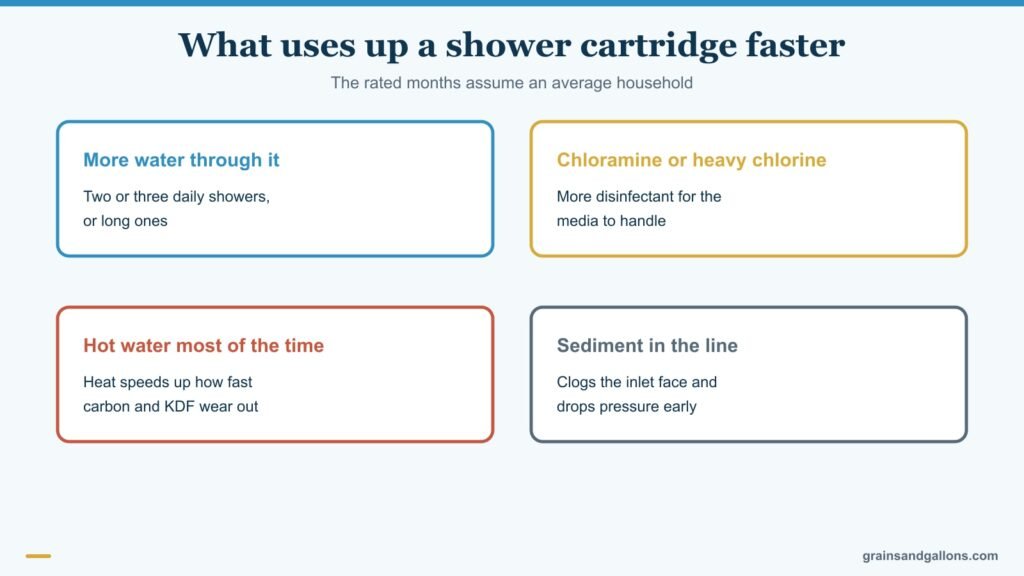
Manufacturers give a time or gallon rating. AquaBliss says to change its SF100 cartridge at least every 6 months, sooner with several users or high chlorine. Canopy rates its showerhead refill for 90 days, and most inline cartridges land in the three-to-six-month range. Those numbers assume an average household. Yours will wear out sooner if:
- Two or three people shower every day, or someone takes long showers
- Your water is chloraminated or heavily chlorinated. The EPA notes many utilities now disinfect with chloramine; our chlorine vs. chloramine test guide shows how to tell which you have
- The water is hot most of the time, which speeds up how fast carbon and KDF media wear out
- Sediment in the line clogs the inlet face of the cartridge
Trust your senses. If you can smell chlorine at the shower again, the cartridge isn't stopping it. Soap that lathers poorly or skin and hair that feel less soft are other common signs. Pressure that sags over a few weeks usually means a clogged sediment pad or cartridge face rather than spent media. Either way, it's time to swap.
Match the exact refill to your filter
There are two broad designs, and they don't share parts.
Inline filters sit between the shower arm and your existing showerhead: a cylinder that unscrews in the middle with a sealed cartridge inside. "Universal" cartridges exist, but length, diameter and end seals vary, so match by the model number printed on the housing or in your order history. Our roundup of the best shower filter replacement cartridges notes which housings each one actually fits. If you own an AquaBliss body, our AquaBliss shower filter review covers which cartridges match the SF100 and SF500.
Filtered showerheads (Canopy, Jolie, Hello Klean and similar) hide a small cartridge inside the head or handle. These are almost always brand-specific. For a Canopy head, it's the Canopy replacement filter. A generic cartridge that "almost fits" lets water bypass the media, leaving you with a filter that filters nothing.
If a performance claim matters to you, check whether the filter is listed in NSF's certified product database before buying refills for it.
How to replace shower filter cartridges in an inline housing
1. Turn the water fully off. The shower valve is enough; there's no need to shut off the house supply.
2. Hold the top half and twist the bottom half. Most inline housings open counterclockwise when you look up at them from below. If it's tight, wrap a dry towel around it for grip. Don't put pliers on plastic housings, since they crack.
3. Catch the spill. A few ounces of water will come out. Hold a towel or cup underneath.
4. Pull the old cartridge and look at it. Rust-colored or gray buildup on the inlet end means sediment or iron in your water. If it's heavy, change cartridges more often or add a sediment pad if your housing takes one. Rinse any grit out of the housing.
5. Check the washers and seals. There's usually one washer at the shower arm and one or two seals inside the housing (AquaBliss bodies have three). If one is flattened, cracked, missing or sitting out of its groove, fix it now. That's where almost every post-swap drip starts.
6. Insert the new cartridge facing the flow. Water flows down from the shower arm, so the arrow points toward the showerhead, or the mesh end faces up toward the arm on cartridges marked that way. Reversed, some cartridges filter poorly or leak at the seal.
7. Close it hand-tight. Snug, then stop. Overtightening squashes the washer, can crack the housing, and makes the next swap a fight.
8. Flush. Run cold water for one to two minutes before you shower. Gray water or a few dark specks are normal: that's carbon dust from the new media. A vitamin C cartridge may give a faint tint or smell at first, which fades quickly.
Changing the cartridge in a filtered showerhead
These vary more, so check the card that came with the head. The general pattern:
- Shut the water off and, for a handheld, unscrew the head from the hose.
- Twist open the filter compartment, often the base of the handle or the back of the head.
- Pull the old cartridge out by its tab and note which end faced up.
- Push the new one in the same way until it seats. Many have an O-ring that must slide into place without rolling.
- Close the cap, reconnect and flush for a minute.
If the head only screws back on with heavy force, the O-ring is probably pinched. Open it and reseat it rather than cranking harder.
Leaks, gray water and low pressure after the swap

| What you notice | Likely reason | What to do |
|---|---|---|
| Drip at the shower arm | Washer missing, doubled or crooked | Unscrew, seat one flat washer, hand-tighten |
| Leak at the housing seam | Cross-threaded, or a seal pinched or shifted | Open, reseat the seals, rethread slowly |
| Gray or black specks | Carbon fines from new media | Flush longer; it should clear in a few minutes |
| Lower pressure than before | Dense new media, clogged arm screen or washer screen | See our shower filter low-pressure guide |
| Odd smell that wasn't there before | New media, or bacteria in a long-stored cartridge | Flush; if it persists, see why a shower filter smells |
Patchy discoloration on the inside of a metal housing is often just plating and doesn't affect performance, according to AquaBliss.
FAQ
How often should you replace a shower filter cartridge?
Usually every three to six months, depending on the brand. AquaBliss says at least every 6 months; Canopy rates its refill for 90 days. Change sooner if several people shower daily, your water is chloraminated, or you smell chlorine again.
Which way does a shower filter cartridge go in?
With the arrow pointing in the direction of flow, toward the showerhead, or with the mesh end facing up toward the shower arm on cartridges marked that way. Check the arrow on the cartridge or the housing.
Why is my shower water gray after changing the filter?
That's loose carbon dust from the new media. Run cold water through the filter for one to two minutes before showering and it should clear. If dark specks keep coming for days, the cartridge may be damaged or the wrong size.
Can I use a universal cartridge in my shower filter?
Sometimes. Universal cartridges vary in length, diameter and end seals, so match the model number. In filtered showerheads, stick with the brand's own refill; a loose fit lets water bypass the media.
Will a new shower filter cartridge fix hard water?
Generally no. Most shower filters target chlorine, not the calcium and magnesium that cause scale and stiff hair. Our comparison of a water softener vs. a shower filter explains when you need each.
Swap on schedule, seat the washers, flush before you shower
Now you know how to replace shower filter cartridges without the usual drips: match the exact refill, point it toward the flow, check every washer, hand-tighten, and flush. Write the install date on tape inside the bathroom cabinet or in your calendar, because decline is gradual and it's easy to run eight months on a three-month cartridge. If you're setting up your first filter rather than refilling one, start with how to install a shower filter.