

Quick Answer: To install faucet water filters, unscrew the aerator from the spout, check whether the threads are inside or outside, and thread on the matching adapter with its washer, hand-tight. Twist or click the filter onto the adapter, put the cartridge in, switch to filtered and run cold water to flush it (Brita says 5 minutes). It takes under 10 minutes with kits like the PUR Plus faucet mount or Brita Elite faucet system, as long as your faucet isn't a pull-down or pull-out style.
Disclosure: As an Amazon Associate, Grains & Gallons earns from qualifying purchases.
In this guide
Will a faucet water filter fit your faucet?

- Round screw-on aerator at the tip: good. That's what these filters are made for.
- Pull-down or pull-out spray head: no. PUR states that pull-out and handheld faucets aren't compatible, and EPA's filter installation guide warns that flexible or extendable faucets may not fit.
- Smooth tip with a tiny slot: a hidden (cache) aerator. It needs a special key, and standard adapters usually don't fit.
- Low spout or shallow sink: the filter hangs below or beside the tip, so check you can still fit a pot underneath.
Still shopping? See our best faucet water filters and Brita vs PUR comparison.
Remove the aerator and match the threads

Turn the aerator counterclockwise as you look up at it from below. Brita says no tools are needed; PUR suggests a rubber jar opener or rubber band for grip. If scale has locked it on, see our page on scale on faucet aerators for freeing it without marring the chrome. Bag the aerator and its washer and keep them.
Now look at the spout:
- Threads inside (female spout): you need an adapter threaded on the outside. Brita's faucet system support page says inside threads call for an adapter.
- Threads outside (male spout): try the filter directly first; you may not need an adapter.
PUR's kit includes three adapters. Try them by hand with the washer seated flat inside. The right one starts easily; if it binds after a turn, back it off. EPA's advice is blunt: if none fit perfectly, don't force it. Cross-threading ruins a faucet tip. Hand-tight is enough, and a wrench usually squashes the washer.
Install faucet water filters hand-tight, then flush the cartridge
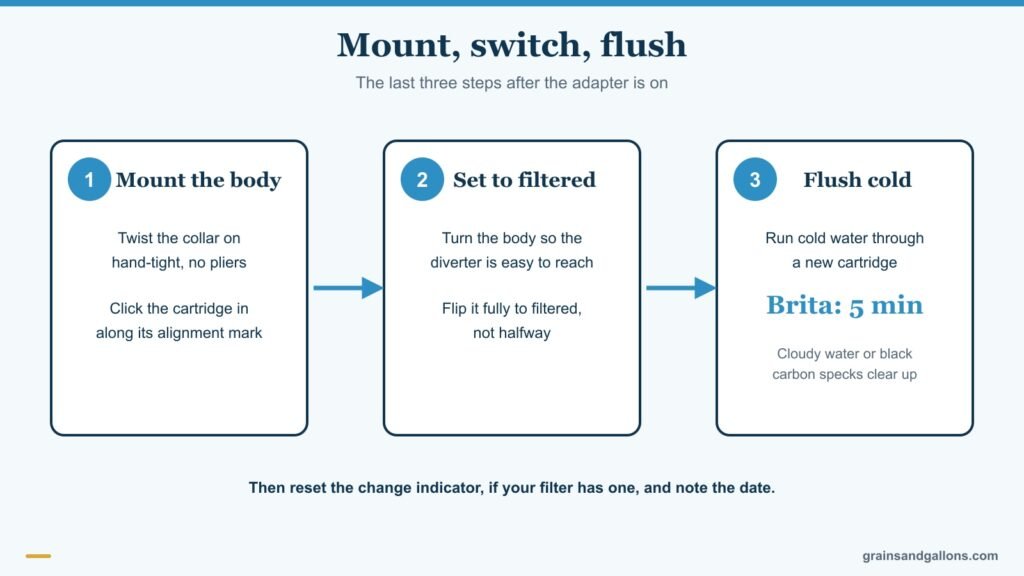
- Mount the body. Twist the collar on by hand until snug, or push until it clicks. Turn it so the diverter is easy to reach.
- Insert the cartridge. Line up its groove or arrow with the mark on the housing and push until it clicks. EPA notes a poor fit lets some water bypass the filter.
- Flush. Switch fully to filtered and run cold water through the new cartridge. Brita calls for 5 minutes. Cloudy water or black specks at first are carbon dust and air, and they clear.
- Reset the indicator if your model has one, and note the date.
Cold water only, and other daily habits

- Cold water only. PUR says not to run water above 82°F through the filter, because heat can damage it. Flip to unfiltered for hot water.
- Use the bypass for dishes and cleaning. Every gallon of rinse water comes off the cartridge's rated life.
- Change on schedule. Brita's faucet cartridge is rated for about 100 gallons; PUR's FAQ gives 100 gallons or 3 months. The indicator light counts for you.
These carbon filters don't remove calcium and magnesium, so they won't stop kettle scale; see whether filtering or boiling softens water.
Fixing drips after the install
| What you see | Likely reason | Fix |
|---|---|---|
| Drip between faucet and adapter | Washer missing, doubled or not flat | Reseat one washer, retighten by hand |
| Spray from adapter threads | Wrong adapter or cross-threaded | Try the other adapters; inspect the threads |
| Leak where filter meets adapter | Collar not fully seated | Remove, push straight on, retighten |
Still dripping? Our faucet filter leaking guide covers cracked housings and worn spout threads.
FAQ
Do faucet water filters fit all faucets?
No. They fit standard faucets with a removable screw-on aerator. Pull-down, pull-out and handheld spray faucets aren't compatible, and hidden aerators usually aren't either. Consider an under-sink filter or pitcher instead.
How long should I run water through a new faucet filter?
Follow your model's instructions. Brita says to run cold water for 5 minutes on setup and after every cartridge change. The first water may look cloudy or carry carbon specks, which is normal.
How often should I replace a faucet filter cartridge?
At the rated capacity: about 100 gallons for Brita's faucet cartridge, and 100 gallons or 3 months in PUR's FAQ. Slowing flow is another sign it's due.
Can hot water go through a faucet water filter?
No. PUR says to use cold water only and not to exceed 82°F, because hot water can damage the filter. Switch to the unfiltered setting before running hot water.
Ten minutes, the right adapter, then cold water only
To install faucet water filters is to take on one of the easiest upgrades in the kitchen: check the faucet fits, match the adapter to the threads, mount it hand-tight, flush the cartridge, and keep hot water on the bypass.