

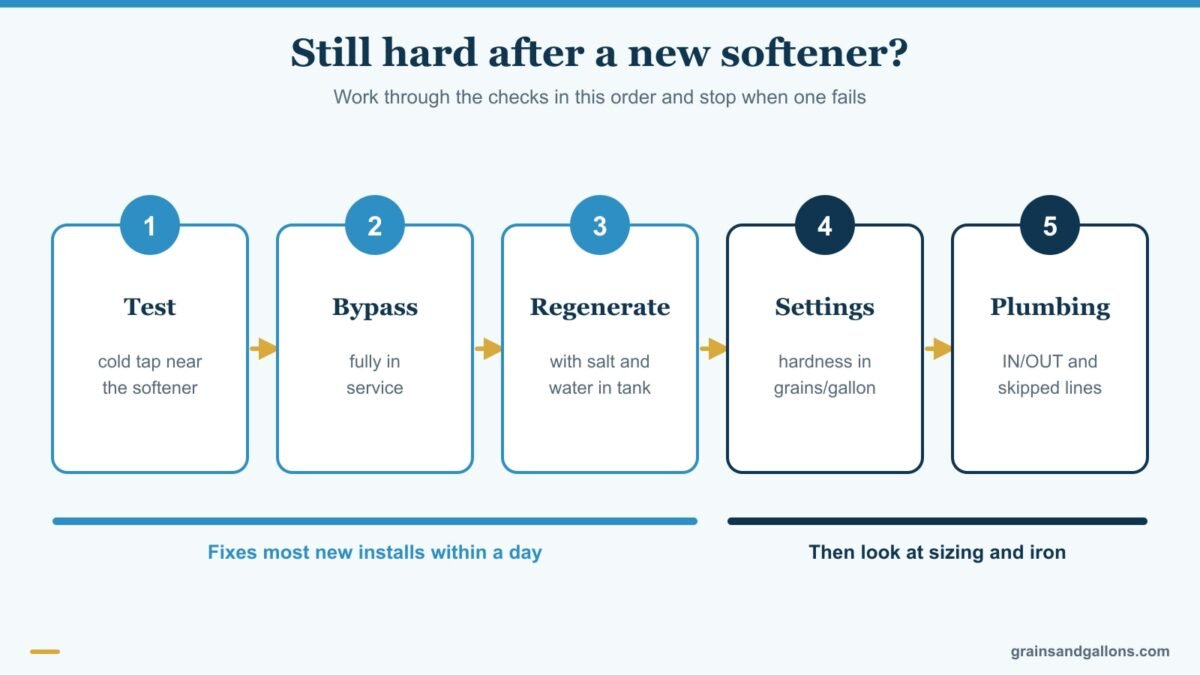
Quick Answer: Water still hard after installing softener equipment is almost always a setup problem, not a bad unit. Test a cold tap near the softener with strips such as Varify Water Hardness Test Strips, make sure the bypass is fully in service, then run a full manual regeneration with salt and water in the brine tank. Those steps fix most new installs within a day.
Disclosure: As an Amazon Associate, Grains & Gallons earns from qualifying purchases.
The softener has been in for a few days and the shower glass still spots the way it always did. Work through the checks below in order; they run from free and fast to more involved, so stop when one turns up the problem.
In this guide
- Test a cold tap close to the softener
- Check the bypass handle and the flow arrows
- Run a full startup regeneration with salt and water
- Set the hardness for your water, not the factory default
- Find water that never reaches the softener
- Water still hard after installing softener? Match the timing
- FAQ
- Bring your test numbers when you call the installer
Test a cold tap close to the softener
Feel is a poor test, and spots on glass can come from water that sat in the heater since before the install. Get a number instead:
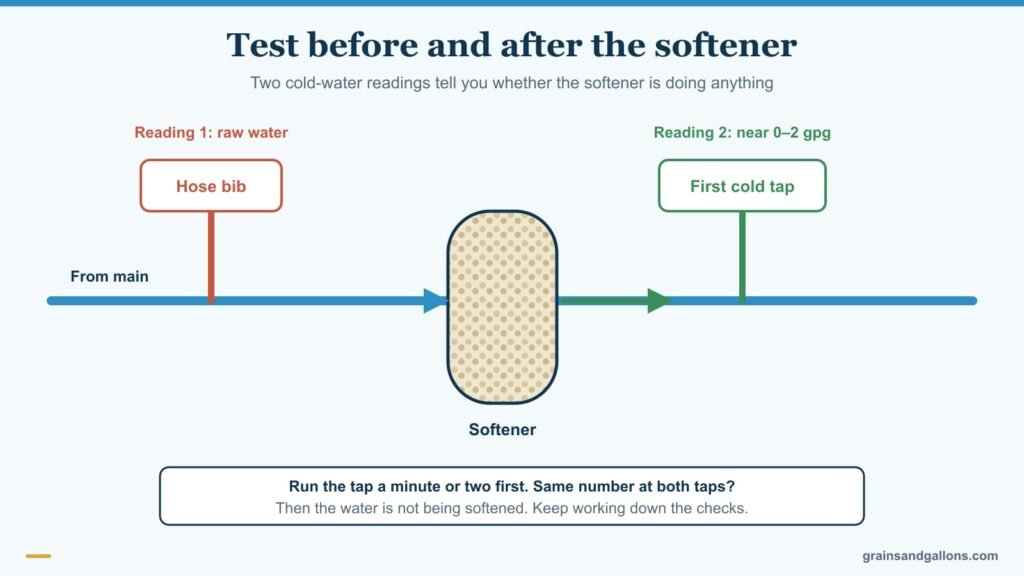
- Use the first cold tap downstream of the softener, such as a laundry tub.
- Run it for a minute or two to clear water left in the pipes.
- Test with hardness strips or a drop-count kit. Softened water should read close to zero, roughly 0 to 2 grains per gallon (gpg).
Then test a tap you know is unsoftened, often an outdoor hose bib, for a "before" number. If both readings match, the softener isn't treating that water. Our guide to the best water hardness test kits compares strips and more precise titration kits, and why hardness tests differ between faucets explains mixed readings.
Check the bypass handle and the flow arrows
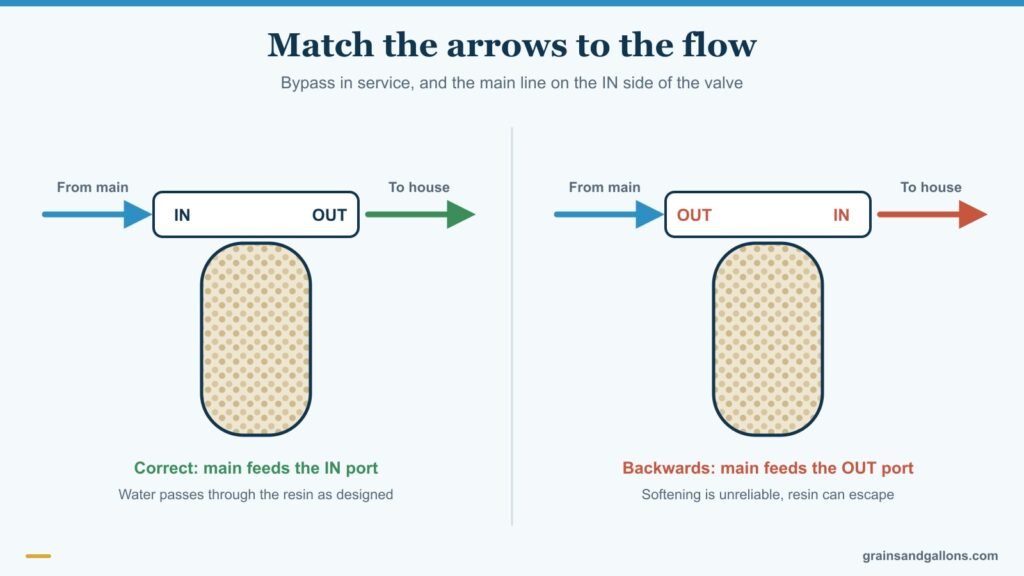
A bypass left in the wrong spot is the most common cause. Push-pull knobs and twin handles look much the same in "service" and "bypass," and a valve left partway blends raw water into soft. GE's softener troubleshooting chart lists the bypass position among its most common no-soft-water problems. Set the handle fully to service; if it's cracked or stuck, don't force it (see our replacement bypass valves).
Check direction too. The arrow on the valve should point away from the main and toward the house. If inlet and outlet are swapped, softening is unreliable and resin can reach your faucets. More signs in softener plumbed backwards.
Run a full startup regeneration with salt and water

Many new softeners need a manual regeneration after installation to fully charge the resin. If that startup was skipped or cut short, the resin may be partly spent.
Before you start one, look in the brine tank:
- Salt level. GE's manual says the tank should be at least one-third full.
- Water in the bottom. No water means no brine, so nothing recharges even when the valve cycles. Our guide to no water in the brine tank covers the causes.
- No salt bridge. A hard crust can form above the water with an empty gap below. Push a broom handle down gently; if it hits a solid layer, break it up.
Start the regeneration (see how to manually regenerate a water softener) and watch the brine level fall during the draw step. If it doesn't drop, suspect the brine line or injector. Test again the next morning.
Set the hardness for your water, not the factory default
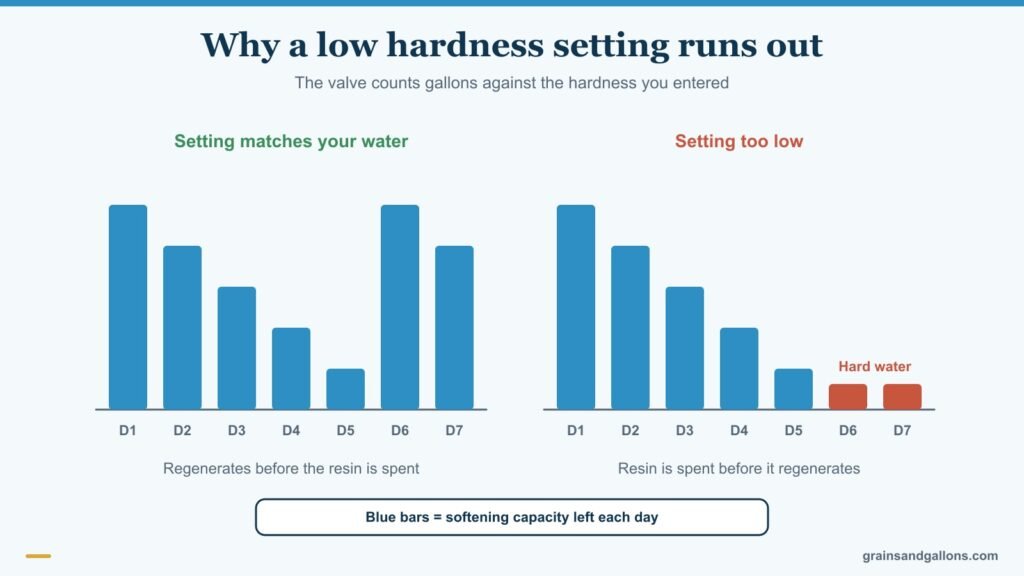
A metered softener counts gallons against the hardness you entered. Set it too low and it waits too long to regenerate, giving soft water right after a regeneration and hard water a few days later.
- Hardness should match your tested raw water in grains per gallon. Penn State Extension notes that 1 gpg is about 17 ppm, so divide a ppm lab result by 17.1.
- Iron adds load. Many installers add about 3 to 5 grains for every ppm of iron; follow your valve maker's guidance.
- Capacity, salt dose and reserve should suit your tank size, not a default meant for another model.
- Clock and regeneration time need resetting after any power loss.
Step-by-step menus are in how to set hardness on a water softener.
Find water that never reaches the softener

Sometimes the softener is fine but part of your water skips it:
- Isolated fixtures. Installers often leave outdoor faucets, toilets or the kitchen cold line unsoftened on purpose. GE's manual also warns that a single-lever kitchen faucet with hard cold water will mix hard and soft, so don't sample there.
- Hot water from before the install. A tank heater can take days to turn over its water, and loosened scale can flake out. Test hot and cold separately.
- Hot water used during regeneration. Most valves send raw water to the house while they regenerate, so the heater refills with hard water. GE advises avoiding hot water during a recharge.
- A branch upstream of the softener that feeds part of the house.
Water still hard after installing softener? Match the timing
| When it's hard | Most likely cause |
|---|---|
| All the time, every tap | Bypass, never regenerated, no brine or a salt bridge |
| Soft after regeneration, hard a few days later | Hardness setting or capacity too low |
| Only at certain taps | Those lines skip the softener |
| Only hot water | Heater still flushing old water and scale |
| Only during heavy use | Flow beyond the unit's rated service flow |
If everything above checks out, look at bigger issues. An undersized softener may regenerate so often it can't keep up. On well water, Penn State warns that oxidized iron will clog the resin, which is why many homes need an iron filter before the softener. A used or refurbished unit may also have worn or chlorine-damaged resin.
FAQ
How long does a new water softener take to soften water?
Most systems soften fully within a day or two, once a complete regeneration has charged the resin and old hard water has flushed from the pipes. The water heater can take several more days, so test cold water first.
Why is my soft water hard again a few days after regenerating?
The hardness setting is usually too low, or the capacity is set for a smaller tank, so the resin runs out before the valve regenerates. Enter your real hardness in grains per gallon, plus extra for iron.
Can I use water while the softener regenerates?
Yes, but most valves pass raw water to the house during regeneration, so hot water used then refills the heater with hard water. That's why regeneration is usually scheduled for the early morning.
What hardness reading means the softener is working?
About 0 to 2 grains per gallon at a cold tap after the softener. A reading close to your raw water means the water is bypassing the resin or the resin isn't being recharged.
Bring your test numbers when you call the installer
If all eight checks pass and you're left with water still hard after installing softener equipment, call the installer or manufacturer. Give them your raw and softened readings, your valve settings and when the hardness shows up. Those details point straight at sizing, iron or a faulty valve much faster than "it's not working."