

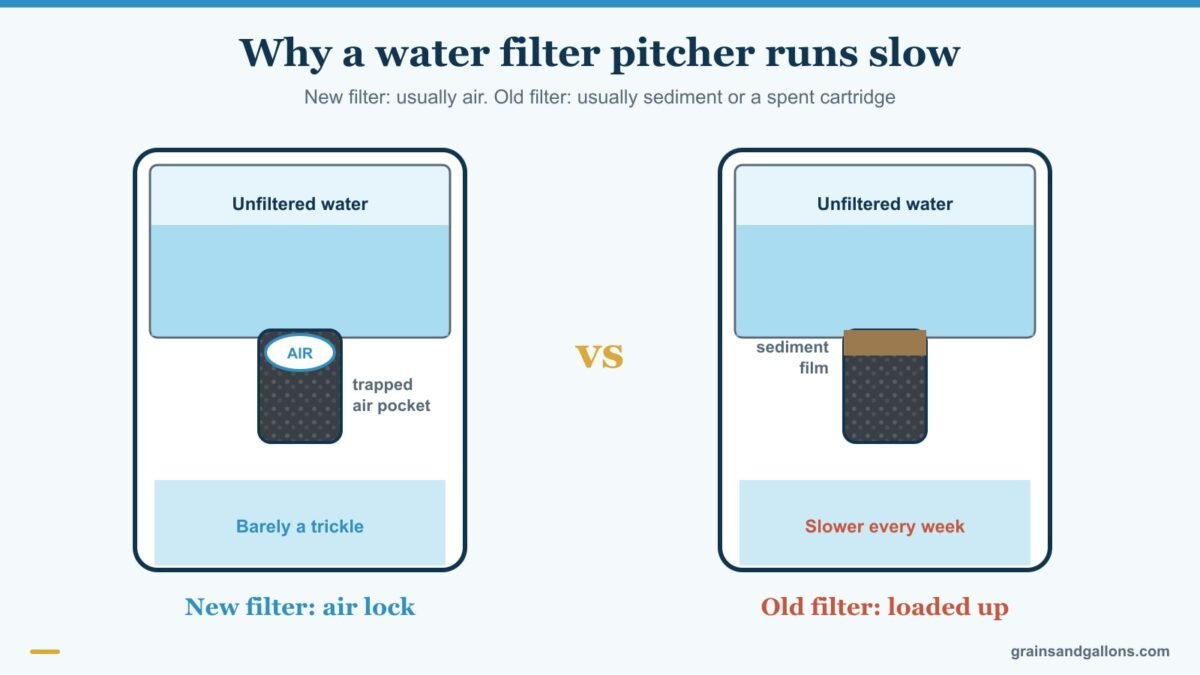
Quick Answer: A water filter pitcher slow from the first fill almost always has air trapped in the new cartridge: flush or soak it, tap it underwater until the bubbles stop, and push it in until it seats flush. A pitcher that has slowed down over weeks has a filter loaded with sediment or past its rated life, and the fix is a new cartridge.
If your water filter pitcher is slow, the cause is almost always one of two things, and the age of the filter tells you which. You poured a full reservoir and came back ten minutes later to find most of it still sitting there, or a pitcher that used to fill in a few minutes now takes half an hour. Pitcher filters work by gravity alone, with only a few inches of water pushing down on the media, so anything in the way, even one bubble, has an outsized effect.
In this guide
Why is my water filter pitcher slow? Start with the filter's age

Ask one question first: is the cartridge new?
- New, and it barely drips: air lock. The dry media holds air, and a pocket forms that the light pressure of the water can't push past. Bubbles rising from the filter now and then are the giveaway.
- Months old, and slower every week: the cartridge is loading up with particles, or it's simply at the end of its life.
- Either age, and something feels off: check the small mechanical causes further down, like a crooked reservoir or a blocked lid vent.
How long a full reservoir should take
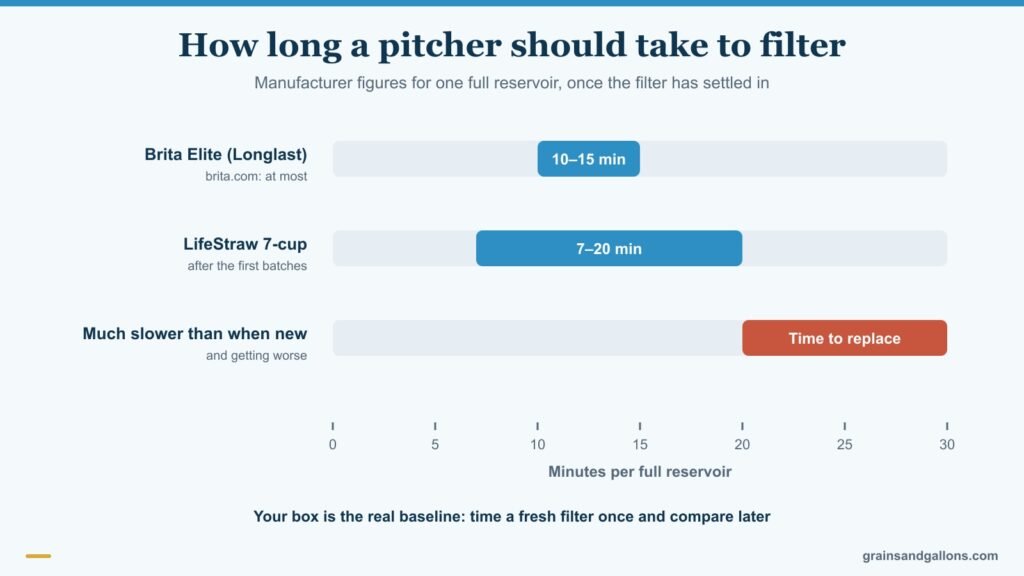
Before you fix anything, make sure it's actually slow. Pitchers vary a lot by filter design:
- Brita Elite (formerly Longlast): Brita's own FAQ says these filters should take at most 10–15 minutes to filter a full reservoir.
- LifeStraw 7-cup pitcher: LifeStraw's help page on slow new filters puts a full pitcher at about 7 to 20 minutes once the membrane has run a few batches, and says new filters often start slowly and improve with use.
- Fine, long-life filters: cartridges that remove more (lead, PFAS, a "0 TDS" reading) generally run slower than basic carbon cartridges. That's the trade-off for more contact time, not a defect.
The best baseline is your own. Time a fresh filter once, and you'll know when it has slowed for real.
Clear the air lock in a new cartridge
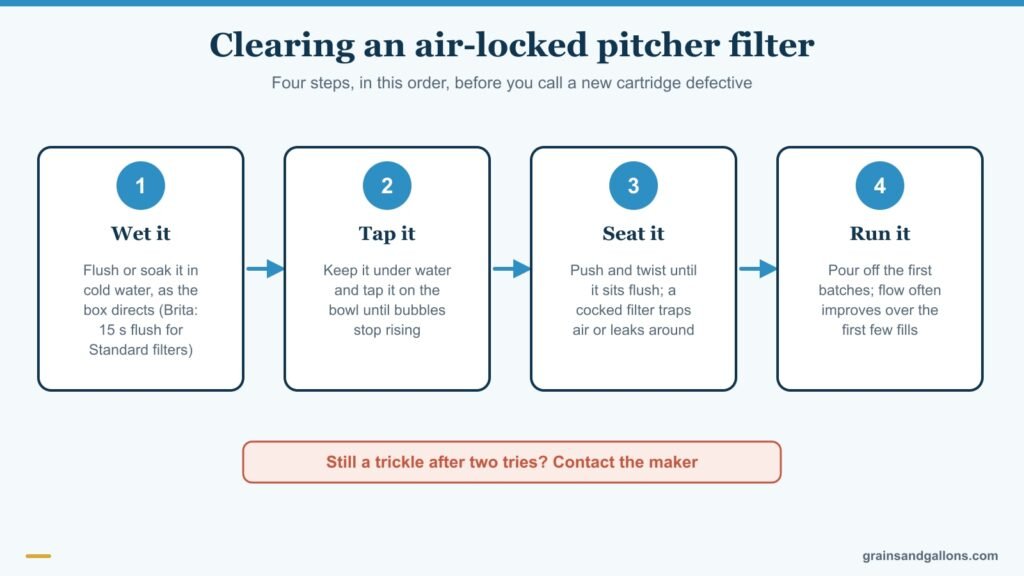
An air bubble in a pitcher filter is the most common reason a brand-new one won't filter. Here's how to clear it:
- Wet it the way the box says. Brands differ. Brita's FAQ says to flush its Standard filters under cold water for 15 seconds, while older-style filters get a 15-minute soak. If yours calls for a soak, keep it fully submerged in a bowl of cold water.
- Tap out the bubbles. While it's underwater, tap it against the bottom of the bowl, or tilt and gently shake it, until no more bubbles rise. LifeStraw suggests the same tap-or-shake trick for its housings.
- Seat it properly. Most cartridges need a firm push, and some need a twist, until they click or sit flush. A slightly cocked filter can trap air at the seal or let water leak around it unfiltered.
- Run it in. Pour off the first batches as your manufacturer directs. Brita says to discard the first three containers from an Elite filter, and LifeStraw recommends pouring out four to five batches.
Still a trickle after two honest attempts? Treat it as a faulty cartridge and contact the maker. It happens.
Old cartridges clog with sediment and wear out
Pitcher filters hold activated carbon and, in many, ion-exchange resin, sealed behind a fine mesh or membrane. Over weeks, particles collect on that media and the flow slows gradually. That slowdown is one of the clearer signs the filter is near the end of its life.
Two clues point here:
- It's past its gallon or month rating. Brita rates its Standard filter at 40 gallons (about two months) and Elite at 120 gallons (about six months). Check the date you wrote down or the indicator.
- Your water carries sediment. Brita's FAQ names high sediment levels in tap water as a common cause of slow filtering, and says you may need to change filters more often. Old galvanized pipes, a recent water main break, or well water can clog a pitcher filter well before its rating.
A clogged pitcher filter can't be washed back to life. The media isn't designed for it, so replace it. If you're replacing them much faster than rated, fix the sediment upstream: a faucet-mounted filter or a sediment filter on the line takes the load off the pitcher.
Does hard water make pitchers slower?
Not much on its own. Calcium and magnesium are dissolved, so they don't block the mesh the way sediment does. What hard water does is use up a resin filter's limited exchange capacity faster, which usually shows up as scale returning in your kettle rather than slow flow. Our explainer on whether filtering softens water covers what a pitcher can and can't do with hardness, and Brita vs PUR for hard water compares the two biggest brands. If you own a TDS meter, a rising reading on a "0 TDS" style filter is a reliable sign it's spent; our guide to using a TDS meter explains what the number does and doesn't tell you.
Aeration, lid vents and a crooked reservoir
If the filter checks out, look at the pitcher itself:
- Filling from a full-blast faucet. Brita notes that aeration can slow filtering and advises against opening the faucet to a full stream. A gentler fill puts fewer bubbles into the reservoir.
- The lid vent. A tight lid with no vent can create a slight vacuum as water drains. Lift the lid and see if the flow picks up.
- A crooked reservoir. If the top reservoir sits at an angle, it presses the filter off-center.
- Scale on the filter seat. In hard-water homes, a crust can build up where the cartridge seals. Scrub the seat with a soft brush and a little vinegar, then rinse well.
- Ice-cold water. Water straight from the fridge runs a little slower through any filter than cool tap water does.
FAQ
Why is my brand-new Brita filter not filtering?
It's almost always trapped air or a filter that isn't fully seated. Remove it, flush or soak it as the box directs, tap it underwater until bubbles stop, then push it down until it sits flush.
Can I clean a clogged pitcher filter instead of replacing it?
No. The carbon and resin inside aren't made to be washed, and rinsing won't remove what has lodged in the media. Tapping out an air bubble is fine; a cartridge clogged with sediment needs replacing.
Is a slower filter a better filter?
Not by default, though fine filters that remove more contaminants usually run slower because the water spends more time in contact with the media. Compare against your brand's stated time, not against a different filter.
How often should I replace a pitcher filter?
Follow the gallon or month rating on the box, whichever comes first, and sooner if flow drops noticeably. Brita's ratings are 40 gallons for Standard and 120 gallons for Elite filters.
Why does my pitcher filter float?
Air in the dry media makes it buoyant, and that same air is what blocks the flow. Soaking it until it sinks and stops releasing bubbles usually fixes both.
Purge the air, then replace a spent filter
A water filter pitcher slow from day one needs the air worked out of its cartridge. One that has slowed over months needs a new one, plus a look at sediment if that keeps happening early. For certified options and what each filter type removes, the EPA's home drinking water filtration fact sheet is a good starting point. If waiting on a small reservoir is the real problem, our roundups of the best water filter dispensers and best water filter pitchers for hard water cover bigger batches, and a faucet water filter gives you filtered water on demand without any wait.