

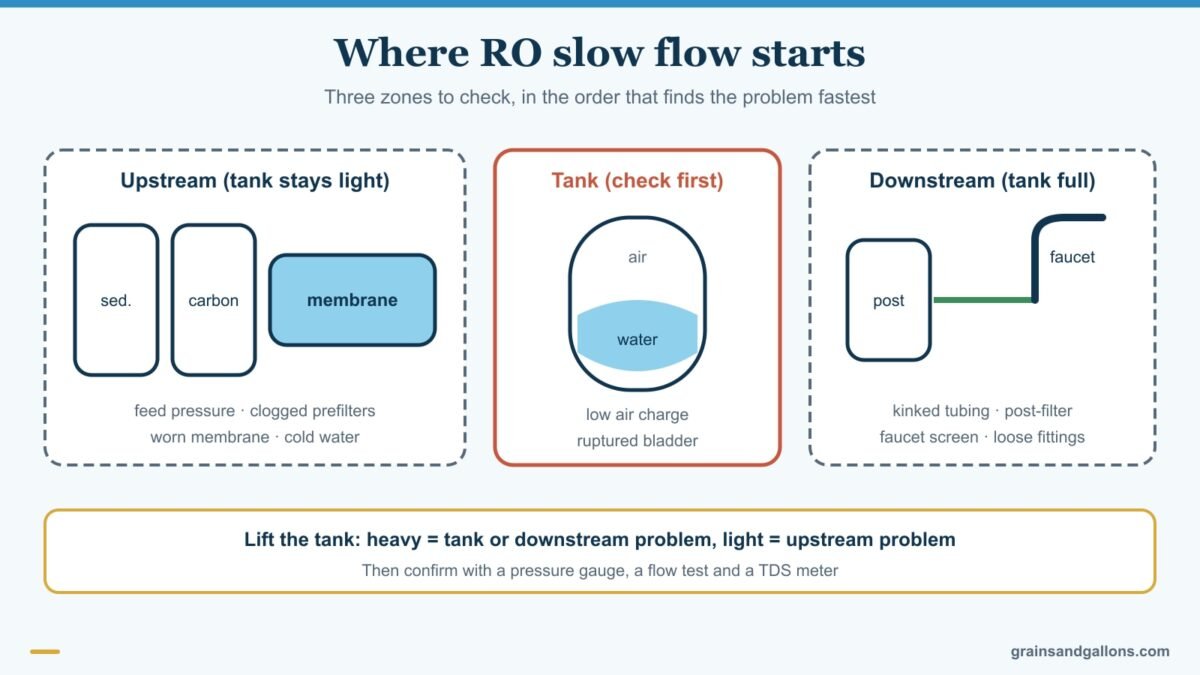
Quick Answer: Reverse osmosis slow flow usually comes from the storage tank. Shut off the feed valve, drain the tank through the RO faucet, then check the air valve with a low-pressure gauge. Most tanks want roughly 5 to 8 psi when empty (check your tank's label). If the tank is fine, the cause is upstream: low house pressure, clogged prefilters, a worn membrane or cold water.
Disclosure: As an Amazon Associate, Grains & Gallons earns from qualifying purchases.
Reverse osmosis slow flow has only two root causes: either the tank isn't filling, or the tank is full but can't push the water out. A 30-second test tells you which.
In this guide
- Heavy tank or light tank? The 30-second test
- Recharge the tank's air pressure first
- Is your house water pressure too low for RO?
- Find where the flow dies: prefilters or membrane
- Cold water slows every RO system in winter
- Check the tubing, post-filter and faucet
- Measure output to confirm the fix
- When a new system makes more sense
- FAQ
- Start at the tank, then work upstream
Heavy tank or light tank? The 30-second test
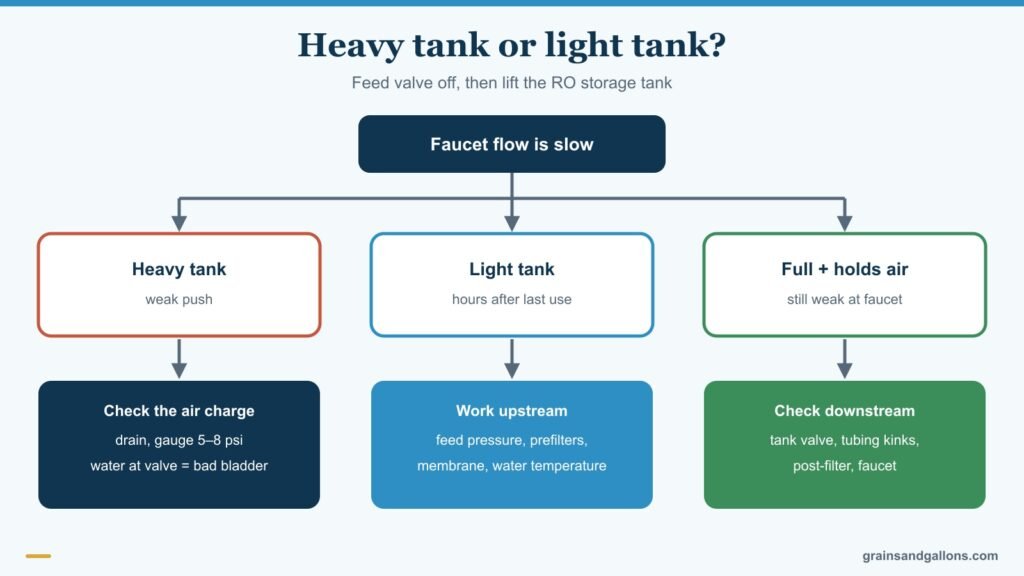
Shut off the feed valve on the cold line where the RO tubing connects. Then lift or tip the storage tank.
- Tank feels heavy, but the faucet is weak. The water is there, but nothing is pushing it out. That's almost always low air pressure in the tank, or a failed bladder.
- Tank feels light hours after you last used it. The system isn't making water fast enough to fill it. The cause is upstream: low feed pressure, clogged prefilters, a tired membrane, cold water or a stuck valve. Our guide to an RO tank not filling goes deeper on that side.
- Tank is full and holds air, but flow is still weak. The restriction is between the tank and the faucet: the post-filter, a kinked line, a half-seated fitting or the faucet itself.
Recharge the tank's air pressure first
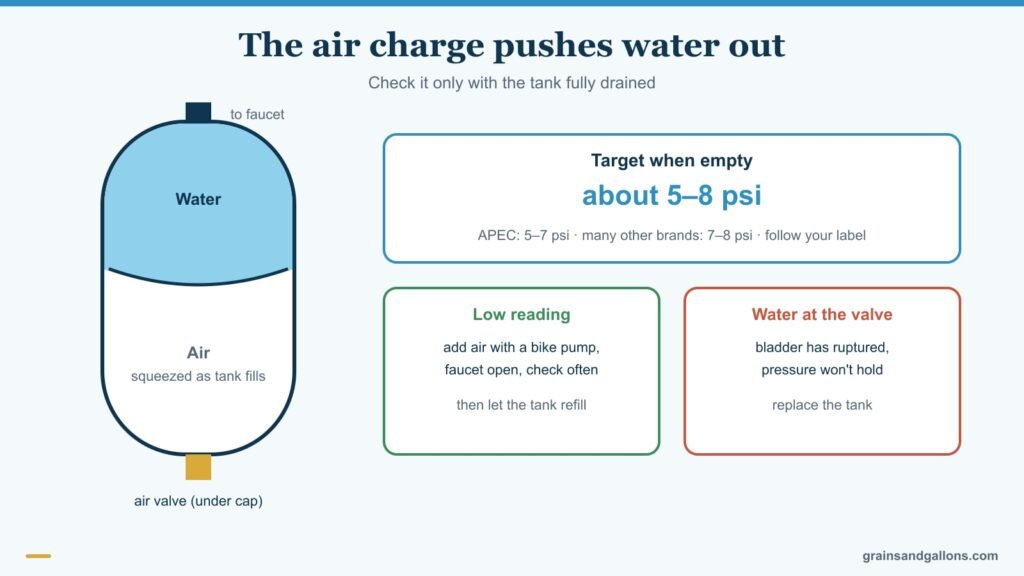
An RO tank holds a rubber bladder or diaphragm. Water fills one side and squeezes air on the other, and that compressed air pushes water to the faucet. Over months the air slowly leaks away, so the tank can be full and still give you a weak stream.
The APEC RO system manual shows how much this matters: on its 4-gallon tank, delivery pressure drops from about 50 psi when the tank is full to about 10 psi with half a gallon left. A tank that's low on air starts the whole curve lower.
How to check and fix it:
- Turn off the feed valve.
- Open the RO faucet and let it run until the flow stops. The tank must be empty, or the reading will be wrong.
- Find the air valve. It looks like a tire valve, usually under a blue or black plastic cap on the side or bottom of the tank.
- Check it with a low-pressure tire gauge. APEC specifies 5 to 7 psi empty; many other brands say 7 to 8 psi. Use the number on your tank's label or in your manual.
- If it's low, add air with a bike pump, slowly, checking often. Keep the faucet open while you pump, and a little more water may come out.
- Close the faucet, open the feed valve and let the tank refill. That can take a couple of hours.
Signs of a ruptured bladder
About one glass of good flow followed by a trickle, or air pressure that won't hold, means the bladder has likely failed. APEC's test: press the air valve stem with a small screwdriver. If water comes out, replace the tank; no amount of pumping will fix it.
Is your house water pressure too low for RO?
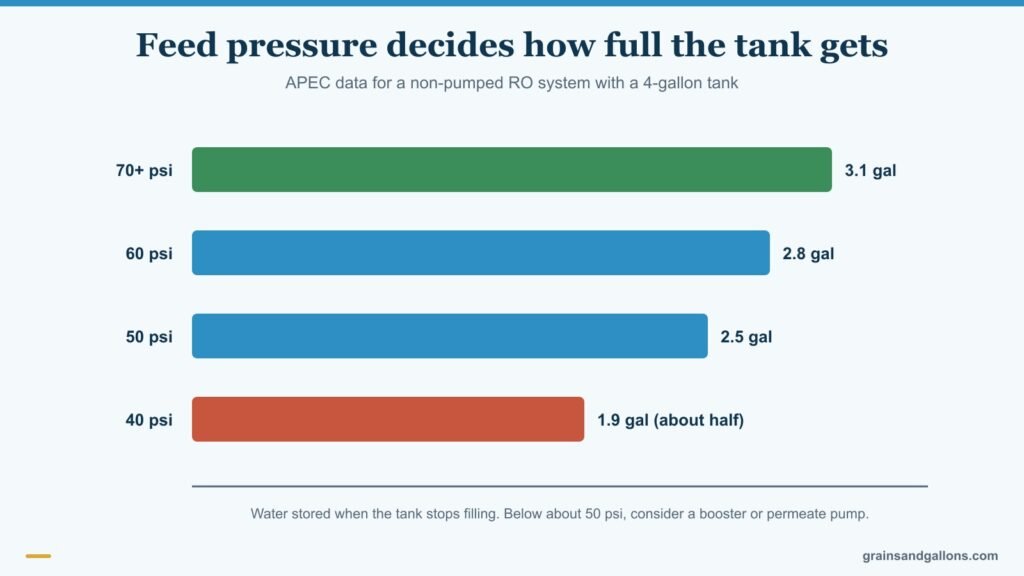
RO needs pressure to push water through the membrane and into a tank that pushes back harder as it fills. Low feed pressure means a half-full tank and weak flow, even with new filters.
APEC's manual puts numbers on it for a non-pumped system with a 4-gallon tank:
| Feed pressure | Water in the tank when it stops filling |
|---|---|
| 70+ psi | about 3.1 gallons (almost full) |
| 60 psi | about 2.8 gallons |
| 50 psi | about 2.5 gallons |
| 40 psi | about 1.9 gallons (about half) |
Check your house pressure with a hose-bib gauge at an outdoor spigot. On a well, read it at the low end of the pump cycle, just before the pump kicks on, because that's when the RO is struggling most. If you're consistently under about 40 to 50 psi, a booster pump or a permeate pump designed for your system is the usual fix.
Find where the flow dies: prefilters or membrane
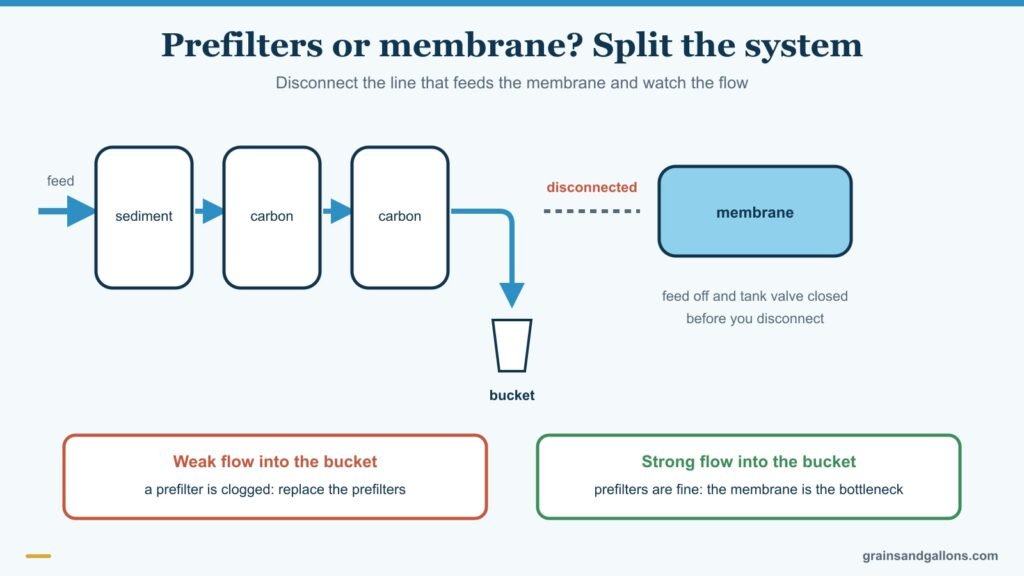
If the tank is light and your pressure is fine, something upstream is choking production. APEC's manual gives a simple way to split the problem in two:
- Turn off the feed valve and close the tank valve. Open the RO faucet to release pressure.
- Disconnect the tubing coming out of the last prefilter (the line that feeds the membrane housing) and aim it into a bucket.
- Slowly open the feed valve.
Weak flow from that tube? One or more prefilters is clogged. Replace the sediment and carbon stages. If they're overdue, this is almost always the answer. Our guide on how to change RO filters and the membrane covers the order and the flush.
Strong flow from that tube? The prefilters are fine and the membrane is the bottleneck. Membranes slow down as they foul or scale, and very hard water and chlorine both shorten their life. If your home has hard water and no softener, that may be why the membrane wore out early; see reverse osmosis and a water softener together.
A TDS meter confirms a worn membrane. Compare the tap with the RO faucet using a handheld meter like the HM Digital TDS-3. If the RO reading has climbed toward the tap reading, the membrane is done. How to use a TDS meter explains the rejection math.
Cold water slows every RO system in winter

If the slowdown showed up in December and nothing else changed, the water temperature may be the whole story. University of Nebraska Extension's reverse osmosis guide says production drops 1 to 2 percent for every degree below the standard 77°F test temperature, and well water at 45°F makes roughly half the water it would at 77°F.
APEC rates its systems at 50 psi and 77°F, so winter output below the rating is normal, not a fault. If it isn't enough for your household, a booster pump helps make up for the cold.
Check the tubing, post-filter and faucet
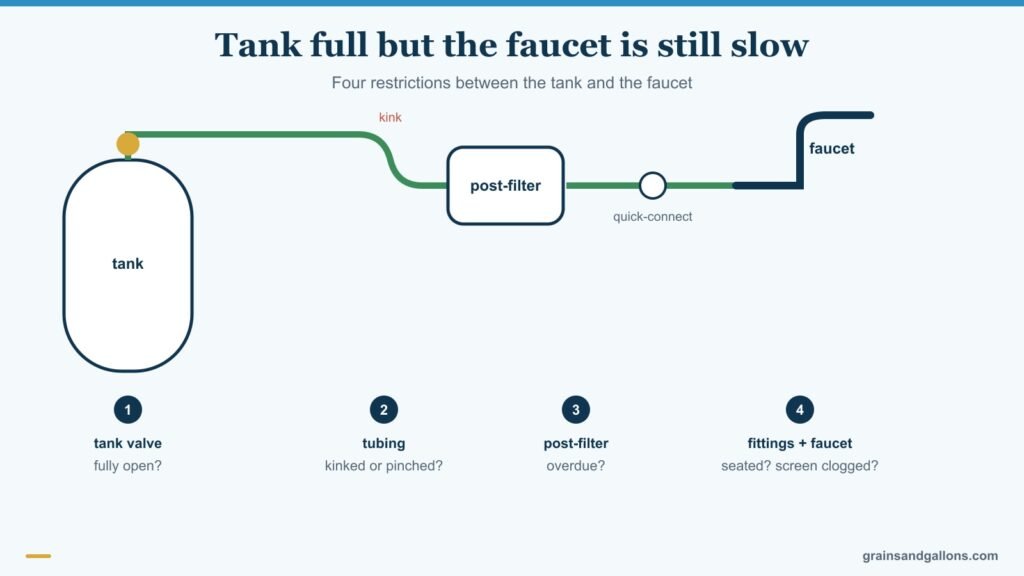
When the tank is full and holds its air charge, the problem is on the short run from the tank to the faucet:
- Kinked tubing. Look for flattened tubing behind bins or pinched by a cabinet door.
- Tank valve partly closed. The small ball valve on top of the tank should be fully open, with the handle in line with the tubing.
- Clogged post-filter. The final carbon or remineralization cartridge before the faucet can clog. If it's overdue, change it.
- The faucet itself. Some RO faucets have a small screen. Disconnect the tube at the faucet and check the flow there.
- Quick-connect fittings. A tube that isn't fully seated can restrict flow or leak. Push it in firmly, then tug gently to make sure the collet holds.
Measure output to confirm the fix
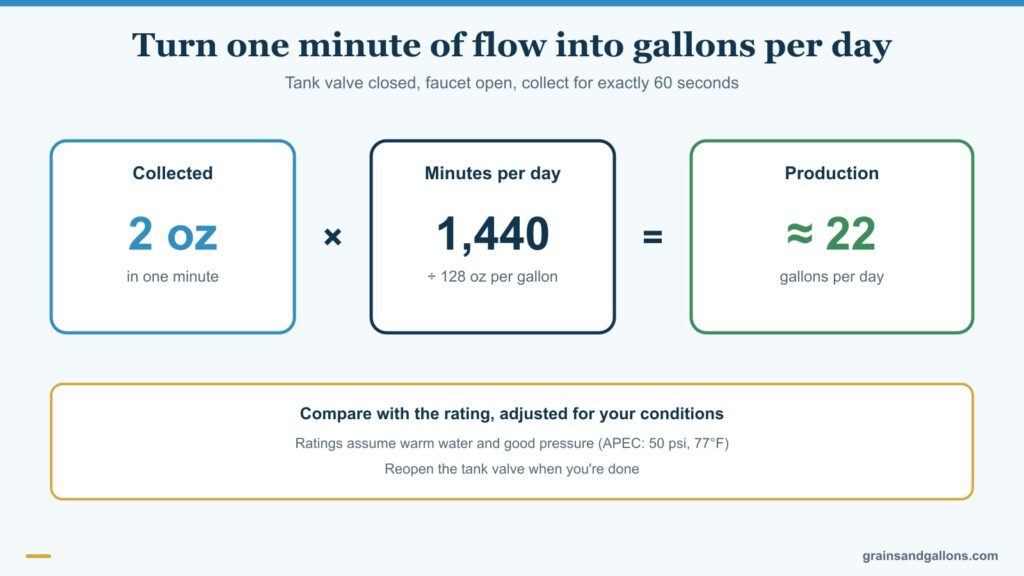
Once you've made a change, check that production actually came back:
- Close the tank valve so the membrane's output goes straight to the faucet.
- Open the RO faucet, wait a few minutes for the flow to settle, then collect water for exactly one minute in a measuring cup.
- Multiply the ounces per minute by 1,440 (minutes in a day) and divide by 128 (ounces in a gallon).
For example, 2 ounces per minute is about 22 gallons per day. Compare that with your system's rating, which assumes warm water and good pressure, then reopen the tank valve.
When a new system makes more sense
If the membrane is several years old and the tank won't hold air, parts can cost close to a new unit. A tankless or permeate-pump system may suit you better if slow refill is the main complaint. Our Waterdrop vs. iSpring RO comparison covers tank versus tankless, and the Express Water RO5DX review covers a simple five-stage tank system.
FAQ
What causes reverse osmosis slow flow all of a sudden?
A sudden change usually means the tank lost its air charge, a line got kinked, or a prefilter clogged. A gradual slowdown over months points to a fouling membrane or overdue filters.
What should the air pressure be in an RO tank?
Usually about 5 to 8 psi with the tank completely empty. APEC specifies 5 to 7 psi and many other brands use 7 to 8 psi, so go by your tank's label. Always drain the tank before measuring.
How long should an RO tank take to fill?
It depends on the membrane rating, pressure and water temperature. APEC says its high-output model fills a 4-gallon tank in about 1 to 1.5 hours at 50 psi and 77°F; slower membranes and colder water take longer, often a few hours.
Can low water pressure cause slow RO flow?
Yes. Below roughly 40 to 50 psi, a non-pumped system makes water slowly and the tank only partly fills, so the faucet flow is weak and fades quickly. A booster pump is the usual fix.
Start at the tank, then work upstream
Most reverse osmosis slow flow is fixed in under an hour once you know which half of the system to look at. A heavy tank with a weak faucet needs air or a new bladder. A light tank means the system can't keep up, so check house pressure, then the prefilters, then the membrane, and remember that winter water slows everything down. Measure production after the fix so you know it's really back.