

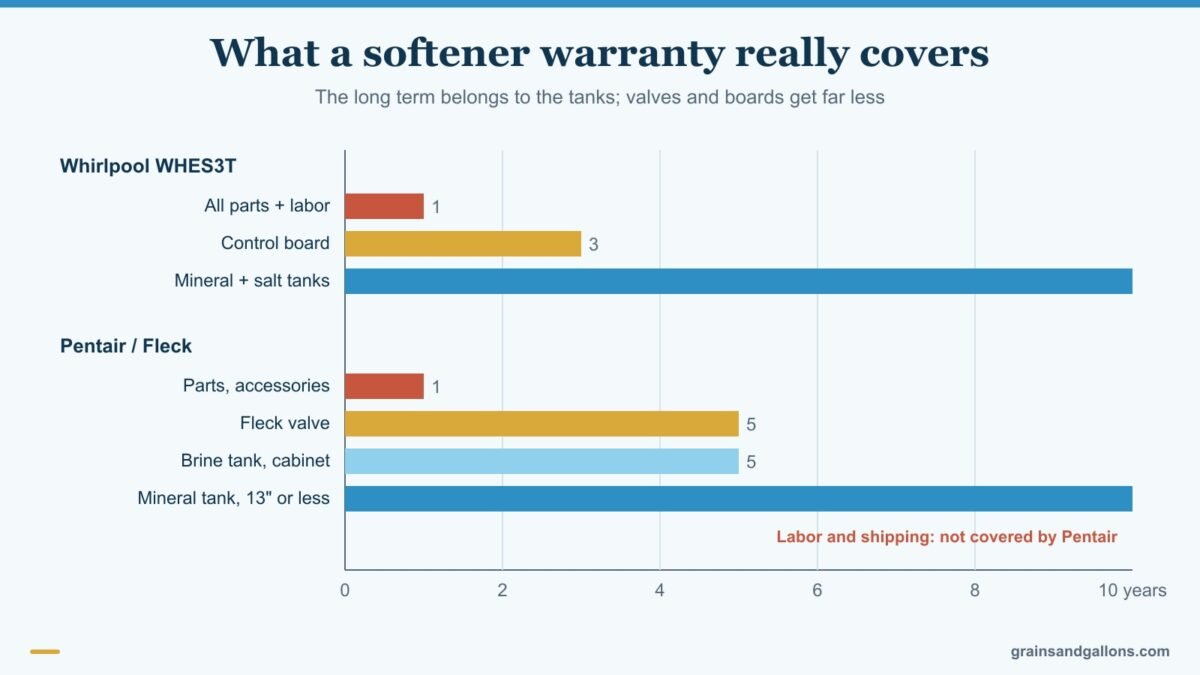
Quick Answer: To learn how to read a water softener warranty, start by treating it as several warranties: one each for the tanks, the control valve, the electronics and small parts. The long numbers almost always belong to the tanks. Then check the term on the valve and electronics, whether labor and shipping are covered, who is covered (original buyer and original installation only?), what voids it, such as freezing, high pressure or non-brand parts, and whether registration or a maintenance plan is required.
"Lifetime warranty" is printed across the box. The softener costs a lot of money, and you're counting on that line. But the parts that usually fail on a softener are the control valve's seals, motor and circuit board, and those are rarely what "lifetime" or "10 years" refers to. Knowing how to read a water softener warranty means finding the term on those parts, the labor clause and the exclusions before you buy. Two real warranties, from Whirlpool and from Pentair (the maker of Fleck valves), show what to look for.
In this guide
- How to read a water softener warranty part by part
- Labor and shipping can shrink a long warranty
- Whose warranty is it, and does it follow the softener?
- Exclusions that quietly void coverage
- Registration, maintenance plans and pro-rating
- Filing a claim without getting bounced
- Compare two softeners' warranties side by side
- What a softener warranty won't pay for
- Judge the valve term and the labor clause, not the tank number
- FAQ
How to read a water softener warranty part by part

Almost every softener warranty splits coverage by component. The headline number is the longest one on the list.
Whirlpool WHES3T (owner's manual):
- 1 year full warranty: all parts, with labor to repair or replace defective parts included
- 3 years limited: electronic control board
- 10 years limited: salt storage tank and fiberglass mineral tank (against rusting, corroding, leaking or bursting)
Pentair (Fleck and Autotrol valves and tanks, from the Pentair residential filtration warranty):
- Fleck and Autotrol valves: 5 years
- U.S.-made Structural PolyGlass mineral tanks: 10 years for 13" diameter and smaller, 5 years for 14" and larger
- U.S.-made brine tanks and cabinets: 5 years
- Parts and accessories: 1 year
Two details in Pentair's document are easy to miss. Coverage starts on the date Pentair ships the product, not the day you install it. And a replacement part is warranted only for the rest of the original term or 30 days, whichever is longer, so a new valve in year four doesn't restart the clock.
The valve term is the one to compare between brands, because that's where most repair bills come from. A tank warranty is nice, but fiberglass tanks rarely fail in normal use. Resin is the other line to look for: some warranties cover it separately, many don't mention it at all. Our article on how long a water softener lasts explains which parts wear out first.
Labor and shipping can shrink a long warranty

This is where a long warranty can shrink fast. Whirlpool covers labor only during the first year. After that, the parts may be covered but you pay to install them.
Pentair's warranty is stricter. It lists labor expenses as an exclusion and says Pentair isn't responsible for shipping or transportation costs, travel or time. To claim, you ship the failed part back freight prepaid, with a Return Goods Authorization form from Pentair's customer care.
So a "5-year valve warranty" can mean a free circuit board in year three, but you still pay for a service call, or you install it yourself. If you're comfortable swapping a board or a seal kit, that's fine. If you'd rather never open the valve, labor coverage is worth more to you than tank years. Ask the seller directly whether they cover labor or ship parts free; some do on their own systems even when the valve maker doesn't.
Whose warranty is it, and does it follow the softener?
Many online softeners are built by a seller using a Fleck or Clack valve on their own tanks. In that case:
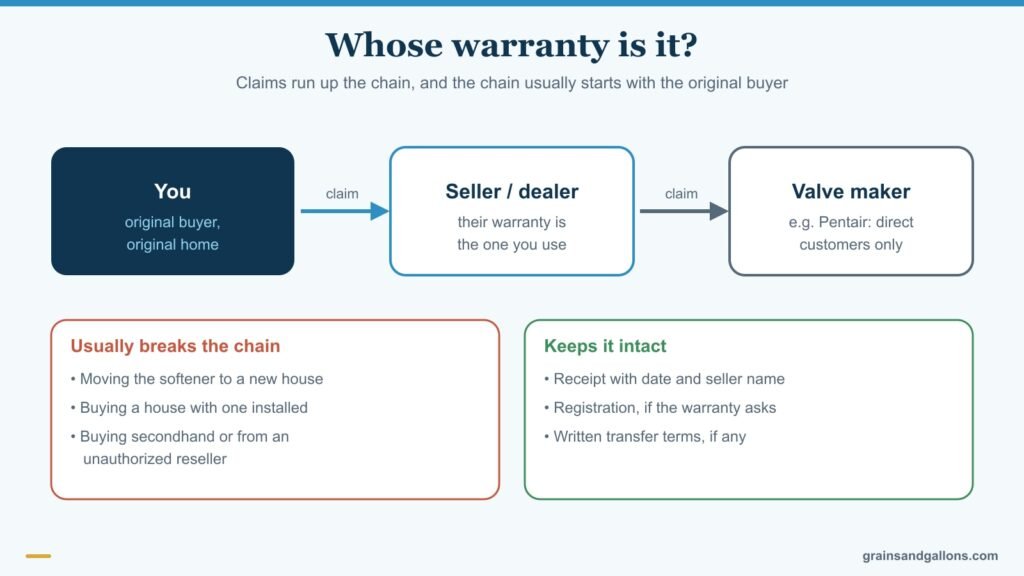
- The seller's warranty is the one you claim against. Read theirs, not the valve maker's.
- The valve maker's warranty may only run to its direct customers. Pentair's says so plainly: it extends to direct transactional customers, and secondary customers submit claims through their direct suppliers.
That's not a problem if the seller is responsive. It does mean the seller's reputation and support are part of the warranty's value. Our best Fleck valve softeners list compares systems from several sellers built on the same valve, which is exactly where the seller's warranty and support become the deciding factor.
Original buyer, original home. Most warranties stop there. Whirlpool's covers consumer-owned installations. Pentair's covers the original purchaser and the original home installation only. If you move the softener to a new house, or buy a house with one already installed, assume the warranty didn't come with it unless the paperwork says it's transferable. If you're selling a home, a written transfer clause is worth pointing out to buyers.
Exclusions that quietly void coverage

These conditions show up again and again. Read for each one:
- Pressure and temperature limits. Whirlpool excludes operation above 125 psi or 120°F. Install a pressure-reducing valve if your house runs high.
- Freezing. Excluded by both Whirlpool and Pentair. A softener in a garage or crawl space needs protection.
- Installation not to the manual or code. Pentair excludes failure to install or maintain the product as the owner's manual says, use outside the water conditions the manual specifies, and noncompliance with plumbing codes.
- Oxidizers and chemicals. Pentair excludes damage from oxidizing agents and corrosive chemicals. That's relevant if you have heavily chlorinated or chloraminated water, or if you shock-chlorinate a well upstream of the softener.
- Non-brand parts. Pentair says putting third-party parts, including seal kits, pistons, motors and bypass valves, into its product completely voids the warranty for that product.
- Normal wear and tear. Pentair lists it outright. Seals, spacers and pistons often fall here.
Some sellers add their own rules, such as a required salt type or professional installation. Those live in the seller's warranty, so read it for the words "must," "required" and "void."
Registration, maintenance plans and pro-rating

Some warranties grow if you follow a maintenance plan. Whirlpool's extended warranty program stretches the base warranty from 1 year to 5 on the WHES30, WHES33, WHES40 and WHES44, and from 2 years to 10 on Pro Series models such as the WHES48. Both require product registration and regular use of Whirlpool's own softener cleanser; the WHES3T manual specifies the WHE-WSC cleaner every four months and says other additives don't qualify.
Registration matters even where it doesn't extend anything. Pentair's warranty notes that California and Quebec residents don't lose warranty rights by skipping registration, which tells you it counts elsewhere. Register the day you install, and screenshot the confirmation.
Pro-rated warranties pay a shrinking share of the part cost as the years pass, so a "10-year" pro-rated term may be worth little by year eight. If the document mentions a schedule, percentage or "pro rata," read that table before you count the years.
Keep proof that you followed the rules: your receipt, a photo of the install showing the bypass and drain air gap, a note of the house water pressure, and receipts for any required cleaner.
Filing a claim without getting bounced

When something fails, the order you do things in matters:
- Pin down the part. Note the error code or symptom, the model and serial number, and when it started. A vague "it stopped working" claim gets a slower answer.
- Contact the right party. Go to the seller or dealer first. Only go to the valve or tank maker directly if you bought from them.
- Send the evidence. Receipt, install photos, pressure reading and registration confirmation answer most of the questions that delay claims.
- Return the part if asked. Expect a return authorization number, and expect to pay freight under warranties like Pentair's.
Don't wait. Pentair asks you to contact customer care as soon as possible after you find the problem and no later than the end of the warranty period. And don't fit a non-brand repair kit while you wait for an answer, since that can void the very coverage you're claiming.
Compare two softeners' warranties side by side
| Softener A | Softener B | |
|---|---|---|
| Control valve term | ||
| Electronics term | ||
| Mineral tank term | ||
| Resin covered? | ||
| Labor included? For how long? | ||
| Shipping paid by | ||
| Who handles claims | ||
| Transferable? | ||
| Registration required? | ||
| Pro-rated? | ||
| Pressure / temp / freeze exclusions |
Fill it in from the actual warranty document, not the product listing. Listings tend to quote the longest term only. If you're shopping in a budget range, run this table on the finalists from our best water softeners under $1,000 list.
What a softener warranty won't pay for

A softener warranty covers the softener. It doesn't cover the water damage when a fitting or tank lets go; Pentair's, like most, excludes incidental and consequential damages. That's a homeowners insurance question, and policies vary a lot. See whether homeowners insurance covers a softener leak. Salt, filters and routine maintenance aren't covered either. And once the warranty runs out, deciding between a repair and a new unit is a separate call; our repair or replace guide walks through it.
Judge the valve term and the labor clause, not the tank number
If you only remember one thing about how to read a water softener warranty, make it this: skip the headline and find three lines: how long the control valve and electronics are covered, who pays labor and shipping, and what voids it. Then confirm who you'd actually claim with, whether you must register or buy a cleaner, and whether the term is pro-rated. A five-year valve warranty from a seller who answers the phone is worth more than a lifetime tank warranty you'll never use.
FAQ
What does a lifetime water softener warranty usually cover?
Usually the tanks: the mineral tank and sometimes the brine tank or cabinet. Control valves and electronics typically carry much shorter terms, often 1 to 5 years, so check those lines separately.
Does a water softener warranty cover labor?
Often only for the first year, if at all. Whirlpool includes labor in its 1-year full warranty; Pentair excludes labor, travel and shipping costs entirely.
What voids a water softener warranty?
Common exclusions include freezing, running above the pressure or temperature limit, installation that doesn't follow the manual or code, damage from oxidizers or chemicals, and using non-brand replacement parts.
Is a water softener warranty transferable to a new owner?
Usually not. Most cover the original buyer at the original installation only. If transfer matters to you, look for a written transferability clause before you buy.
Do I have to register my water softener for the warranty?
Some warranties require it, and Whirlpool's extended warranties won't apply without it. Registering at installation costs nothing and removes one reason a claim could be refused.
Who do I contact for a warranty claim on a Fleck valve softener?
The seller or dealer you bought the system from. Pentair's warranty runs to its direct customers, and everyone else claims through their supplier.