


Quick Answer: A dishwasher white film on dishes is either hard water minerals or undissolved detergent. Wipe a plate with a damp finger: if it smears off, it's detergent, so clean the filter and spray arms. If it stays but dissolves in vinegar, it's minerals: fill the rinse aid, add a citric-acid booster such as Lemi Shine, and run an empty descaling cycle.
Disclosure: As an Amazon Associate, Grains & Gallons earns from qualifying purchases.
When the dishwasher leaves a white film on dishes, glasses look dusted with chalk and plastics turn hazy. Before you buy anything, find out which of two very different problems you have.
In this guide
- Wipe test: is dishwasher white film on dishes detergent or minerals?
- Free fixes: rinse aid, filter, spray arms and hot water
- Get the detergent dose and formula right
- Strip existing film off dishes and the machine
- When the water is simply too hard
- FAQ
- Rinse aid and the right dose fix most film; very hard water needs a softener
Wipe test: is dishwasher white film on dishes detergent or minerals?

- Wipe a filmed plate with a damp fingertip. A pasty or gritty smear is detergent that never dissolved or rinsed away.
- If it stays, put a few drops of white vinegar on it and wait a minute. If it disappears, it's calcium carbonate from hard water.
- If neither touches it and it's only on glass, it's probably etching, which is permanent. See cloudy glasses: etching or hard water.
Free fixes: rinse aid, filter, spray arms and hot water

Refill the rinse aid and turn it up
Rinse aid makes water sheet off instead of drying in beads, and those beads are where minerals end up. Refill it, and if the dispenser has a dose setting, turn it up a step. Finish Jet-Dry Rinse Aid is a fine start; our best rinse aids for hard water compares options.
Clean the filter and spray arms
A clogged filter recirculates dirty, detergent-heavy water onto dishes. Twist it out, rinse it and scrub the mesh; see cleaning a dishwasher filter clogged with scale. If film is worst on one rack, pop the spray arms off and clear each hole with a toothpick, soaking crusted arms in vinegar.
Start with hot water
Detergent dissolves poorly in lukewarm water. Run the kitchen tap until it's hot before starting; appliance guides commonly cite 120–150°F. Try the heated wash option for a few loads.
Get the detergent dose and formula right

Too much detergent leaves powdery residue, especially in soft water. Too little can't keep minerals suspended in hard water. Use a full dose of a hard-water formula if you have no softener, and often half a dose with softened water. Gels and powders let you adjust; pods don't. Replace detergent that has clumped.
GE Appliances ties the rise in white film to 2010, when phosphates were removed from dishwasher detergent. Phosphate kept calcium from redepositing, so a citric-acid booster with every load helps today's formulas in hard water. Choosing between brands? See Finish vs Cascade in hard water.
If your dishwasher has a hardness setting or a built-in softener with a salt reservoir, set it to your real hardness and keep the salt topped up. Our guide to adjusting a dishwasher after a water softener explains the settings.
Strip existing film off dishes and the machine
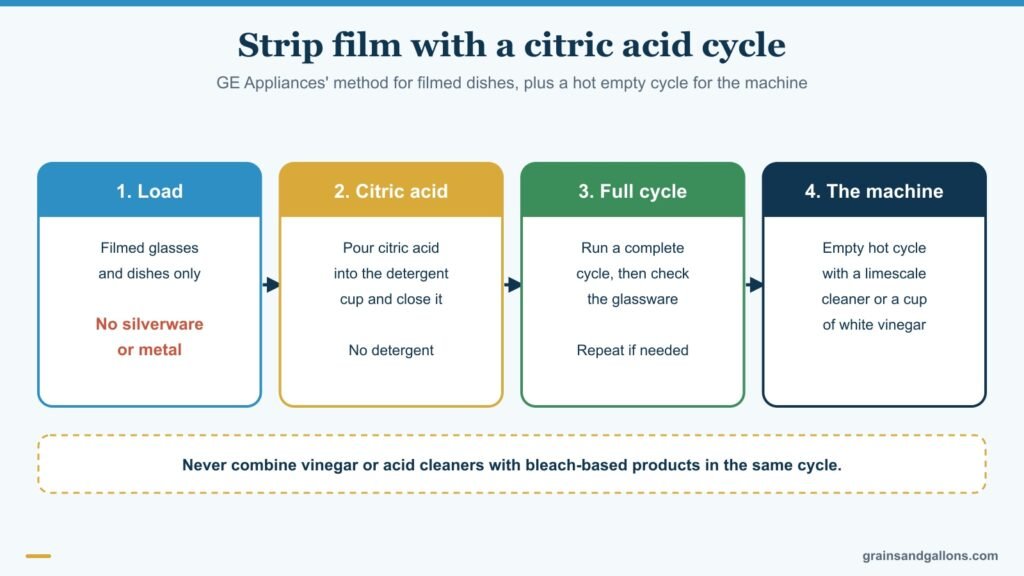
Scale inside the tub, pump and heating element keeps shedding minerals onto dishes. GE's method for filmed dishes: put citric acid in the detergent cup, load the filmed glassware and dishes (no silverware or metal), and run a full cycle with no detergent. For the machine, run an empty hot cycle with a limescale cleaner from our best dishwasher cleaners, or a cup of white vinegar. Never combine vinegar or acid cleaners with bleach. Heavy crust on the element is covered in scale on the dishwasher heating element.
When the water is simply too hard
If you do everything right and film returns, test your water. Above about 10 grains per gallon, film is common; above 15, additives alone fight an uphill battle. A whole-house softener removes hardness at the source; Penn State Extension's water softening guide explains how it works. Cut your detergent dose afterward, or you'll trade film for etching.
FAQ
How do I get rid of white film on dishes from the dishwasher?
Run filmed dishes through a cycle with citric acid in the detergent cup and no detergent, then keep rinse aid filled and add a booster to each load.
Why is my dishwasher suddenly leaving white residue?
Usually an empty rinse aid dispenser, a clogged filter, or a new detergent. A change in water hardness can also do it.
Is white film on dishes harmful?
Mineral film is calcium and magnesium; it's unsightly, not dangerous. Rewash dishes with heavy detergent residue.
Can vinegar replace rinse aid?
Not reliably. Vinegar is fine for an occasional descaling cycle, but check your manual before putting it in the rinse aid dispenser.
Rinse aid and the right dose fix most film; very hard water needs a softener
Most dishwasher white film on dishes clears with the wipe test, a filled rinse aid dispenser, a clean filter, hot water and a citric acid cycle. If it keeps coming back, the water is the problem.